Why the Middle Corridor is a geopolitical game-changer
TL;DR
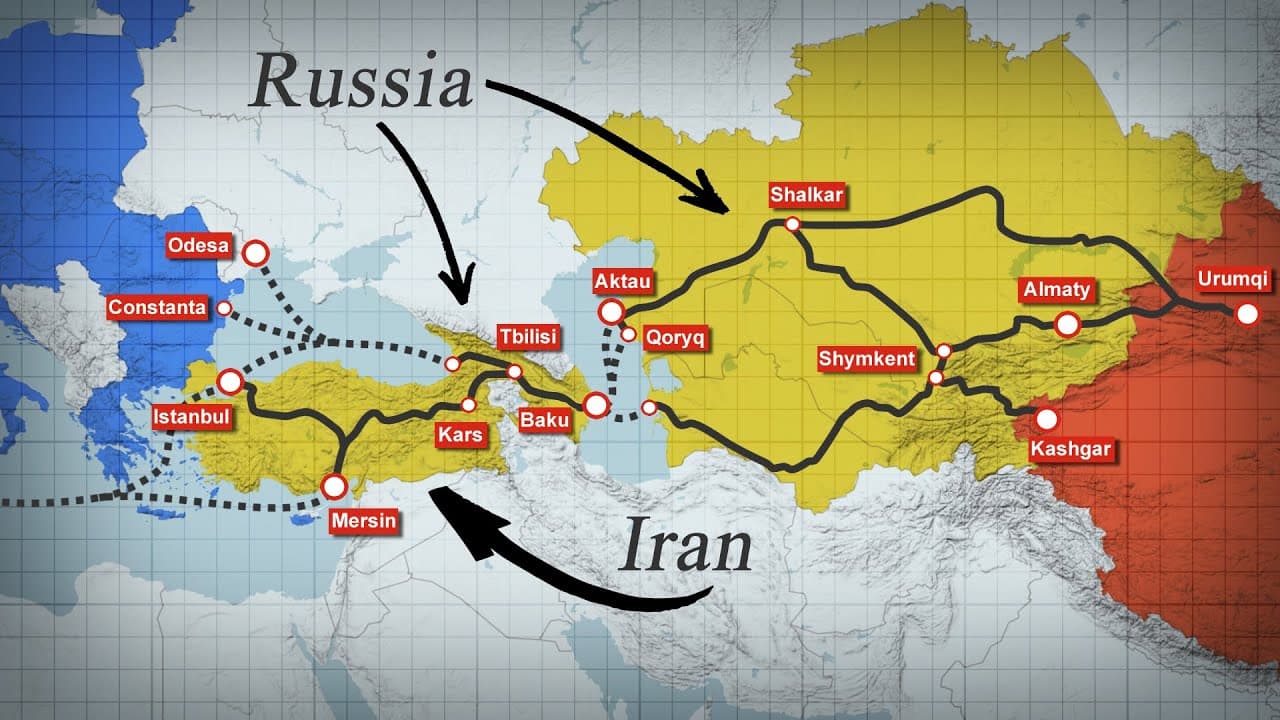
The Middle Corridor, a railway route spanning from China to Europe via Central Asia and Azerbaijan, is transforming global trade by offering a shorter overland route that bypasses high-risk areas and choke points.
Transcript
this Railway going across Baku Azerbaijan is the only East-West land transit route by which goods from China and Central Asia can transit to Europe without going through Pariah States like Iran or Russia it's called the middle Corridor and it is revolutionizing global trade the conflict in Ukraine has disrupted Supply chains generated food shortage... Read More
Key Insights
- 😥 The Middle Corridor provides a shorter and more secure overland trade route from China to Europe, bypassing high-risk areas and choke points.
- 🇪🇺 Turkey, positioned at the crossroads of various regions, aims to become a hub for containerized freight between China and the European Union through the Middle Corridor.
- 💗 Cargo volumes along the Middle Corridor have grown significantly in 2022, indicating its increasing popularity as an alternative trade route.
- ❓ The success of the Middle Corridor depends on overcoming infrastructure shortcomings, resolving regional tensions, and navigating geopolitical instability in the region.
- ™️ China's involvement in the Middle Corridor showcases its commitment to diversifying trade routes and ensuring the stability of its geo-economic portfolio.
- 🔇 Trade volumes along Russia's Northern Corridor have been significantly affected by sanctions and disruptions caused by the conflict in Ukraine.
- 💨 The Middle Corridor's growth has accelerated following Central Asian countries' reorientation away from Russia and the removal of barriers to regional integration.
Install to Summarize YouTube Videos and Get Transcripts
Explore YouTube Video Summarizer or Get YouTube Transcript Extractor
Questions & Answers
Q: What is the Middle Corridor and how is it revolutionizing global trade?
The Middle Corridor is a railway route that connects China to Europe through Central Asia and Azerbaijan, providing a shorter and more efficient overland transport route for cargo. It bypasses high-risk areas and choke points, allowing for trade route diversification and reducing travel times.
Q: What are the key advantages of the Middle Corridor compared to other trade routes?
The Middle Corridor offers several advantages, including shorter travel times, cost savings, and increased cargo volumes. It bypasses high-risk areas like Iran, Afghanistan, and Russia, as well as choke points such as Malacca. By diversifying trade routes, the Middle Corridor reduces the dependency on vulnerable routes like Russia's Northern Corridor and the Malacca Strait.
Q: How is Turkey leveraging its geographic position to benefit from the Middle Corridor?
Turkey, strategically located at the crossroads of Europe, Russia, Central Asia, and the Middle East, aims to become a hub for containerized freight between China and the European Union. By aligning its interests with wider geopolitical trends and integrating with China's Belt and Road Initiative, Turkey is capitalizing on the opportunities presented by the Middle Corridor.
Q: What are the key challenges and potential obstacles facing the Middle Corridor's success?
The Middle Corridor faces obstacles such as infrastructure shortcomings in Turkmenistan and Kyrgyzstan, regional tensions between Armenia, Azerbaijan, and Georgia, and the risk of geopolitical instability. The project's success depends on the lack of viable alternatives and the ability to navigate these challenges.
Key Insights:
- The Middle Corridor provides a shorter and more secure overland trade route from China to Europe, bypassing high-risk areas and choke points.
- Turkey, positioned at the crossroads of various regions, aims to become a hub for containerized freight between China and the European Union through the Middle Corridor.
- Cargo volumes along the Middle Corridor have grown significantly in 2022, indicating its increasing popularity as an alternative trade route.
- The success of the Middle Corridor depends on overcoming infrastructure shortcomings, resolving regional tensions, and navigating geopolitical instability in the region.
- China's involvement in the Middle Corridor showcases its commitment to diversifying trade routes and ensuring the stability of its geo-economic portfolio.
- Trade volumes along Russia's Northern Corridor have been significantly affected by sanctions and disruptions caused by the conflict in Ukraine.
- The Middle Corridor's growth has accelerated following Central Asian countries' reorientation away from Russia and the removal of barriers to regional integration.
- Business interests and pragmatism have driven cooperation and trade between China and Turkey, making China Turkey's second-largest trading partner.
Summary & Key Takeaways
-
The Middle Corridor is a railway route connecting China to Europe through Central Asia and Azerbaijan, offering a shorter overland route for cargo transportation.
-
Cargo volumes along the Middle Corridor have grown six-fold in 2022, signaling its increasing popularity as an alternative trade route.
-
Turkey, strategically located at the crossroads of Europe, Russia, Central Asia, and the Middle East, aims to become a hub for containerized freight between China and the European Union.
Read in Other Languages (beta)
Share This Summary 📚
Summarize YouTube Videos and Get Video Transcripts with 1-Click
Try YouTube Summary with ChatGPT & Claude or YouTube Transcript Generator
Explore More Summaries from CaspianReport 📚



Summarize YouTube Videos and Get Video Transcripts with 1-Click
Try YouTube Summary with ChatGPT & Claude or YouTube Transcript Generator