do algebra first, then do the definite integral (with radical)
TL;DR
Solving a definite integral using reverse power rule and algebraic manipulation, with final answer 55/63.
Transcript
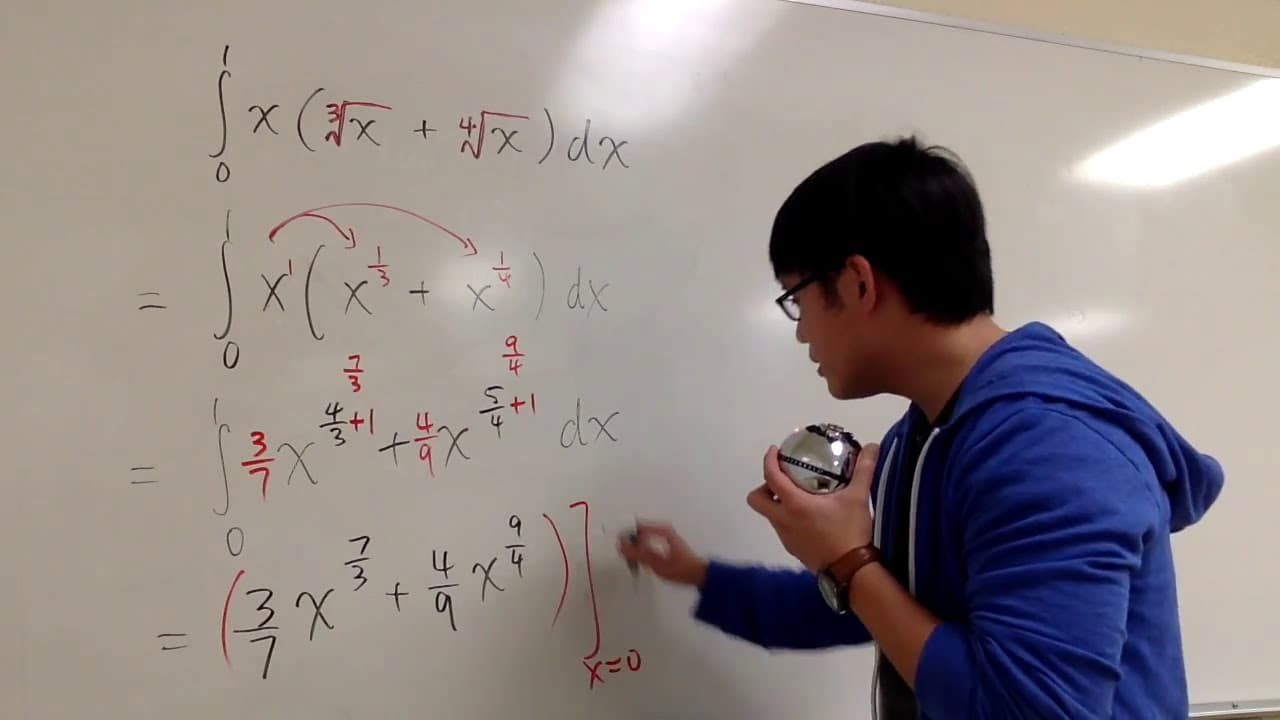
let's work this out and in this situation we have the numbers this is a definite integral so we are not just going to find the anti-derivative but then we also have to plug in numbers and then do the subtraction here we have x * the cube root of x plus the fourth root of x inside and we should distribute the X into the parenthesis first because you... Read More
Key Insights
- 📏 Applying algebraic rules like exponent addition facilitates simplification before integration.
- ✊ Reverse power rule aids in finding antiderivatives by adjusting exponents and dividing by the new exponent.
- 💻 Definite integrals involve computing the area under a curve between specific limits.
- ❓ Proper algebraic manipulation is essential for accurate integration results.
- 👻 Plugging in limits in definite integrals allows for the evaluation of the integral over a specific domain.
- 😑 Understanding the properties of roots helps in converting expressions to suitable forms for integration.
- ❓ Step-by-step computation is crucial for clarity and precision in calculus problem-solving.
Install to Summarize YouTube Videos and Get Transcripts
Explore YouTube Video Summarizer or Get YouTube Transcript Extractor
Questions & Answers
Q: How is the definite integral solved in the given example?
The definite integral is solved by distributing x into terms, simplifying exponents, applying the reverse power rule, and computing the integral from 0 to 1, producing the final answer of 55/63 by plugging in the limits.
Q: What steps are involved in simplifying the exponents before integrating?
To simplify exponents before integrating, convert the cube root of x into x to the 1/3 power and the fourth root of x into x to the 1/4 power, distribute x, and add the exponents to get terms with manageable powers.
Q: Why is it important to show all the intermediate steps in solving the definite integral?
Showing all intermediate steps is crucial to understand the process clearly, allowing for error identification, ensuring correctness, and providing a comprehensive explanation for each algebraic manipulation and integration step.
Q: What is the significance of the reverse power rule in finding the antiderivative of the given function?
The reverse power rule helps determine the antiderivative by adding 1 to the exponent and dividing by the new exponent, which simplifies the integration process and yields the correct function.
Summary & Key Takeaways
-
Demonstrates finding a definite integral by distributing x into terms and applying reverse power rule.
-
Utilizes algebraic manipulation to simplify exponents before integrating.
-
Computes the integral from 0 to 1, showcasing step-by-step calculations leading to the final answer of 55/63.
Read in Other Languages (beta)
Share This Summary 📚
Summarize YouTube Videos and Get Video Transcripts with 1-Click
Try YouTube Summary with ChatGPT & Claude or YouTube Transcript Generator
Explore More Summaries from blackpenredpen 📚
Summarize YouTube Videos and Get Video Transcripts with 1-Click
Try YouTube Summary with ChatGPT & Claude or YouTube Transcript Generator