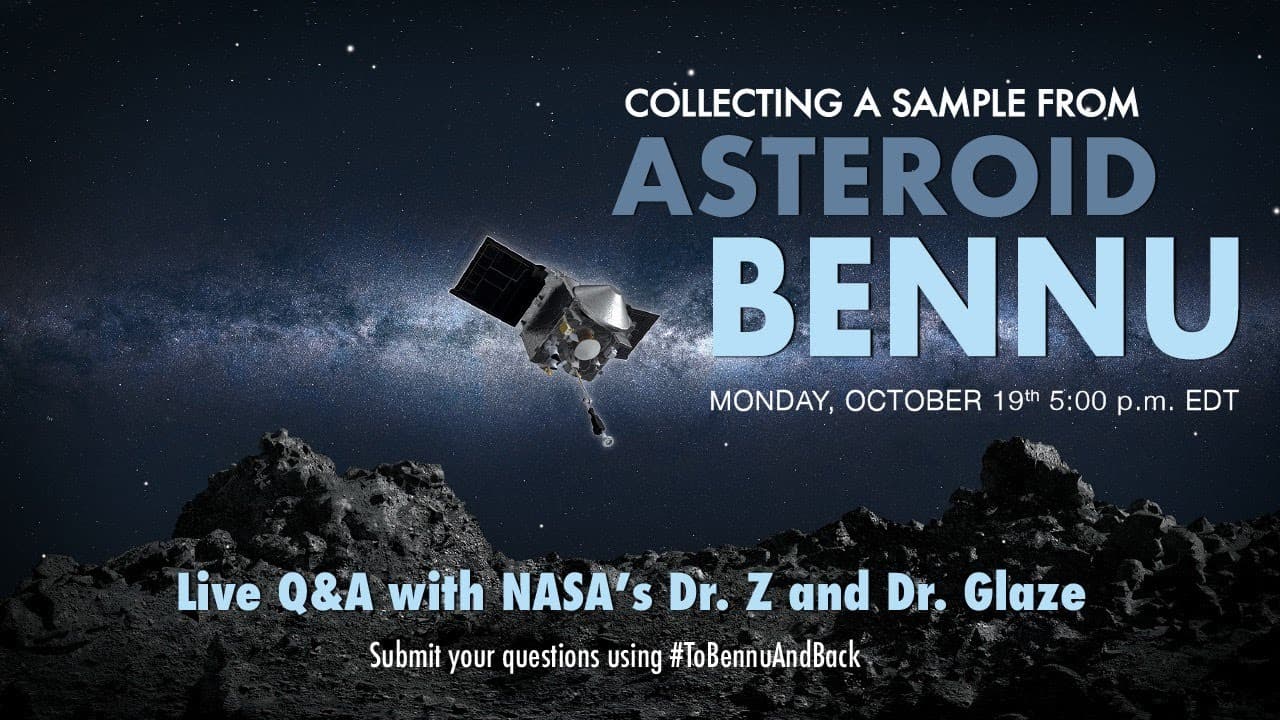
Live Q&A: How NASA Plans to Collect a Sample from Asteroid Bennu
TL;DR
NASA's OSIRIS-REx mission aims to collect samples from an asteroid to learn about the composition and history of our solar system, as well as the potential impact of asteroids on Earth.
Transcript
. ABOUT 24 HOURS BEFORE THIS LIVE BROADCAST STARTS. THE HIGH FIVE. >> I'M THE DIRECTOR OF THE PLANETARY DIVISION OF NASA HEADQUARTERS. >> WE HAVE QUESTIONS THAT WE'RE GOING TO START ASKING THE FIRST QUESTION IS FROM STEPHEN MARTIN. WHAT DELAY WILL THERE BE? >> THAT'S A POPULAR QUESTION. THERE WILL BE 18.5 MINUTES OF DELAY. IT TAKES 18.5 MINUTES FOR... Read More
Key Insights
- 💁 The OSIRIS-REx mission will provide valuable information about the composition and history of our solar system.
- 🧑🔬 The samples collected from the asteroid can help scientists understand the origins of life and how it may have been distributed throughout the universe.
- 🎟️ The mission also contributes to our ability to predict and prevent potential asteroid impacts on Earth.
- ❓ NASA is developing techniques, such as asteroid redirection, to nudge asteroids out of potentially hazardous trajectories.
- 🛩️ The amount of samples collected may seem small, but they can yield significant scientific discoveries and be studied for many years to come.
- 🥇 Planetary protection measures are in place to prevent contamination of both Earth and the asteroid.
- 🦖 The OSIRIS-REx spacecraft will return to Earth in September 2023, and the collected samples will be analyzed.
Install to Summarize YouTube Videos and Get Transcripts
Explore YouTube Video Summarizer or Get YouTube Transcript Extractor
Questions & Answers
Q: How long is the delay in receiving signals from the spacecraft due to the distance between Earth and the asteroid?
There is an 18.5-minute delay in receiving signals from the spacecraft due to the time it takes for the signal to travel back to Earth.
Q: What is the significance of finding carbon and organic molecules on the asteroid?
The presence of carbon and organic molecules on the asteroid's surface can provide insights into the origins of life and how these molecules may have been distributed throughout the solar system.
Q: How does the sampling process work?
The spacecraft uses a nitrogen canister to blow particles off the surface of the asteroid, which are then captured and stored for return to Earth.
Q: What is the purpose of the OSIRIS-REx mission?
The mission aims to determine the history of the solar system, study the potential for life on other celestial bodies, and improve our ability to predict and mitigate the impact of asteroids on Earth.
Summary & Key Takeaways
-
The OSIRIS-REx spacecraft will collect samples from an asteroid and bring them back to Earth for analysis.
-
Spectrometers on board the spacecraft help determine the composition and age of the rocks on the asteroid's surface.
-
Landing on the asteroid's outskirts will not significantly change its trajectory, as the small spacecraft has a minimal impact on the asteroid's mass and gravitational pull.
Read in Other Languages (beta)
Share This Summary 📚
Summarize YouTube Videos and Get Video Transcripts with 1-Click
Try YouTube Summary with ChatGPT & Claude or YouTube Transcript Generator
Explore More Summaries from NASA 📚

Summarize YouTube Videos and Get Video Transcripts with 1-Click
Try YouTube Summary with ChatGPT & Claude or YouTube Transcript Generator