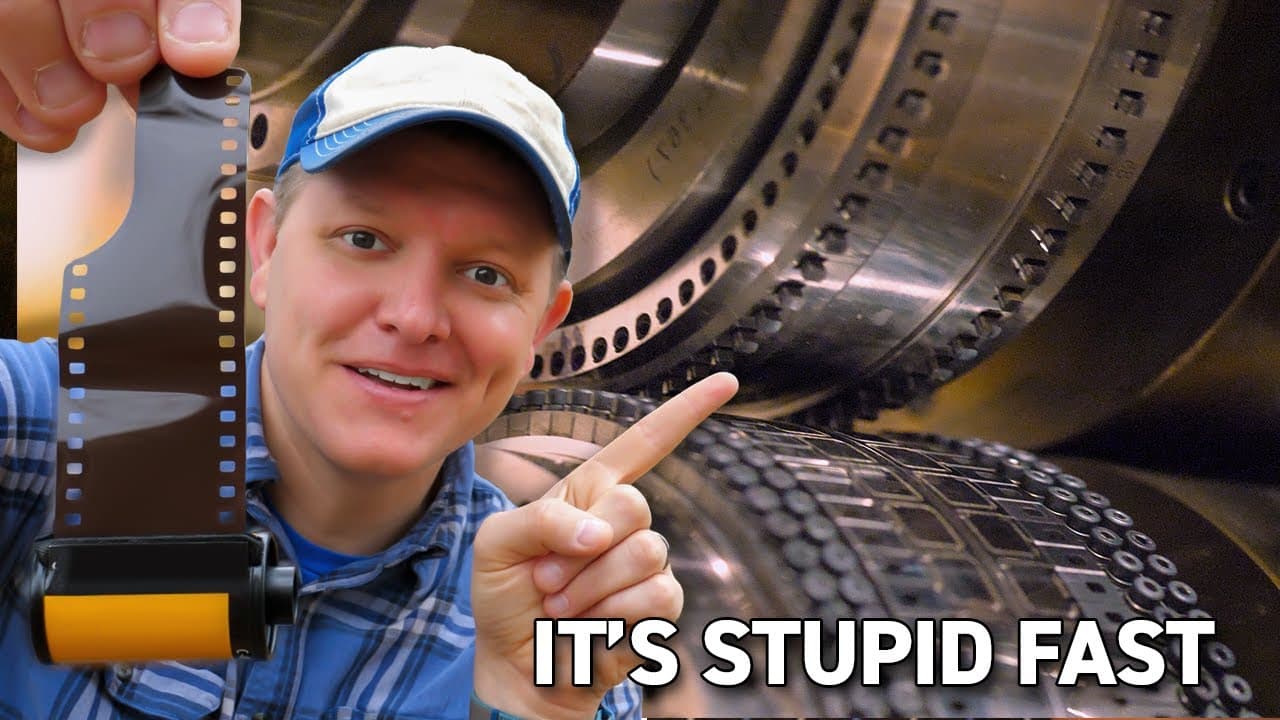
This Thing is Crazy Fast - Kodak Part 3- Smarter Every Day 286
TL;DR
A detailed walkthrough of Kodak's film production process.
Transcript
Hey it’s me, Destin. Welcome back to Smarter Every Day. This... [KA-CHUNK, KA CHUNK] [JET ENGINE NOISES] [CHU-KUH, CHU-KUH] [KER-FLOP] [DING!] is at the Kodak Film Factory in Rochester, New York. The fact that we get to film in the plant is amazing. This is how Kodak photography film is made. And this is the third of three videos. In the first vide... Read More
Key Insights
- The Kodak film production process involves multiple complex steps, including backing creation, light-sensitive coating application, and slitting.
- An accumulator is used to maintain continuous production, allowing for seamless material collection and processing.
- The slitting process involves cutting 12,000-foot rolls of film into smaller sections with precise tension control to prevent errors.
- Film perforation is crucial for camera compatibility, with advanced machinery ensuring accuracy at high speeds.
- The manufacturing process includes creating metal film canisters, which involves precise cutting and alignment techniques.
- The final packaging of film rolls involves automated systems that ensure quality control and correct labeling.
- The Kodak factory fosters a collaborative environment, with experienced workers mentoring newer employees.
- The resurgence of film photography has led to increased production at Kodak, highlighting the enduring appeal of analog media.
Install to Summarize YouTube Videos and Get Transcripts
Explore YouTube Video Summarizer or Get YouTube Transcript Extractor
Questions & Answers
Q: What is the role of the accumulator in the Kodak film production process?
The accumulator plays a crucial role in maintaining continuous production during the Kodak film manufacturing process. It is a clever arrangement of pulleys that collects material inside the production line, allowing the extrusion from the auger to continue without interruption. This ensures that the production process remains seamless, even when rolls need to be stopped or cut at the end of the line.
Q: How does Kodak ensure precise film perforation for camera compatibility?
Kodak uses advanced machinery to ensure precise film perforation, which is critical for camera compatibility. The perforation process involves punching holes in the film at high speeds, up to 3000 feet per minute. The machinery is designed to align and shear the film accurately without making contact, ensuring that the perforations are perfectly positioned for camera sprockets to engage effectively.
Q: What steps are involved in creating the metal canisters for Kodak film?
The creation of metal canisters for Kodak film involves several precise steps. Large metal sheets are first cut into strips, which are then inspected for quality. These strips are used to form the cylindrical body of the canister, with velvet applied to the edges to ensure it is light-tight. The canister is then assembled with end caps using automated machinery, which crimps and stakes the components together securely.
Q: How does the Kodak factory manage film roll packaging and quality control?
The Kodak factory employs automated systems for film roll packaging and quality control. After the film is slit and perforated, it is rolled onto spools and placed into cans. The packaging process involves aligning components such as end caps and plastic canisters, ensuring they are correctly oriented. Quality control checks include metal detection to verify the presence of the correct number of film rolls in each package, and visual inspections to ensure packaging integrity.
Q: What is the significance of the collaborative environment at the Kodak factory?
The collaborative environment at the Kodak factory is significant as it fosters knowledge transfer and innovation. Experienced workers mentor newer employees, sharing their expertise and ensuring that high standards are maintained throughout the production process. This teamwork not only enhances productivity and quality but also strengthens the sense of community and pride among employees, contributing to the factory's overall success.
Q: How has the resurgence of film photography impacted Kodak's production?
The resurgence of film photography has positively impacted Kodak's production, leading to an increase in demand for their products. This renewed interest in analog media has resulted in the factory operating at higher capacities, with some employees working overtime to meet the growing needs of film enthusiasts and professionals alike. The continued popularity of film photography highlights its enduring appeal and the importance of maintaining traditional manufacturing techniques.
Q: What technological advancements are highlighted in Kodak's film production process?
Kodak's film production process highlights several technological advancements, including the use of laminar flow waterfalls for coating application, automated slitting and perforation machines, and precision engineering in canister production. These technologies ensure high-quality film production with minimal defects, allowing Kodak to maintain its reputation for excellence in the photography industry. The integration of advanced machinery and processes demonstrates Kodak's commitment to innovation and efficiency.
Q: How does Kodak's manufacturing process reflect the strength of American industry?
Kodak's manufacturing process reflects the strength of American industry through its emphasis on innovation, quality, and collaboration. The factory combines traditional craftsmanship with advanced technology to produce high-quality photographic film. The teamwork between experienced and newer employees showcases the value of mentorship and skill development, while the factory's ability to adapt to changing market demands demonstrates resilience and a commitment to excellence in American manufacturing.
Summary & Key Takeaways
-
The video provides an in-depth look at Kodak's film production process, showcasing the intricate steps involved in creating photographic film. Viewers are taken on a tour of the Rochester, New York factory, where they see the creation of film backing, the application of light-sensitive coatings, and the slitting of film rolls.
-
Key processes such as film perforation and canister production are highlighted, demonstrating the precision and technology required to produce high-quality film. The video also emphasizes the importance of maintaining tension during slitting to ensure film integrity.
-
The Kodak factory is portrayed as a place of innovation and collaboration, with experienced workers sharing their knowledge with newer employees. The video concludes with a demonstration of film packaging and a celebration of the renewed interest in film photography, which has led to increased production at Kodak.
Read in Other Languages (beta)
Share This Summary 📚
Summarize YouTube Videos and Get Video Transcripts with 1-Click
Try YouTube Summary with ChatGPT & Claude or YouTube Transcript Generator
Explore More Summaries from SmarterEveryDay 📚


Summarize YouTube Videos and Get Video Transcripts with 1-Click
Try YouTube Summary with ChatGPT & Claude or YouTube Transcript Generator