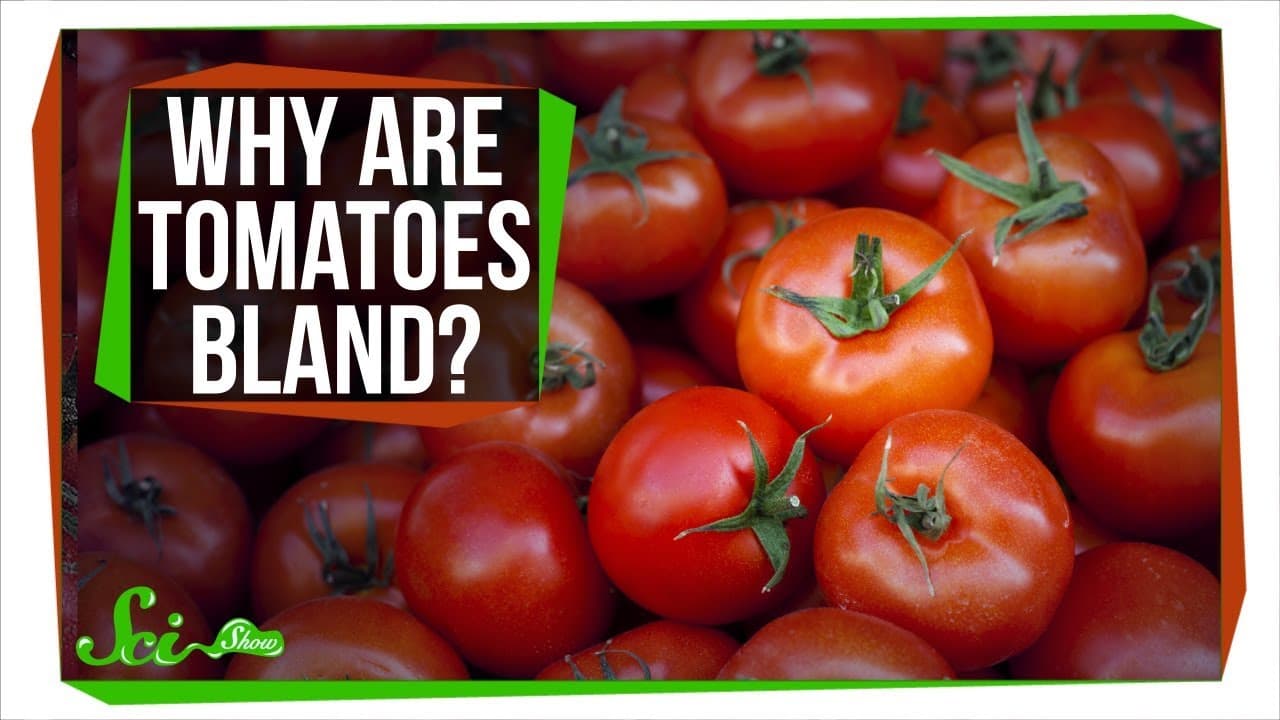
Why Do Tomatoes Taste So Bland?
TL;DR
Tomatoes have become bland due to selective breeding for uniform red color, impacting taste and sweetness.
Transcript
[♩INTRO] Isn’t it just so disappointing when you pick out a nice, red tomato at the supermarket only to find out it’s watery and bland when you slice into it? Well, it turns out that’s kind of a recent problem. Back in the day, when your parents or grandparents were kids, tomatoes actually tasted better. Our obsession with perfectly red tomatoes is... Read More
Key Insights
- 😪 Selective breeding for uniform red color led to bland flavors in modern tomatoes.
- 🍅 The GLK2 gene controls tomato sweetness and flavor by affecting chlorophyll and carotenoids.
- 🧑🔬 Scientists confirmed the connection between tomato flavor and the GLK2 gene in a 2012 study.
- ✋ Genetically modified tomatoes with activated GLK2 had higher sugar and carotenoid levels.
- 🍅 Interest in heirloom tomatoes, with unaltered GLK2 genes, is rising to improve tomato flavor.
- 🍅 Natural breeding methods are being explored to reintroduce the GLK2 gene for better tasting tomatoes.
- 👅 Understanding the genetic basis of tomato flavor can guide efforts to enhance taste in commercial varieties.
Install to Summarize YouTube Videos and Get Transcripts
Explore YouTube Video Summarizer or Get YouTube Transcript Extractor
Questions & Answers
Q: Why do modern tomatoes lack flavor compared to older varieties?
Modern tomatoes lack flavor due to breeding practices that focused on uniform color rather than taste. The uniform gene, GLK2, responsible for color, also affects sweetness and flavor by altering chlorophyll and carotenoids.
Q: How did scientists confirm the link between tomato flavor and the GLK2 gene?
Scientists confirmed the link between tomato flavor and the GLK2 gene through a study published in Science in 2012. By inserting DNA to activate GLK2 in tomatoes, they increased sugar and carotenoid levels, enhancing flavor.
Q: What is the significance of heirloom tomatoes in addressing flavorless tomatoes?
Heirloom tomatoes, containing the unaltered GLK2 gene, offer more flavorful options compared to uniform modern varieties. Farmers and scientists are exploring heirloom varieties to reintroduce the gene for improved taste in tomatoes.
Q: How are farmers and scientists working to improve the flavor of tomatoes without genetic engineering?
Farmers and scientists are seeking alternative methods to reintroduce the GLK2 gene in tomatoes without genetic modifications. By exploring heirloom varieties and natural breeding techniques, they aim to produce more flavorful tomatoes.
Summary & Key Takeaways
-
In the past, tomatoes had better flavor, but breeding for uniform red color made them bland.
-
The uniform gene, GLK2, controls tomato sweetness and color by affecting chlorophyll and carotenoids.
-
Scientists are working to breed tomatoes with the GLK2 gene back in for better flavor.
Read in Other Languages (beta)
Share This Summary 📚
Summarize YouTube Videos and Get Video Transcripts with 1-Click
Try YouTube Summary with ChatGPT & Claude or YouTube Transcript Generator
Explore More Summaries from SciShow 📚

Summarize YouTube Videos and Get Video Transcripts with 1-Click
Try YouTube Summary with ChatGPT & Claude or YouTube Transcript Generator