Tim Buszard on Sports Science and Skill Acquisition
TL;DR
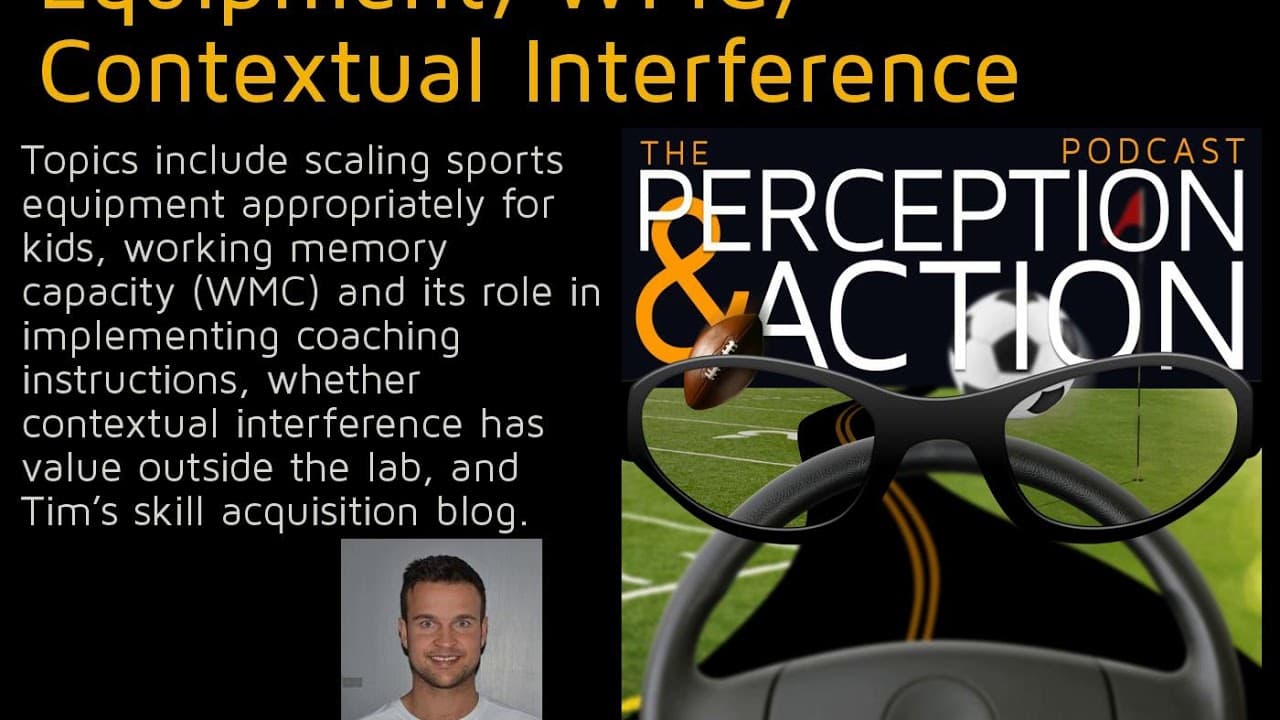
Tim Buszard discusses the benefits of scaling sports equipment for children, the role of working memory in sports, and the application of contextual interference in real-world sports settings. He emphasizes the importance of tailoring coaching strategies to individual cognitive abilities and highlights his blog aimed at bridging the gap between research and practical coaching.
Transcript
this is Rob gray from ASU and perception action calm today on the perception and action podcast my interview with Kim Buzzard postdoctoral research fellow at the Institute of Sport exercise and active living and Tennis Australia hi everyone welcome to the perception and action podcast where I discuss how psychological research can be applied to imp... Read More
Key Insights
- Scaling sports equipment for children involves using smaller racquets and softer balls, which improves skill performance and mimics adult play styles.
- Working memory capacity is similar to short-term memory and is crucial in processing and recalling information during tasks.
- Children with lower working memory capacity may struggle with explicit instruction-heavy environments, affecting their skill acquisition.
- High-contextual interference practices, like random practice, can potentially enhance skill transfer in sports, though findings are inconsistent.
- Tailoring coaching strategies to an athlete's cognitive abilities, such as working memory, can optimize skill learning and performance.
- Representative learning design aims to make practice sessions more reflective of actual game conditions to improve transfer of skills.
- Tim Buszard's blog focuses on summarizing skill acquisition research for coaches, filling a gap in accessible information for practical application.
- Research on contextual interference in skilled athletes is limited, and collaboration among scientists could help address this gap.
Install to Summarize YouTube Videos and Get Transcripts
Explore YouTube Video Summarizer or Get YouTube Transcript Extractor
Questions & Answers
Q: How does scaling sports equipment benefit children's skill development?
Scaling sports equipment, such as using smaller racquets and softer balls, benefits children's skill development by making it easier for them to perform tasks and mimic adult play styles. This approach allows children to develop proper techniques and enhances their ability to learn and adapt to the sport, ultimately leading to improved performance and skill acquisition.
Q: What is working memory capacity and its role in sports?
Working memory capacity is akin to short-term memory, involving the ability to hold and process information while performing tasks. In sports, it plays a crucial role in an athlete's ability to follow and implement coaching instructions. Athletes with higher working memory capacity are better at selecting and applying relevant instructions, which can enhance their skill acquisition and performance.
Q: Why might children with lower working memory capacity struggle in explicit instruction environments?
Children with lower working memory capacity may struggle in environments with heavy explicit instructions because they can become overwhelmed by the information. They might find it challenging to process and apply multiple instructions simultaneously, leading to poorer strategy selection and potentially hindering their skill development and learning outcomes.
Q: What is contextual interference and its application in sports?
Contextual interference refers to the variability in practice conditions, such as random practice, which can enhance skill transfer. Its application in sports involves creating practice environments that mimic the unpredictability of actual games. While it is well-researched in controlled settings, its effectiveness in real-world sports remains debated, highlighting the need for further study.
Q: How can coaching strategies be tailored to cognitive abilities?
Coaching strategies can be tailored to cognitive abilities by assessing an athlete's working memory capacity and adapting instruction delivery accordingly. For athletes with lower working memory, coaches might simplify instructions or use implicit learning techniques to reduce cognitive load, thereby optimizing the learning environment and enhancing skill acquisition.
Q: What is representative learning design in sports practice?
Representative learning design in sports practice involves structuring training sessions to closely reflect the conditions and demands of actual competition. This approach aims to improve the transfer of skills from practice to game situations by incorporating realistic scenarios, decision-making processes, and environmental factors that athletes will encounter during competitions.
Q: What is the focus of Tim Buszard's skill acquisition blog?
Tim Buszard's skill acquisition blog focuses on summarizing and translating research findings into practical insights for coaches and educators. The blog addresses the gap in accessible information on skill acquisition, providing concise summaries of studies that can inform coaching practices and enhance the application of scientific research in real-world sports settings.
Q: What are the challenges in researching contextual interference in skilled athletes?
Researching contextual interference in skilled athletes presents challenges due to inconsistent findings and the complexity of real-world sports environments. Most studies focus on controlled settings and simple tasks, making it difficult to apply results to skilled athletes. Collaborative efforts among scientists and larger sample sizes are needed to better understand the phenomenon and its practical implications.
Summary & Key Takeaways
-
Tim Buszard discusses the significance of scaling sports equipment for children, noting that appropriately sized equipment enhances skill performance and mirrors adult play styles. He highlights his research showing that children adapt differently based on the equipment used, which can influence their learning process.
-
Working memory capacity plays a critical role in an athlete's ability to implement coaching instructions. Buszard's research suggests that children with lower working memory capacity may not benefit as much from instruction-heavy environments, which could hinder their skill development.
-
The concept of contextual interference, particularly random practice, is explored for its potential benefits in skill transfer to sports. Buszard emphasizes the need for more research in real-world settings and suggests that representative learning design could improve the effectiveness of practice sessions.
Read in Other Languages (beta)
Share This Summary 📚
Summarize YouTube Videos and Get Video Transcripts with 1-Click
Try YouTube Summary with ChatGPT & Claude or YouTube Transcript Generator
Explore More Summaries from Rob Gray 📚
Summarize YouTube Videos and Get Video Transcripts with 1-Click
Try YouTube Summary with ChatGPT & Claude or YouTube Transcript Generator