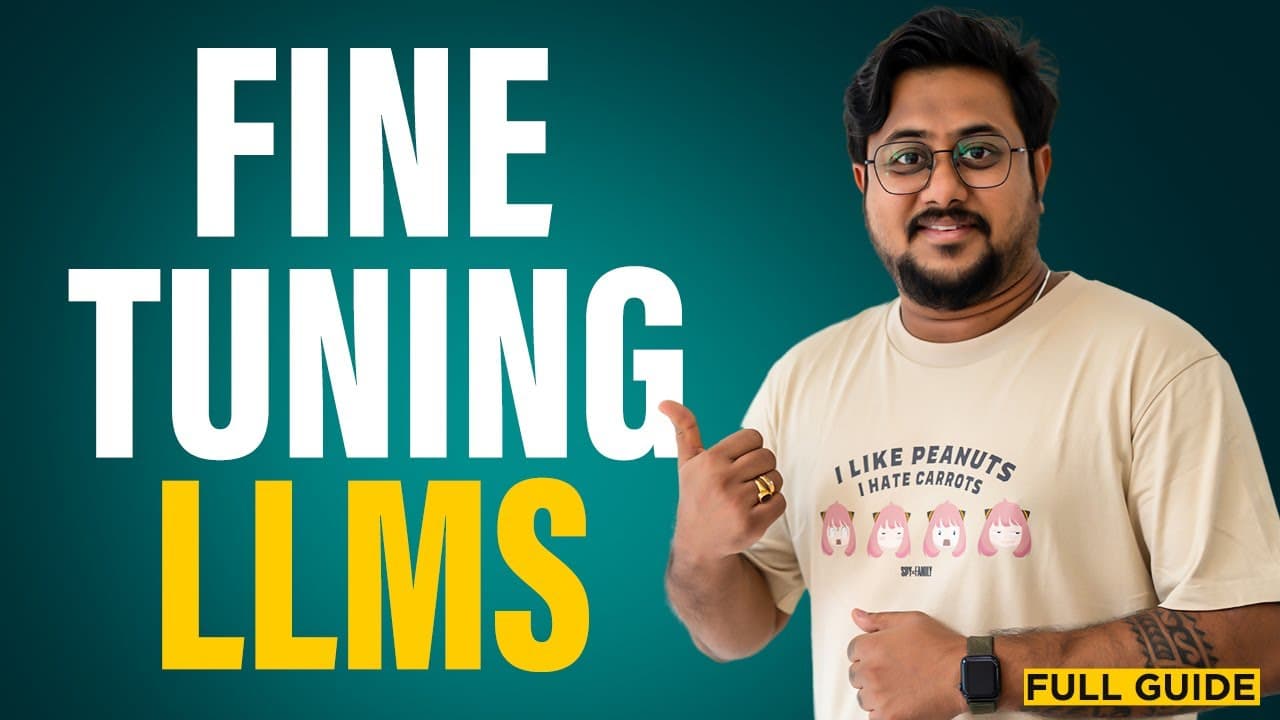
Learn Fine Tuning LLMs in 2 hours | RAGs vs Fine Tuning | Quantization | PEFT Techniques
TL;DR
Explore fine-tuning LLMs with RAGs, quantization, and PEFT techniques.
Transcript
hi welcome to a brand new episode on generative AI my name is Sati Patnayak and I welcome you all to my channel in case you are a complete beginner in the field of generative AI I already have a 6 hours dedicated video on generative AI for you to get started learning about generative AI concepts like rags and multiple other topics i would encourage... Read More
Key Insights
- Fine-tuning LLMs involves pre-training and task-specific training to adapt models for particular tasks, enhancing performance and accuracy.
- Retrieval-Augmented Generation (RAG) and fine-tuning are two distinct approaches, each with unique benefits and use cases in AI model training.
- RAG is often more secure, reliable, and scalable, making it suitable for most enterprise use cases, while fine-tuning offers higher accuracy.
- Fine-tuning can be more expensive and time-consuming but is preferred when detailed prompts or niche data are involved.
- Quantization reduces the precision of model weights, decreasing memory usage and improving computational efficiency.
- LoRA (Low-Rank Adapters) and QLoRA (Quantized LoRA) are advanced techniques that optimize fine-tuning by reducing trainable parameters.
- Adapters in transformer models help reduce the number of parameters that need updating, making the process more efficient.
- QLoRA combines quantization with LoRA, further enhancing efficiency by lowering the precision of model weights.
Install to Summarize YouTube Videos and Get Transcripts
Explore YouTube Video Summarizer or Get YouTube Transcript Extractor
Questions & Answers
Q: What is the main purpose of fine-tuning in LLMs?
Fine-tuning is the process of adapting a pre-trained language model to perform well on a specific task by training it further on a smaller, task-specific dataset. This helps the model to adjust its general knowledge to a particular domain, improving its performance and accuracy for specific applications.
Q: How does RAG differ from fine-tuning?
RAG, or Retrieval-Augmented Generation, differs from fine-tuning in that it combines retrieval of relevant information with language model generation. It is often more secure, reliable, and scalable, making it suitable for most enterprise use cases. Fine-tuning, on the other hand, involves adjusting the model's parameters for specific tasks, offering higher accuracy but at a greater computational cost.
Q: When should one use RAG over fine-tuning?
RAG should be used over fine-tuning when dealing with scenarios that require secure, reliable, and scalable solutions. It is particularly effective when the model needs to handle large volumes of data or when constant data updates are necessary. RAG is also more cost-efficient and less time-consuming compared to fine-tuning.
Q: What are the benefits of quantization in model training?
Quantization benefits model training by reducing the precision of numerical values, typically floating-point values, representing model weights. This reduction decreases memory usage and computational costs, allowing models to run more efficiently on devices with limited resources. It enables developers to deploy models on edge devices or laptops without high-end GPUs.
Q: What is LoRA and how does it optimize fine-tuning?
LoRA, or Low-Rank Adapters, optimizes fine-tuning by introducing low-rank matrices into transformer models, significantly reducing the number of trainable parameters. This approach maintains model performance while reducing memory consumption and computational costs, making fine-tuning more efficient and scalable.
Q: How does QLoRA differ from LoRA?
QLoRA, or Quantized LoRA, extends the LoRA approach by incorporating quantization techniques, which reduce the precision of model weights. This further decreases memory usage and enhances computational efficiency compared to LoRA alone. QLoRA maintains the benefits of LoRA while offering additional performance improvements through quantization.
Q: Why is fine-tuning considered more expensive than RAG?
Fine-tuning is considered more expensive than RAG because it involves adjusting the model's parameters for specific tasks, which requires significant computational resources and time. The process of training on task-specific data can be resource-intensive, especially for large language models, making it a costly approach compared to the more scalable and efficient RAG.
Q: What are parameter-efficient fine-tuning techniques?
Parameter-efficient fine-tuning techniques, such as LoRA and QLoRA, aim to optimize the fine-tuning process by reducing the number of trainable parameters. These techniques introduce low-rank matrices and quantization to decrease memory usage and computational costs, allowing models to be fine-tuned more efficiently without sacrificing performance.
Summary & Key Takeaways
-
The video explores advanced concepts in fine-tuning large language models (LLMs), focusing on techniques like Retrieval-Augmented Generation (RAG) and quantization. It emphasizes the need for fine-tuning when dealing with specific tasks or data, highlighting the benefits and drawbacks of different approaches.
-
RAG is presented as a more secure and scalable solution for most use cases, while fine-tuning offers superior accuracy for detailed tasks. The video also delves into parameter-efficient fine-tuning (PEFT) techniques, including LoRA and QLoRA, which optimize the fine-tuning process.
-
Quantization is explained as a method to reduce model weight precision, enhancing computational efficiency. The video concludes by comparing LoRA and QLoRA, demonstrating how these techniques can significantly optimize fine-tuning by reducing trainable parameters and memory usage.
Read in Other Languages (beta)
Share This Summary 📚
Summarize YouTube Videos and Get Video Transcripts with 1-Click
Try YouTube Summary with ChatGPT & Claude or YouTube Transcript Generator
Explore More Summaries from Satyajit Pattnaik 📚


Summarize YouTube Videos and Get Video Transcripts with 1-Click
Try YouTube Summary with ChatGPT & Claude or YouTube Transcript Generator