CLIP - Keras Code Examples
TL;DR
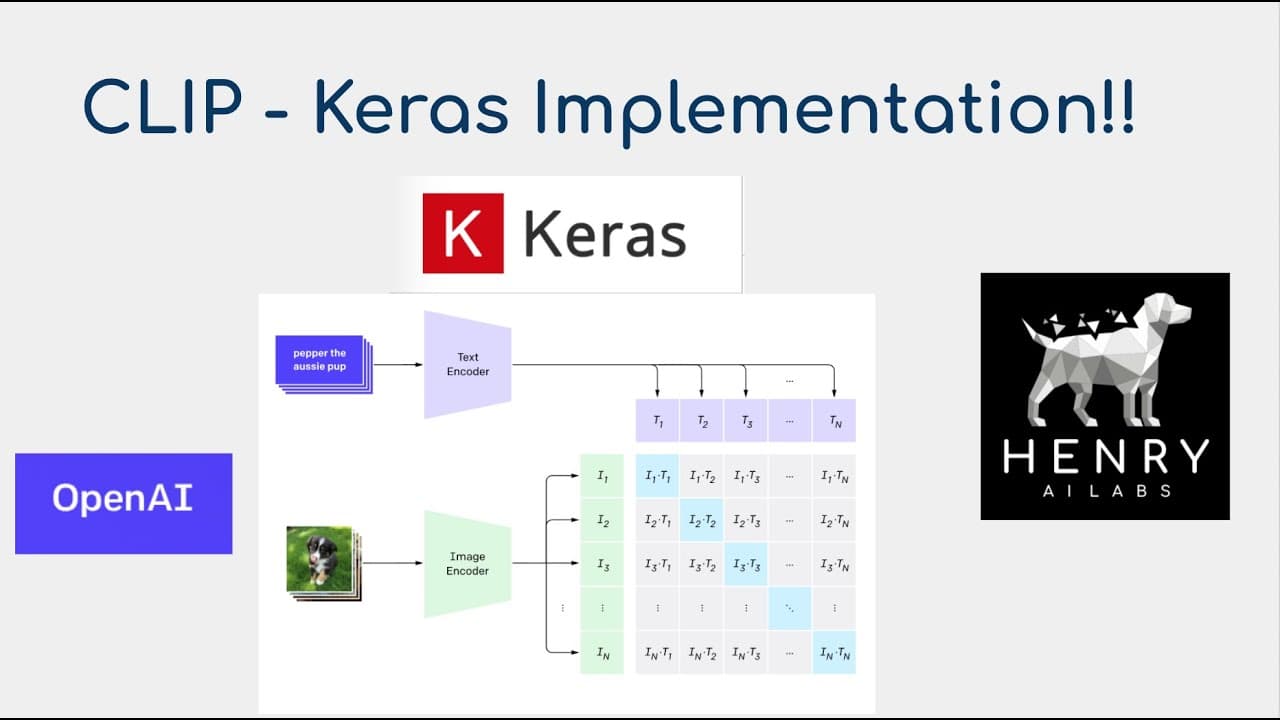
A comprehensive guide to implementing OpenAI’s CLIP model using Keras for natural language image search tasks.
Transcript
welcome to the henry ai labs walkthrough of keras code examples keras has provided 56 code examples implementing popular ideas in deep learning this ranges from the basics such as simple mnist and imdb text classification all the way to cutting-edge research ideas such as knowledge distillation supervised contrastive learning and transformers we'll... Read More
Key Insights
- 🥰 Keras facilitates the implementation of advanced deep learning models, such as the CLIP model, streamlining the integration of state-of-the-art techniques in a user-friendly format.
- 👻 The dual encoder architecture allows for the effective processing of both text and image data, enabling significant advancements in natural language image search applications.
- 😑 Pre-trained models from TensorFlow Hub enhance model training efficiency by allowing developers to leverage existing frameworks and optimize performance through fine-tuning.
- 🤑 The MS COCO dataset serves as a foundational resource for training these models, offering rich annotations and enabling robust learning through diverse image-caption pairs.
- 📈 Contrastive learning provides a powerful method for aligning multimodal data types (like images and text) by maximizing similarity metrics, essential for tasks involving zero-shot learning.
- 📚 Efficient preprocessing using libraries such as TensorFlow Text is crucial for preparing data, especially given the substantial size and complexity of datasets used in modern deep learning tasks.
- 🌸 Understanding tensor operations, batch computations, and loss functions is critical for navigating the intricacies of contrastive learning and image-text alignment methodologies.
Install to Summarize YouTube Videos and Get Transcripts
Explore YouTube Video Summarizer or Get YouTube Transcript Extractor
Questions & Answers
Q: What is the primary purpose of the CLIP model as discussed in the content?
The primary purpose of the CLIP model is to enable the alignment of image captions with corresponding images through a dual encoder setup. This allows for various downstream tasks, most notably natural language image search, which benefits anything from image classification to representation learning by understanding both textual and visual contexts interactively.
Q: How does the dual encoder framework in the CLIP model work?
The dual encoder framework comprises two separate neural networks: one for encoding images and another for encoding text. Each encoder maps its input into a shared embedding space where contrastive learning is applied. This technique allows the model to learn semantic correlations between images and text, which is crucial for tasks such as zero-shot image classification and image retrieval based on textual queries.
Q: What dataset is primarily used for training the CLIP model in this tutorial, and why is it significant?
The MS COCO dataset is primarily utilized for training the CLIP model. It's significant because it contains a large collection of images with multiple captions, allowing for effective training of image captioning models. The dataset's dense annotations (convertible image captions and object detection info) make it ideal for training contrastive learning approaches that rely on pairing images with captions.
Q: What tools and libraries are recommended for optimizing the CLIP model’s performance?
The tutorial recommends using TensorFlow Hub for pre-trained models and specific libraries like TensorFlow Text and TensorFlow Add-ons for enhanced preprocessing and optimization. These tools facilitate the integration of advanced techniques such as BERT for text encoding, streamlining the model training and inference processes, thereby improving overall performance.
Summary & Key Takeaways
-
This content details a walkthrough of Keras code examples, showcasing implementations of the CLIP model for image and text representation alignment, enabling advanced natural language image search applications.
-
It covers the importance of dual encoders for processing text and image data, explaining how contrastive learning frameworks help in establishing semantic connections through similarity metrics.
-
The tutorial emphasizes the use of the MS COCO dataset for training, describing the preprocessing steps necessary for efficient model learning and image classification tasks in the Keras environment.
Read in Other Languages (beta)
Share This Summary 📚
Summarize YouTube Videos and Get Video Transcripts with 1-Click
Try YouTube Summary with ChatGPT & Claude or YouTube Transcript Generator
Explore More Summaries from Connor Shorten 📚
Summarize YouTube Videos and Get Video Transcripts with 1-Click
Try YouTube Summary with ChatGPT & Claude or YouTube Transcript Generator