Vectors
TL;DR
Vectors are useful for representing physical quantities that have magnitude, direction, scale, and follow commutative addition. Displacements and forces can be represented by vectors, while rotations cannot.
Transcript
Suppose you get a text message. Your friend tells you to go to Lobby 7 at MIT to find the gift they left you 7 meters from the center of the lobby. Is that enough information to find the gift right away? As you can see, there are many locations 7 meters from the center of the room. Don't forget that we live in 3 dimensions, so there are actually ev... Read More
Key Insights
- 💄 Vectors have both magnitude and direction, making them suitable for representing physical quantities.
- ❓ Displacements provide a useful context for understanding vector algebra and decomposing vectors.
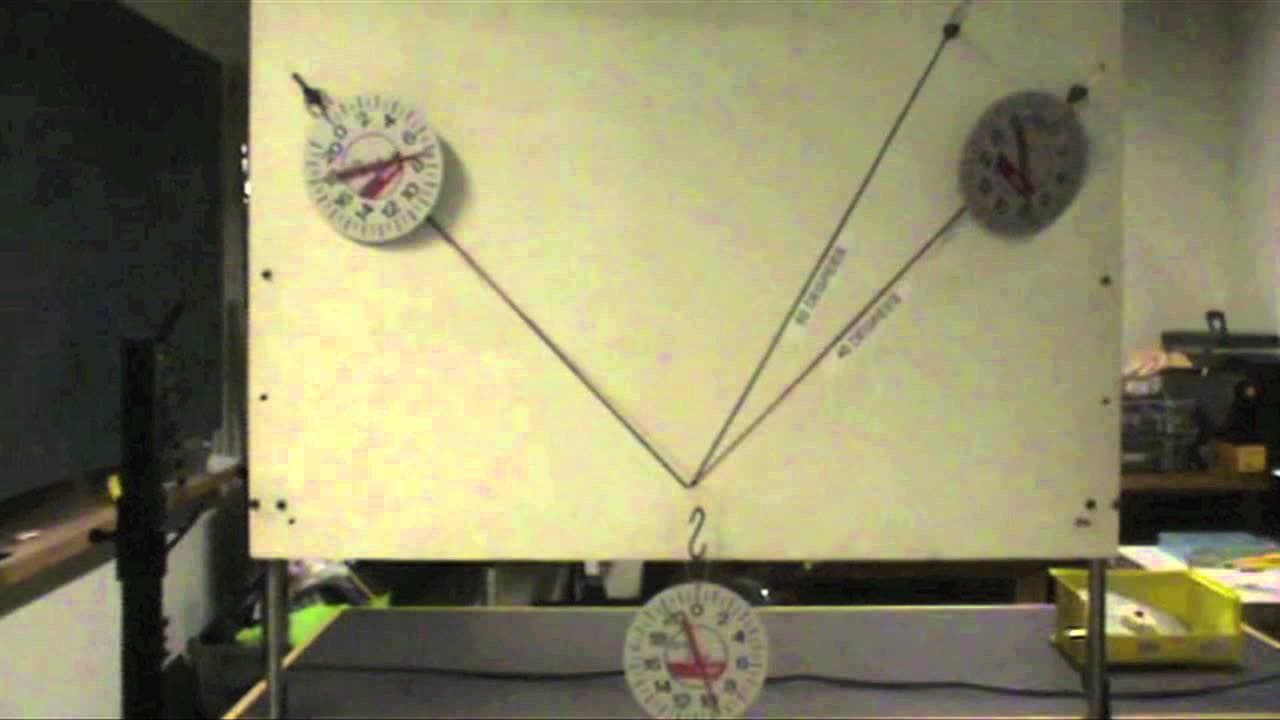
- ✖️ Forces can be represented by vectors and exhibit the properties of vector addition and scalar multiplication.
- 😒 Rotations cannot be accurately represented using vectors and require the use of matrices.
- 😘 Velocity, lift force, and air velocity over a wing are examples of physical quantities that can be described by magnitude and direction.
- 👻 Vector addition is commutative and allows for the combination of multiple displacements or forces.
- ⚖️ Practical experiments, such as the demonstration with Newton scales, can verify the properties of vector addition for forces.
Install to Summarize YouTube Videos and Get Transcripts
Explore YouTube Video Summarizer or Get YouTube Transcript Extractor
Questions & Answers
Q: Can you provide an example of a physical quantity that can be described by a magnitude and direction?
An example of a physical quantity with magnitude and direction is velocity. The magnitude is the speed of an object, and the direction indicates the object's motion.
Q: How can displacement help in understanding vector algebra?
Displacement is a useful concept in vector algebra as it provides an intuitive understanding of vector addition and decomposition. By considering displacements, we can determine the total displacement by summing the individual displacements.
Q: Are forces considered vector quantities?
Yes, forces are vector quantities as they possess both magnitude and direction. Forces can be added like vectors and scaled using scalar multiplication.
Q: Can rotations be represented using vectors?
No, rotations cannot be accurately represented using vectors. While vector notation can be used to represent the rotation rate, the combinations of rotations require the use of matrices and matrix multiplication.
Summary & Key Takeaways
-
Vectors are objects with both magnitude and direction.
-
Displacements and forces are physical quantities that can be represented by vectors.
-
Rotations cannot be represented by vectors and require the use of matrices.
Read in Other Languages (beta)
Share This Summary 📚
Summarize YouTube Videos and Get Video Transcripts with 1-Click
Try YouTube Summary with ChatGPT & Claude or YouTube Transcript Generator
Explore More Summaries from MIT OpenCourseWare 📚


Summarize YouTube Videos and Get Video Transcripts with 1-Click
Try YouTube Summary with ChatGPT & Claude or YouTube Transcript Generator