What Are Maxwell's Equations and Their Applications?
TL;DR
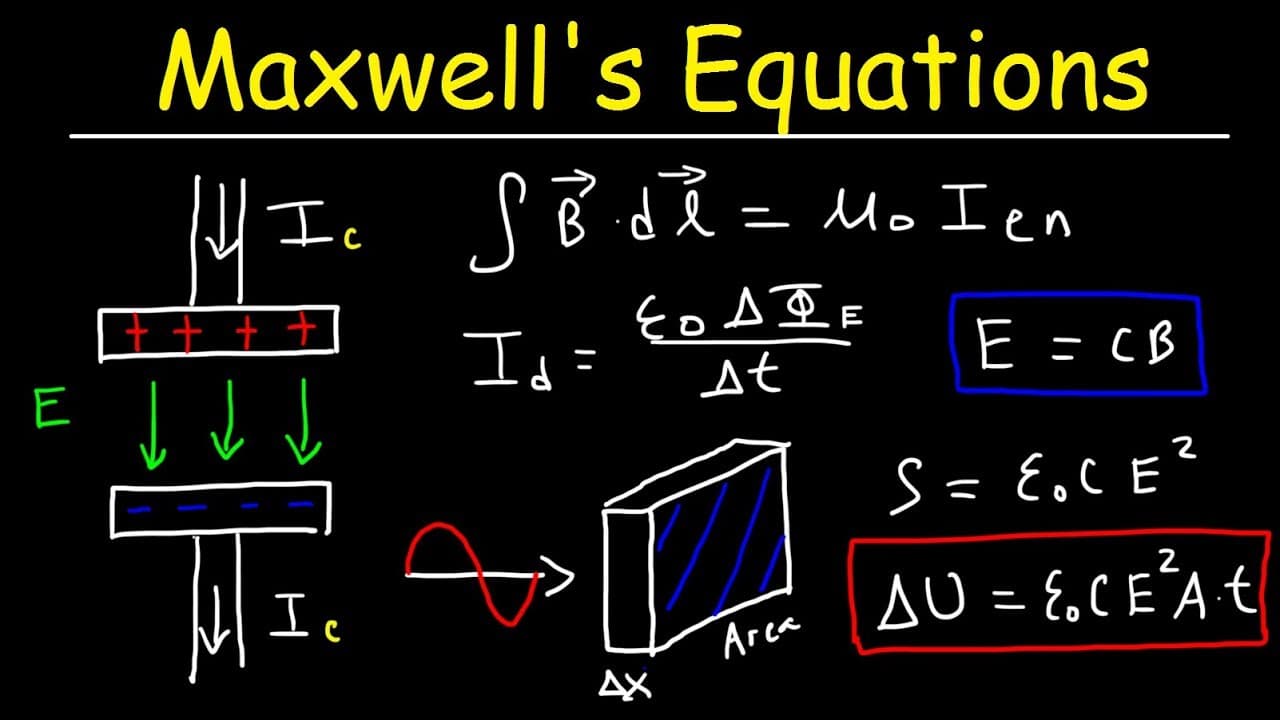
Maxwell's equations describe the behavior of electric and magnetic fields, encompassing four fundamental laws: Gauss's law for electricity and magnetism, Faraday's law of induction, and Ampere's law. These equations highlight concepts like displacement current, which connects changing electric fields to magnetic fields, and they are crucial for understanding electromagnetic waves and their properties.
Transcript
in this video we're going to go over practice problems associated with maxwell's equations electromagnetic waves and even displacement current so let's start with this problem which of the following is not one of maxwell's equations so looking at the first one this is definitely one of them and that's basically gauss's law for electric fields which... Read More
Key Insights
- 🏑 Maxwell's equations encompass four fundamental equations that describe electric and magnetic fields, providing a framework for understanding electromagnetic phenomena.
- 🏑 Displacement current is a fictitious current that represents the change in electric field and can induce a magnetic field.
- 🏑 The electric field and magnetic field in an electromagnetic wave are perpendicular to each other and have a relationship described by the equation E = cB.
- 🇦🇪 The power per unit area of an EM wave can be calculated using the pointing vector, which represents the energy flow per unit area.
Install to Summarize YouTube Videos and Get Transcripts
Explore YouTube Video Summarizer or Get YouTube Transcript Extractor
Questions & Answers
Q: What are Maxwell's equations and why are they important in understanding electromagnetic waves?
Maxwell's equations are a set of fundamental equations in electromagnetism that describe the behavior of electric and magnetic fields. They are important as they provide a mathematical framework to understand and predict electromagnetic phenomena, including the propagation of electromagnetic waves.
Q: How can displacement current be calculated between the plates of a capacitor?
Displacement current can be calculated using the formula I_d = ε_0 * (∆E * A) / ∆t, where ε_0 is the permittivity of free space, ∆E is the change in electric field between the plates, A is the area between the plates, and ∆t is the change in time.
Q: How is the magnetic field calculated at a specific point outside the plates of a capacitor?
The magnetic field can be calculated using Ampere's law, which states that the magnetic field times the distance it travels is equal to the permeability of free space times the displacement current divided by 2πr, where r is the distance from the center of the plates.
Q: What is the wavelength of an EM wave with a frequency of 99 megahertz?
The wavelength is calculated using the equation λ * f = c, where λ is the wavelength, f is the frequency, and c is the speed of light. In this case, the wavelength is approximately 3.03 meters.
Summary & Key Takeaways
-
The video discusses Maxwell's equations, including Gauss's law for electric and magnetic fields, Ampere's law, and Faraday's law, explaining their significance in describing electromagnetic phenomena.
-
Practice problems are presented, such as identifying which equations belong to Maxwell's equations and calculating displacement current and magnetic fields.
-
The video explores the electric field between the plates of a capacitor, the absorption of EM waves by a flat surface, and the relationship between electric and magnetic fields in an EM wave.
-
Various calculations and formulas are used to solve the presented problems, including the permittivity of free space, speed of light, electric and magnetic field strength, and energy density.
Read in Other Languages (beta)
Share This Summary 📚
Summarize YouTube Videos and Get Video Transcripts with 1-Click
Try YouTube Summary with ChatGPT & Claude or YouTube Transcript Generator
Explore More Summaries from The Organic Chemistry Tutor 📚


Summarize YouTube Videos and Get Video Transcripts with 1-Click
Try YouTube Summary with ChatGPT & Claude or YouTube Transcript Generator