Python and Pandas for Sentiment Analysis and Investing 10 - testing
TL;DR
Implementing a basic sentiment-based trading strategy in Python with Pandas for finance analysis.
Transcript
what's going on everybody welcome to another Python Panda sentiment analysis in finance video in the last video what we were doing is we made this cow position function we have it mapping this function into a position column and then we finally have a column of change and this change column is actually where we will execute any change so by ourselv... Read More
Key Insights
- 🧘 Mapping position in a data frame helps in automated trading decisions.
- ❓ Back-testing functions enable evaluation of trading strategies with historical data.
- ™️ Considerations for trade count and trade costs can enhance strategy optimization.
- 🏆 Extending the strategy to test across multiple stocks in the S&P 500 for a holistic evaluation.
- 🛀 Initial strategy showed positive growth based on simple rules and sentiments analysis.
- 📏 Potential improvements include refining rules, incorporating trade costs, and scaling strategy.
- 👥 Further analysis with a larger group of stocks can provide a more comprehensive understanding of strategy performance.
Install to Summarize YouTube Videos and Get Transcripts
Explore YouTube Video Summarizer or Get YouTube Transcript Extractor
Questions & Answers
Q: What was the purpose of the position function created in the video?
The position function was designed for mapping stock buying and selling decisions based on sentiment analysis in a data frame for financial analysis.
Q: How was the back-testing function defined and what parameters did it include?
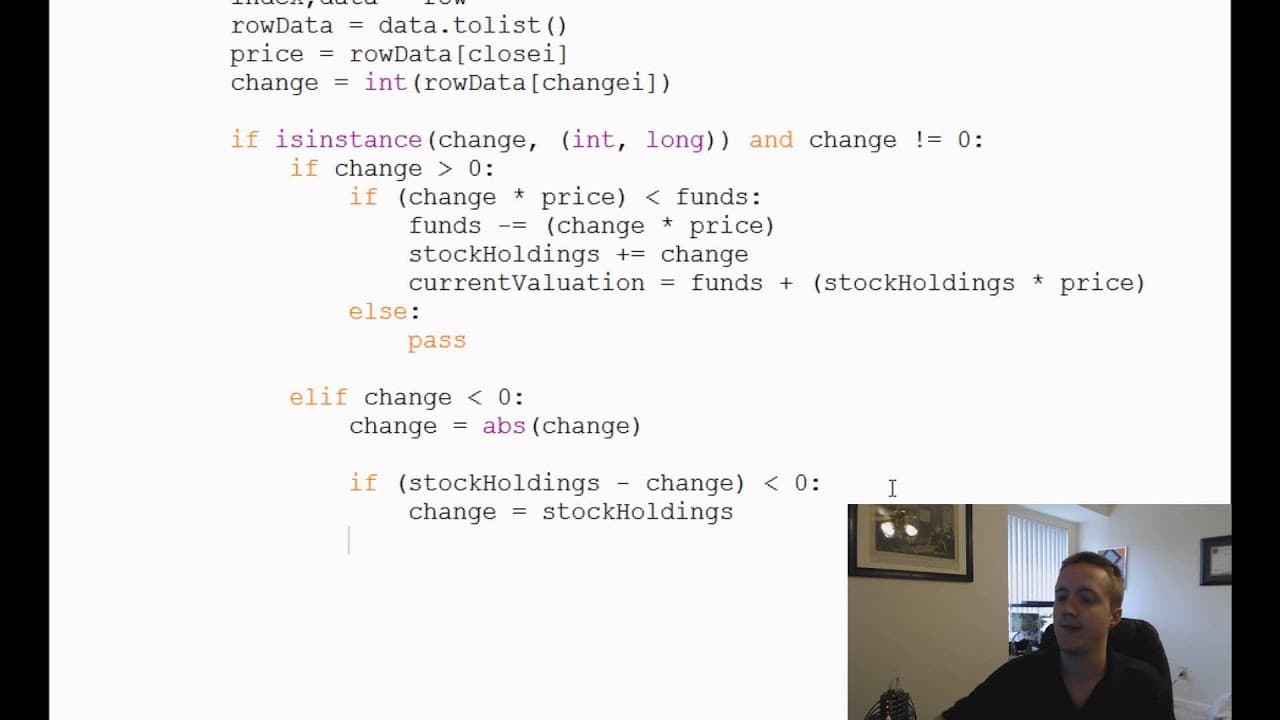
The back-testing function was defined to test the sentiment-based trading strategy using parameters like data frame, close index, and change index to evaluate performance.
Q: What initial values were set for stock holdings and starting capital in the sentiment-based trading strategy?
Stock holdings started at 0 and the starting capital was calculated as the first closing price multiplied by 8 to initiate trading with initial funds.
Q: How was the sentiment-based trading strategy executed and evaluated in the back-testing function?
The strategy involved buying stocks if funds allowed the purchase and selling stocks if available, with the current valuation tracking the performance and growth calculated as a percentage.
Summary & Key Takeaways
-
Created a function for position mapping in a data frame for stock buying and selling.
-
Developed a back-testing function utilizing the data frame for testing the sentiment-based trading strategy.
-
Explored potential improvements for the strategy such as adding trade count and trade costs analysis.
Read in Other Languages (beta)
Share This Summary 📚
Summarize YouTube Videos and Get Video Transcripts with 1-Click
Try YouTube Summary with ChatGPT & Claude or YouTube Transcript Generator
Explore More Summaries from sentdex 📚
Summarize YouTube Videos and Get Video Transcripts with 1-Click
Try YouTube Summary with ChatGPT & Claude or YouTube Transcript Generator