L10.3 Comments on Conditional PDFs
TL;DR
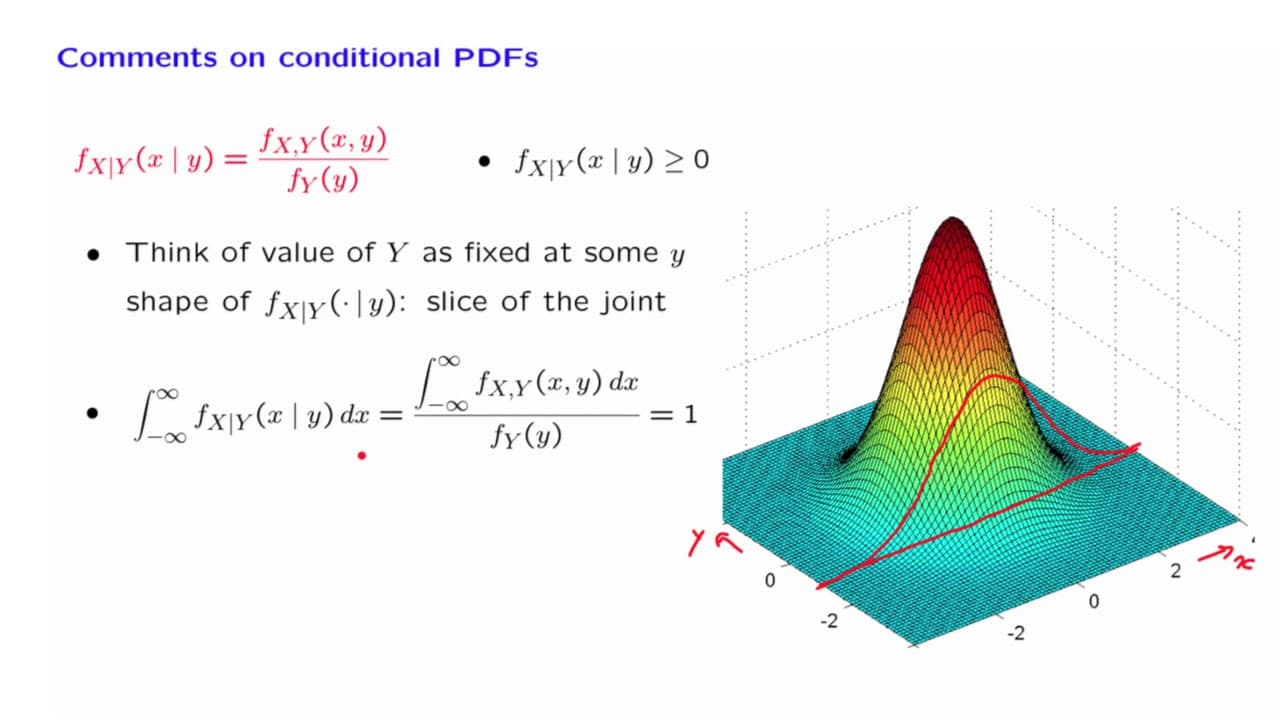
The conditional PDF is similar to the conditional PMF and represents a slice of the joint PDF, with a scaling factor that ensures it integrates to 1.
Transcript
The definition of the conditional PDF is very simple. It is just this formula, which is analogous to the one for the discrete case. In all respects-- mathematical and intuitive-- it is very similar to the conditional PMF. Even so, developing a solid grasp of this concept does take some further thinking, so we will now make some observations that sh... Read More
Key Insights
- ❓ The conditional PDF is analogous to the conditional PMF and represents a slice of the joint PDF.
- 🚱 The conditional PDF is always non-negative and integrates to 1, behaving like an ordinary PDF.
- 🧑🏭 The scaling factor in the denominator ensures the proper normalization of the conditional PDF.
- ❓ The conditional PDF can be obtained from the joint PDF by fixing the value of y.
Install to Summarize YouTube Videos and Get Transcripts
Explore YouTube Video Summarizer or Get YouTube Transcript Extractor
Questions & Answers
Q: How does the conditional PDF differ from the joint and marginal PDFs?
While the joint PDF represents the probability of two random variables occurring together, the conditional PDF is a slice of the joint PDF, dependent on a specific value of y. The marginal PDF represents the probability distribution of a single random variable.
Q: How does the scaling factor in the conditional PDF work?
The scaling factor in the denominator of the conditional PDF ensures that it integrates to 1. This factor can be seen as a normalization constant, allowing the conditional PDF to behave like an ordinary PDF with non-negativity and integration properties.
Q: Can the conditional PDF be interpreted as a probability?
No, the conditional PDF represents a density rather than a probability. It provides information about the likelihood of x given a specific value of y, but it does not directly give the probability of an event occurring.
Q: Is there a relationship between the conditional PDF and the multiplication rule?
Yes, by rearranging the formula, the conditional PDF can be expressed in a form similar to the multiplication rule. This formula shows the relationship between the probabilities of two events happening, given the occurrence of the first event, but with densities instead of probabilities.
Summary & Key Takeaways
-
The conditional PDF is defined by a formula similar to the one for the discrete case and is always non-negative.
-
For a given value of y, the conditional PDF represents a slice of the joint PDF, varying in height along the x-axis.
-
The scaling factor in the denominator of the conditional PDF ensures that it integrates to 1, similar to the marginal PDF of Y.
Read in Other Languages (beta)
Share This Summary 📚
Summarize YouTube Videos and Get Video Transcripts with 1-Click
Try YouTube Summary with ChatGPT & Claude or YouTube Transcript Generator
Explore More Summaries from MIT OpenCourseWare 📚



Summarize YouTube Videos and Get Video Transcripts with 1-Click
Try YouTube Summary with ChatGPT & Claude or YouTube Transcript Generator