How to Solve Differential Equations Fast
TL;DR
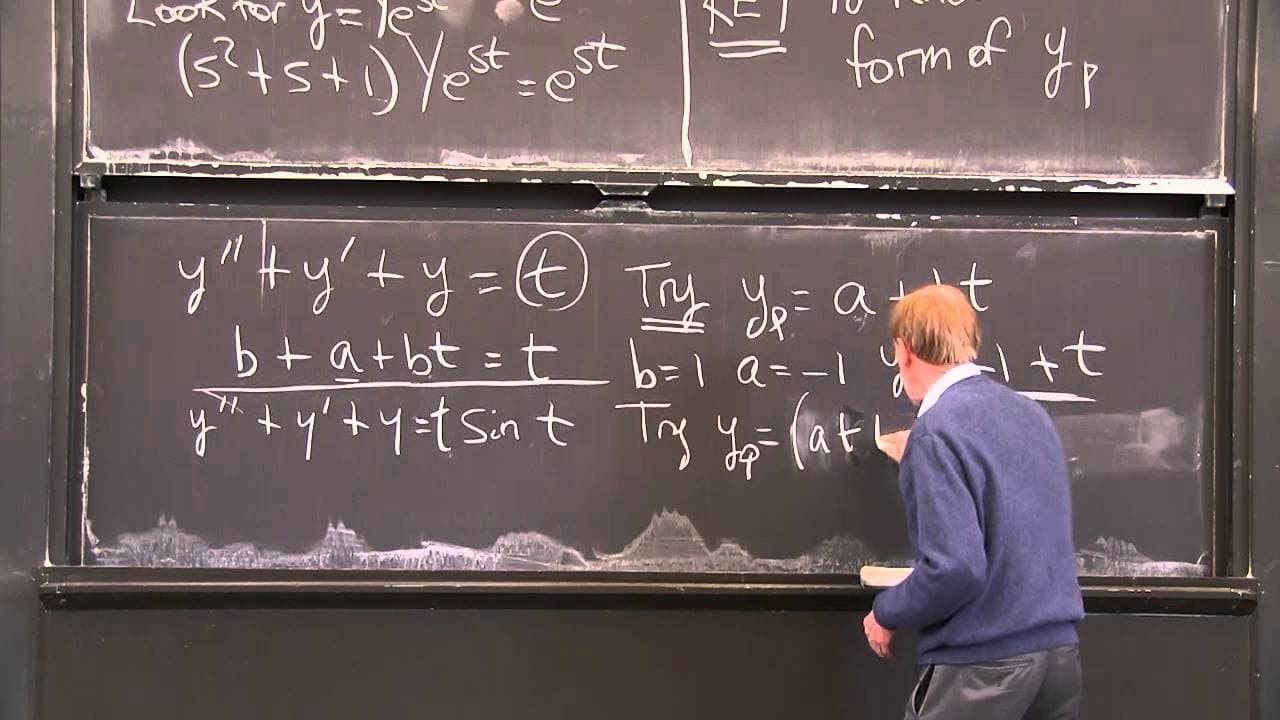
This method allows you to quickly solve differential equations featuring ‘nice functions’ like exponentials, polynomials, and their products. By substituting these forms into the equation, you can efficiently determine the coefficients for the particular solution. Special cases, such as resonance, require modification to the assumed form to ensure valid solutions.
Transcript
GILBERT STRANG: OK. So this is about the world's fastest way to solve differential equations. And you'll like that method. First we have to see what equations will we be able to solve. Well, linear, constant coefficients. I made all the coefficients 1, but no problem to change those to A, B, C. So the nice left-hand side. And on the right-hand side... Read More
Key Insights
- 💨 The method discussed in the video provides a quick and efficient way to solve differential equations for specific types of equations.
- 💁 Nice functions, such as exponentials, polynomials, and polynomial times exponential functions, have the property that their derivatives have the same form, making them easy to solve using this method.
- 🫱 Equations with a null solution as the right-hand side cannot be solved using the assumed form of the particular solution and require an additional factor, such as a t term, to escape resonance.
Install to Summarize YouTube Videos and Get Transcripts
Explore YouTube Video Summarizer or Get YouTube Transcript Extractor
Questions & Answers
Q: What are the characteristics of equations that can be solved using this method?
Equations that have linear, constant coefficients and nice functions on both sides can be efficiently solved using this method. Nice functions include exponentials, polynomials, and polynomial times exponential functions.
Q: How do you determine the coefficients for a polynomial function in the particular solution?
To find the coefficients, you substitute the polynomial function into the equation and solve for the unknown coefficients by matching the terms. The coefficients can be determined by equating the corresponding terms on both sides of the equation.
Q: What is the form of the particular solution for an equation with sine or cosine right-hand side?
For equations with sine or cosine right-hand side, the particular solution is assumed to be in the form of a sum of a constant times cosine of t and another constant times sine of t. The values of the constants can be determined by substituting this form into the equation and matching the terms.
Q: How do you handle the special case of resonance in solving differential equations?
In the case of resonance, where the right-hand side of the equation is a null solution, an additional factor of t is multiplied to the assumed form of the particular solution. This allows the equation to find a unique solution by introducing a t term that was not present in the original assumed form.
Summary & Key Takeaways
-
The video discusses the types of equations that can be solved efficiently using this method, which are linear, constant coefficient equations with nice functions on both sides.
-
The first example uses e to the st as the nice function on the right-hand side, and by substituting it into the equation, the coefficient can be determined to find the particular solution.
-
The video then explores other nice functions such as polynomials, sine and cosine functions, and the product of a polynomial and exponential function.
Read in Other Languages (beta)
Share This Summary 📚
Summarize YouTube Videos and Get Video Transcripts with 1-Click
Try YouTube Summary with ChatGPT & Claude or YouTube Transcript Generator
Explore More Summaries from MIT OpenCourseWare 📚


Summarize YouTube Videos and Get Video Transcripts with 1-Click
Try YouTube Summary with ChatGPT & Claude or YouTube Transcript Generator