Rectangular Wave guide | Propagation of TE waves | Part-2/3 | Microwave Engineering | Lec-14
TL;DR
The video explains the derivation of T-wave propagation in rectangular waveguides using boundary conditions.
Transcript
okay hi everyone in this video I'm continuing the previous derivation of a propagation of T waves in rectangular waveguid so we have taken the T standard equation after that we have assumed HZ is equal to some X into Y2 variable method after that we have taken x square is equal to a square plus b square so after simplifying this a square plus b squ... Read More
Key Insights
- 🌊 T-wave propagation is characterized by the interaction of electric and magnetic fields within rectangular waveguides, necessitating a detailed mathematical approach.
- 👋 Boundary conditions play a vital role in simplifying and validating field equations, significantly influencing the characteristics of the wave's propagation.
- 🏑 The relationship between electric field components and magnetic field constants must be well-understood to derive accurate equations governing wave behavior.
- 👻 Despite initial complexities in the derivation, systematic application of boundary conditions allows for simplification and clearer physical interpretation of T-wave behavior.
- 💁 A total of four boundary conditions are important for a comprehensive understanding of T-wave propagation forms, with each uniquely contributing to the derivation process.
- 🏑 The simplification involves recognizing the zero values of specific electric field components, a fundamental aspect of electromagnetic theory in waveguides.
- 🌊 The approach outlined provides a foundational method for future explorations of other wave types and guide geometries beyond T waves.
Install to Summarize YouTube Videos and Get Transcripts
Explore YouTube Video Summarizer or Get YouTube Transcript Extractor
Questions & Answers
Q: What are the main characteristics of T-wave propagation in rectangular waveguides?
T-wave propagation in rectangular waveguides involves specific mathematical representations of the electric and magnetic fields. The most significant aspect is the behavior of these fields at boundaries, where the electric field components become zero, while magnetic field components contribute to wave propagation, affecting how waves travel through the guide.
Q: How does the first boundary condition influence the derivation process?
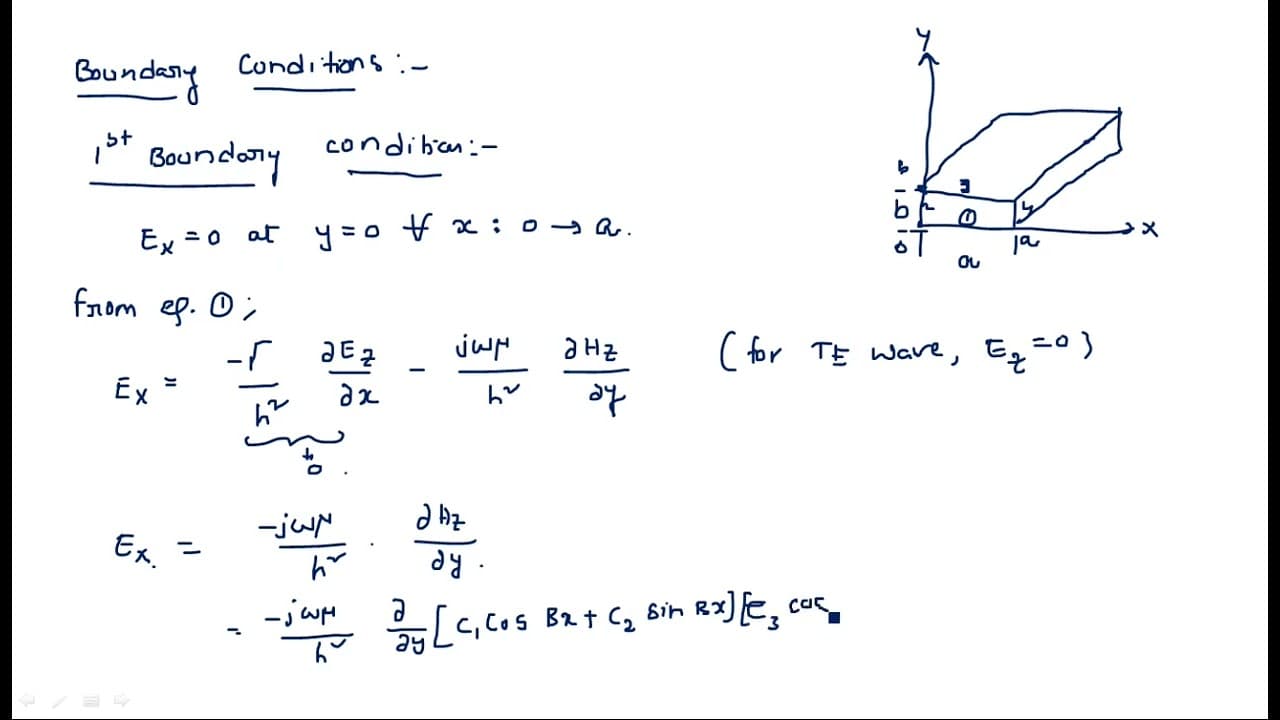
The first boundary condition, which states that the electric field component E_x is zero along the x-axis for all variations of Y, is essential for deriving the equations governing T-wave propagation. By introducing this condition into the initial equations, the presenter simplifies the calculation, ultimately leading to specific values for constants related to the wave function.
Q: Why is the relationship between E_x and H_z important in the derivation?
The relationship between E_x and H_z is crucial because it helps link electric field behavior to magnetic field characteristics in wave propagation. Specifically, it enables the substitution of boundary conditions into the equations governing the waves, ensuring that the mathematical description captures the true nature of field interactions as they adhere to the physical constraints imposed by the waveguide's geometry.
Q: What happens when the second boundary condition is applied in the derivation?
The application of the second boundary condition, where E_y equals zero at the y-axis, leads to simplification of the equations derived earlier. This condition helps set the constants derived in the equations while further clarifying the relationship between the electric and magnetic fields, resulting in simplified expressions that adhere to the physical principles governing T-wave propagation.
Summary & Key Takeaways
-
The video focuses on deriving the propagation of T waves in rectangular waveguides, utilizing the T-mode standard equation and variable methods for simplification.
-
It discusses boundary conditions, emphasizing that the electric field is zero along boundaries, while certain magnetic field components persist, crucial for deriving accurate wave equations.
-
The presenter outlines the first two boundary conditions applied to the derived equations, detailing the process of substituting conditions into equations to simplify terms and find critical constants.
Read in Other Languages (beta)
Share This Summary 📚
Summarize YouTube Videos and Get Video Transcripts with 1-Click
Try YouTube Summary with ChatGPT & Claude or YouTube Transcript Generator