What Is the Law of Total Variance and How Is It Derived?
TL;DR
The law of total variance is derived by manipulating conditional variances, applying formulas for expectation within a conditional universe. The derivation confirms that the variance can be expressed as the sum of conditional expectations and their variances, illustrating the relationship between these important concepts in probability theory.
Transcript
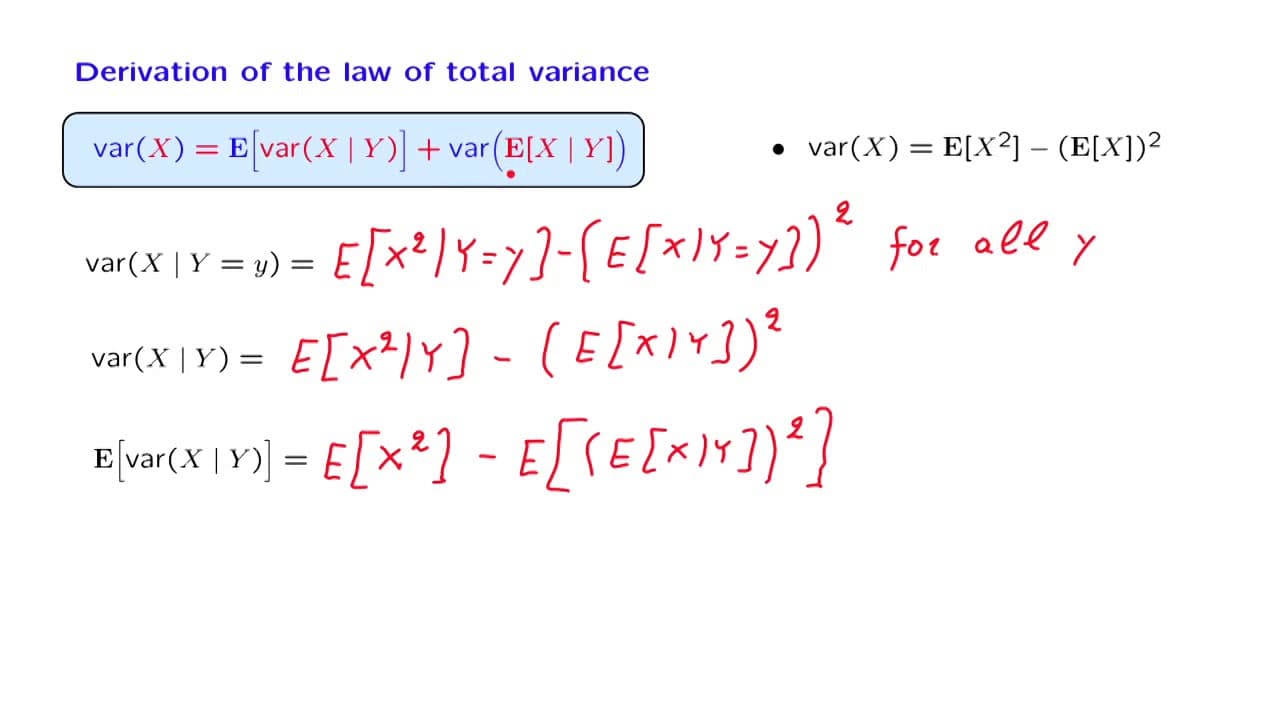
We will now go through a derivation of the law of total variance. This particular derivation is not insightful. It will not really give you any intuition as to why the law of total variance is correct. On the other hand, it involves some interesting manipulations that will be useful to be able to follow, and understand the kinds of objects that the... Read More
Key Insights
- 👮 The law of total variance involves manipulating conditional variances and applying formulas.
- ❓ Conditional variances are calculated in a conditional universe, accounting for specific conditions or variables.
- 👮 The law of iterated expectations simplifies calculations by equating the expected value of a conditional expectation with the unconditional expectation.
- 👍 Proving the equality between random variables in different contexts helps establish their identical numerical values.
- 👮 The derivation of the law of total variance helps understand the mathematical manipulations involved, even if it doesn't provide intuitive insights into why it is correct.
- 👮 The law of total variance formula includes terms related to the expected value and variance of a random variable.
- 👮 The derivation shows how to calculate each term in the law of total variance using conditional expectations and variances.
Install to Summarize YouTube Videos and Get Transcripts
Explore YouTube Video Summarizer or Get YouTube Transcript Extractor
Questions & Answers
Q: What is the purpose of the derivation of the law of total variance?
The derivation helps understand the mathematical manipulations involved in calculating conditional variances and why the law of total variance holds true.
Q: How is the conditional variance different from ordinary variance?
The conditional variance is calculated in a conditional universe, taking into account specific conditions or variables, whereas the ordinary variance is calculated without any specific conditions.
Q: What is the significance of proving the equality between random variables?
Proving the equality between random variables in different contexts shows that they always take the same numerical values, regardless of the specific conditions or variables involved.
Q: How does the law of iterated expectations apply in the derivation?
The law of iterated expectations states that the expected value of a conditional expectation is the same as the unconditional expectation, which simplifies calculations in the derivation.
Summary & Key Takeaways
-
The video goes through a step-by-step derivation of the law of total variance, which is not necessarily intuitive but helps understand the mathematical manipulations involved.
-
The first step is applying the formula for calculating variances to the conditional variance, which is calculated in a conditional universe.
-
The video shows how to calculate the first term in the law of total variance by taking the expectation of a conditional expectation and applies a general property of variances to calculate the second term.
Read in Other Languages (beta)
Share This Summary 📚
Summarize YouTube Videos and Get Video Transcripts with 1-Click
Try YouTube Summary with ChatGPT & Claude or YouTube Transcript Generator
Explore More Summaries from MIT OpenCourseWare 📚



Summarize YouTube Videos and Get Video Transcripts with 1-Click
Try YouTube Summary with ChatGPT & Claude or YouTube Transcript Generator