L09.2 Conditioning A Continuous Random Variable on an Event
TL;DR
Conditional probabilities and PDFs are used in the continuous case to calculate probabilities and expectations, similar to the discrete case.
Transcript
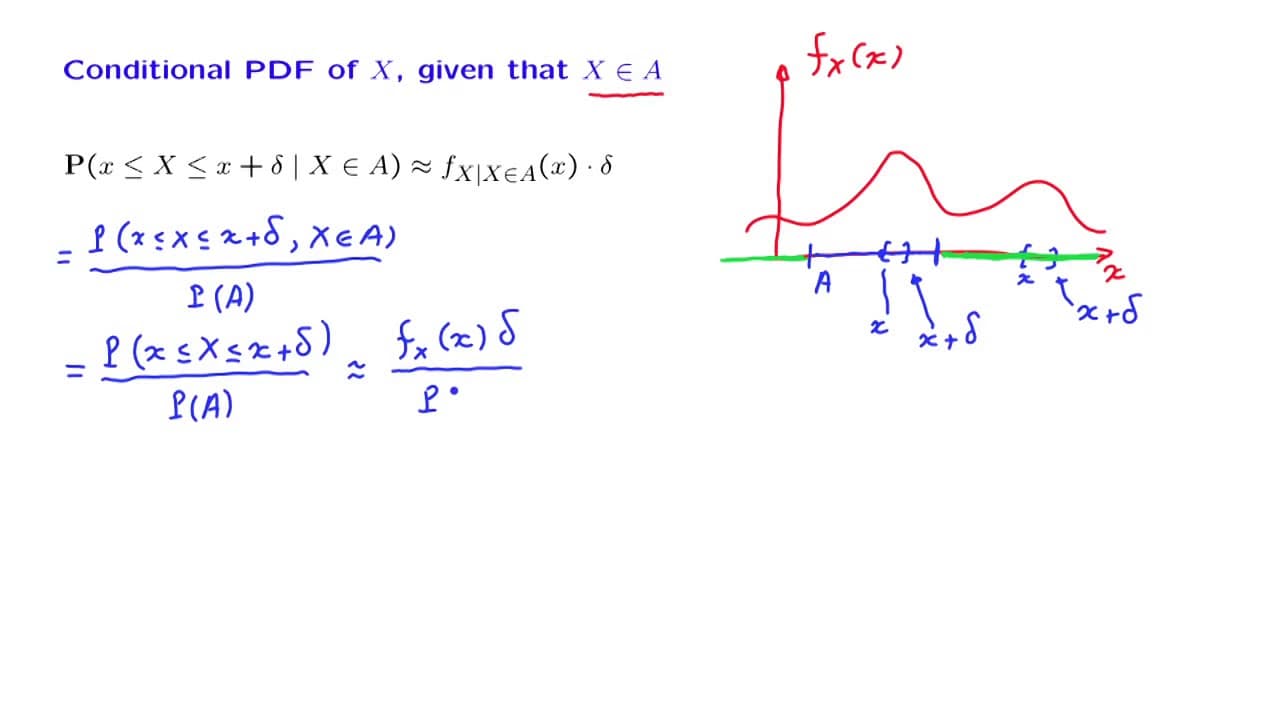
In this segment, we pursue two themes. Every concept has a conditional counterpart. We know about PDFs, but if we live in a conditional universe, then we deal with conditional probabilities. And we need to use conditional PDFs. The second theme is that discrete formulas have continuous counterparts in which summations get replaced by integrals, and... Read More
Key Insights
- 💼 Conditional probabilities and conditional PDFs are used in the continuous case to calculate probabilities and expectations.
- 😌 The form of the conditional PDF depends on whether the random variable lies outside or inside a given set.
- ⚖️ Conditional PDFs maintain the same relative sizes and shape as the unconditional PDFs, but are re-scaled to ensure the total probability is 1.
- 💼 Conditional expectations in the continuous case are calculated using the conditional PDF.
- 📏 The expected value rule for continuous random variables can also be applied in the conditional setting, using conditional probabilities and PDFs.
Install to Summarize YouTube Videos and Get Transcripts
Explore YouTube Video Summarizer or Get YouTube Transcript Extractor
Questions & Answers
Q: What is the difference between conditional probabilities and conditional PDFs in the continuous case compared to the discrete case?
In the continuous case, conditional probabilities and conditional PDFs are calculated using integrals instead of summations. They represent probabilities and densities given a certain event has occurred.
Q: How is the conditional PDF calculated when the random variable lies outside the given set?
When the random variable lies outside the set, the conditional PDF is 0. This makes sense as values outside the set cannot occur given the given information.
Q: What is the formula for the conditional PDF when the random variable lies inside the given set?
The conditional PDF inside the set is proportional to the unconditional PDF, but it is scaled by a constant. The total area under the conditional PDF is equal to 1.
Q: How can conditional expectations be calculated in the continuous case?
Conditional expectations in the continuous case are calculated using the conditional PDF. The formula for conditional expectation involves integrating the product of the random variable and the conditional PDF.
Summary & Key Takeaways
-
Conditional probabilities and conditional PDFs are used in a conditional universe to calculate probabilities and expectations in the continuous case.
-
Conditional PDFs are similar to PDFs but are applied to a model where a certain event has occurred.
-
The form of the conditional PDF depends on whether the random variable lies outside or inside a given set.
Read in Other Languages (beta)
Share This Summary 📚
Summarize YouTube Videos and Get Video Transcripts with 1-Click
Try YouTube Summary with ChatGPT & Claude or YouTube Transcript Generator
Explore More Summaries from MIT OpenCourseWare 📚



Summarize YouTube Videos and Get Video Transcripts with 1-Click
Try YouTube Summary with ChatGPT & Claude or YouTube Transcript Generator