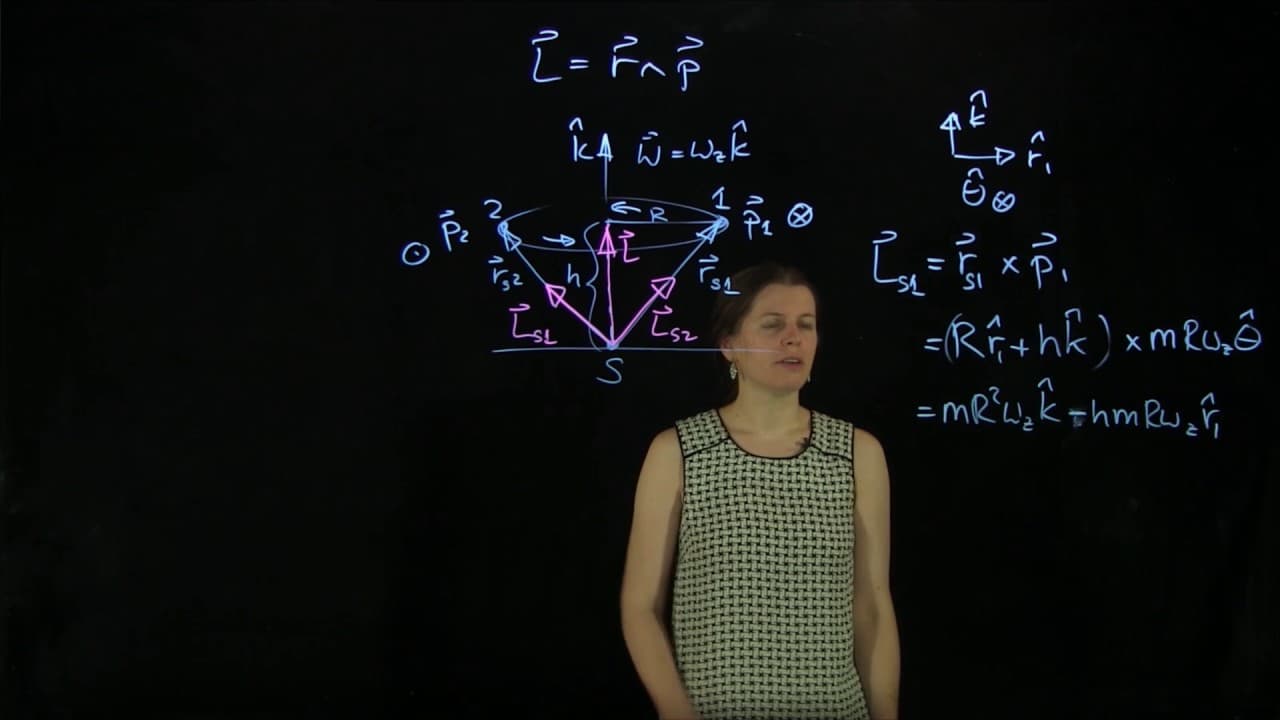
33.1 Worked Example - Angular Momentum of 2 Rotating Point Particles
TL;DR
The video explains how to calculate the angular momentum of particles moving in a circular motion.
Transcript
Let's look at the angular momentum of two particles, one sitting here and one over there. And they are circling each other. And we want to determine the angular momentum of a point on the ground right here underneath. That's the whole point, s. And here is the center. So the circle has radius, R. And here we have a height, h. and let's have the par... Read More
Key Insights
- 😵 Angular momentum is determined by the cross product of the position vector and momentum vector.
- ❓ The direction of the vectors depends on the chosen coordinate system.
- 📐 The total angular momentum of a system is obtained by adding the angular momentum of each particle.
Install to Summarize YouTube Videos and Get Transcripts
Explore YouTube Video Summarizer or Get YouTube Transcript Extractor
Questions & Answers
Q: What is angular momentum and how is it calculated?
Angular momentum is a vector quantity that measures the rotational motion of a particle or system. It is calculated by taking the cross product of the position vector and momentum vector.
Q: What is the significance of the coordinate system in calculating angular momentum?
The choice of coordinate system is crucial because it determines the direction of the vectors involved in the calculation. Depending on the chosen system, the angular momentum may point in different directions.
Q: How does the number of particles affect the total angular momentum?
The total angular momentum of a system increases with the number of particles. Each particle contributes to the overall angular momentum, and by adding them together, we can determine the total angular momentum of the system.
Q: How does the mass of the particles affect the angular momentum?
The mass of the particles affects the magnitude of the angular momentum. In the calculation, the mass is multiplied by the angular velocity component, so an increase in mass would result in a larger angular momentum.
Summary & Key Takeaways
-
The video discusses the concept of angular momentum and how to calculate it for particles moving in a circular motion.
-
The angular momentum of a point on the ground underneath the particles is determined by the cross product of the position vector and momentum vector.
-
By considering the direction and coordinates of the particles, the angular momentum of each particle is calculated and then added together to obtain the total angular momentum of the system.
Read in Other Languages (beta)
Share This Summary 📚
Summarize YouTube Videos and Get Video Transcripts with 1-Click
Try YouTube Summary with ChatGPT & Claude or YouTube Transcript Generator
Explore More Summaries from MIT OpenCourseWare 📚



Summarize YouTube Videos and Get Video Transcripts with 1-Click
Try YouTube Summary with ChatGPT & Claude or YouTube Transcript Generator