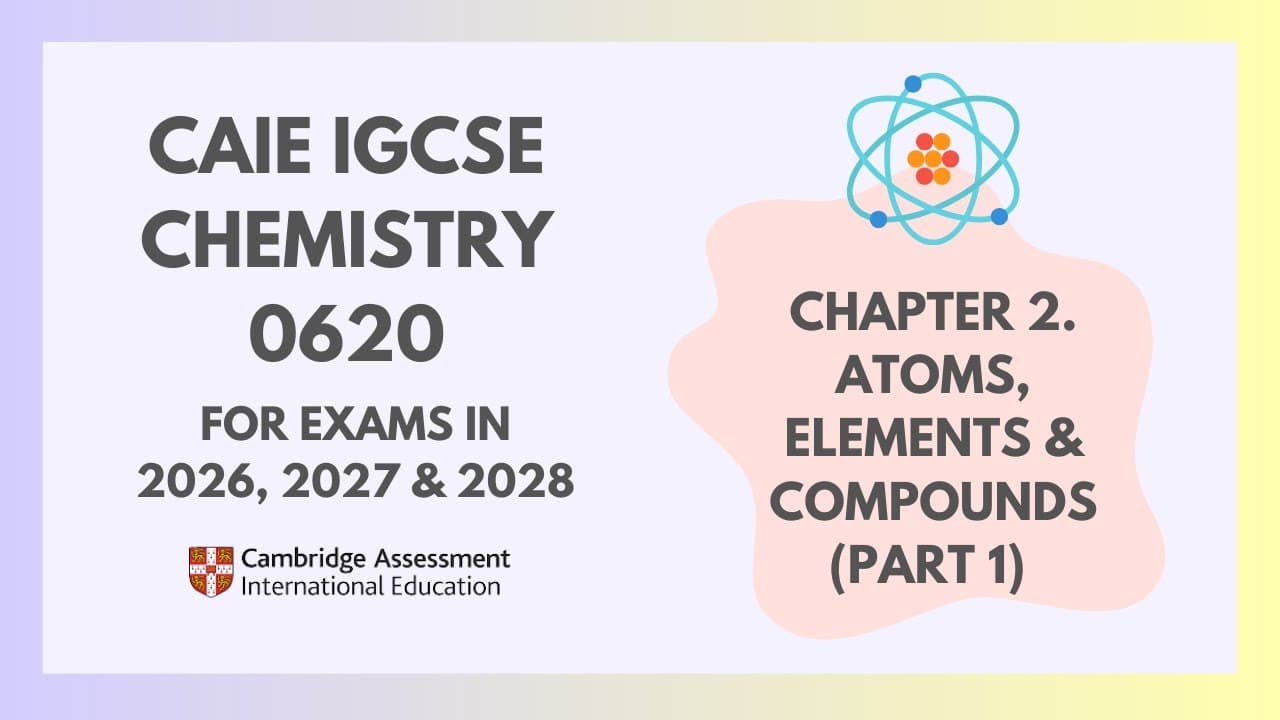
2. Atoms, Elements & Compounds (Part 1) (1/4) (Cambridge IGCSE Chemistry 0620 for 2023, 2024 & 2025)
TL;DR
Introduction to elements, compounds, and atomic structure.
Transcript
hi everyone welcome to igcc study Bud where you can revise chemistry topics from the Cambridge igcc syllabus if you are enjoying our videos so far please don't forget to hit the like button and subscribe to our channel in this video you are going to learn part one of topic two atoms elements and compounds first let's learn about elements compounds ... Read More
Key Insights
- Elements are pure substances consisting of only one type of atom, represented by chemical symbols like O for oxygen and H for hydrogen.
- Compounds are formed when two or more different elements chemically combine, having unique properties different from their constituent elements.
- Mixtures are combinations of elements or compounds that are not chemically bonded and can be separated by physical means.
- Atoms are the smallest units of matter, consisting of protons, neutrons, and electrons, with a nucleus at the center.
- Protons are positively charged particles in the nucleus, while neutrons are neutral, and electrons are negatively charged and orbit the nucleus.
- The atomic number, or proton number, identifies an element and is equal to the number of protons in the nucleus.
- The mass number is the total number of protons and neutrons in an atom's nucleus, representing the atom's total mass.
- Relative atomic mass is the average mass of all isotopes of an element, often used interchangeably with mass number in exams.
Install to Summarize YouTube Videos and Get Transcripts
Explore YouTube Video Summarizer or Get YouTube Transcript Extractor
Questions & Answers
Q: What is an element in chemistry?
An element is a pure substance made up of only one type of atom, making it the simplest form of matter. Each element is represented by a unique chemical symbol, such as O for oxygen or H for hydrogen. Elements cannot be broken down into simpler substances by chemical means.
Q: How do compounds differ from elements?
Compounds are substances formed when two or more different elements chemically combine, resulting in unique properties distinct from the individual elements. They are represented by chemical formulas, such as H2O for water, and cannot be separated into their constituent elements by physical means.
Q: What distinguishes a mixture from a compound?
A mixture is a combination of two or more substances, either elements or compounds, that are physically mixed but not chemically bonded. The components in a mixture retain their individual properties and can be separated by physical means, unlike compounds, which require chemical reactions for separation.
Q: What are the main components of an atom?
An atom consists of a nucleus, which contains protons and neutrons, and electrons that orbit the nucleus in specific energy levels or shells. Protons are positively charged, neutrons are neutral, and electrons are negatively charged. These components define the atom's structure and properties.
Q: How is the atomic number of an element determined?
The atomic number, represented by the symbol Z, is determined by the number of protons in the nucleus of an atom. It is unique to each element and helps identify the element's position on the periodic table. In a neutral atom, the atomic number also equals the number of electrons.
Q: What does the mass number of an atom represent?
The mass number, or nucleon number, is the total number of protons and neutrons in an atom's nucleus. It represents the atom's total mass and is symbolized by A. The mass number is crucial for calculating the number of neutrons in an atom by subtracting the atomic number from it.
Q: How can the number of neutrons in an atom be calculated?
To calculate the number of neutrons in an atom, subtract the atomic number (number of protons) from the mass number (total number of protons and neutrons). For example, if an atom has a mass number of 12 and an atomic number of 6, it has 6 neutrons (12 - 6 = 6).
Q: What is the role of the periodic table in chemistry?
The periodic table organizes elements based on their atomic number, providing a systematic way to identify and categorize elements. It displays elements with their atomic number at the top and relative atomic mass at the bottom, helping chemists understand element properties and relationships.
Summary & Key Takeaways
-
This video introduces the concepts of elements, compounds, and mixtures in chemistry, explaining their distinct properties and how they are represented. Elements are pure substances, compounds are chemically combined elements, and mixtures are physical combinations.
-
Atoms are described as the basic units of matter, consisting of a nucleus with protons, neutrons, and orbiting electrons. The video explains the structure of atoms and the significance of atomic and mass numbers in identifying elements.
-
The video covers the differences between elements, compounds, and mixtures, detailing the properties and separation methods for each. It also explains the periodic table's role in organizing elements based on atomic number and relative atomic mass.
Read in Other Languages (beta)
Share This Summary 📚
Summarize YouTube Videos and Get Video Transcripts with 1-Click
Try YouTube Summary with ChatGPT & Claude or YouTube Transcript Generator
Explore More Summaries from IGCSE Study Buddy 📚
Summarize YouTube Videos and Get Video Transcripts with 1-Click
Try YouTube Summary with ChatGPT & Claude or YouTube Transcript Generator