DC Generator | Separately excited || Types of DC Machines | Lec-19
TL;DR
Understanding the operation and efficiency of separately excited DC generators for maximum power transfer.
Transcript
hello everyone in the last session we discussed about the separately excited dc generator so whenever a field supplies field supply is given then flux will flowing through the armature winding then armature cuts the flux and emf is induces that emf will be corrected by the load that means finally the we are giving we are getting we it will get some... Read More
Key Insights
- 🏑 Separately excited DC generators utilize external sources for field supply, affecting the generated EMF.
- 💦 The output power of a DC generator is contingent upon accurately accounting for armature losses and brush drop.
- 🧑🏭 The armature current acts as a pivotal variable that adjusts based on load changes, impacting overall performance.
- ✊ For maximum efficiency, the load resistance must be equivalent to the armature resistance, aligning power delivery and minimizing energy loss.
- ✊ The maximum power transfer theorem asserts that matching load resistance to source resistance optimizes electricity transfer and minimizes losses.
- 💱 The relationship established by the equations simplifies understanding how changes in load or armature resistance directly influence generated output.
- ✊ Understanding the theoretical limits of DC generators helps engineers design systems that optimize power delivery and efficiency.
Install to Summarize YouTube Videos and Get Transcripts
Explore YouTube Video Summarizer or Get YouTube Transcript Extractor
Questions & Answers
Q: What is the significance of armature resistance in a DC generator?
Armature resistance plays a crucial role in determining the efficiency of a DC generator. It contributes to armature losses, which need to be accounted for when calculating output power. This resistance causes a voltage drop, affecting the overall performance and indicating that load and armature resistances must match for optimal efficiency in power transfer.
Q: How can maximum power be developed in a separately excited DC generator?
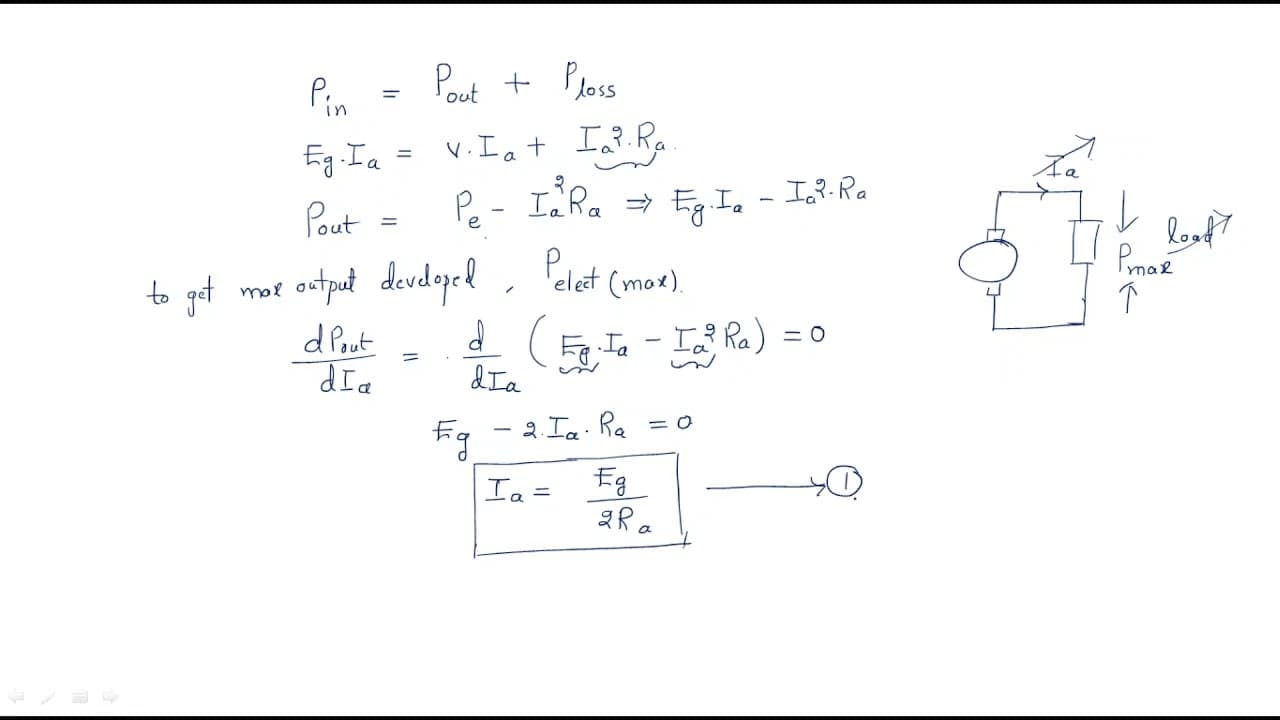
Maximum power is achieved when the load resistance equals the armature resistance. This alignment reduces losses and ensures that a greater portion of the generated EMF is available for conversion into useful power. Additionally, the output voltage must be half of the generated EMF to meet this condition effectively.
Q: What equation represents the relationship between input and output in a DC generator?
The equation relating input and output power is given by the output voltage minus the armature losses. Formally, it can be expressed as output power equaling input generated EMF multiplied by armature current minus the losses represented by the formula, iA²RA.
Q: Why is it essential to differentiate power with respect to current in DC generators?
Differentiating power with respect to current allows engineers to find the optimal armature current that maximizes output power. By setting the derivative equal to zero, it provides the necessary condition to achieve maximum efficiency in generator operation, ensuring all variable terms are accounted for.
Summary & Key Takeaways
-
The session elaborates on the operation of separately excited DC generators, emphasizing the relationship between input power, output power, and losses during operation.
-
Maximum power transfer can be achieved when the load resistance equals the armature resistance, optimizing the output voltage which should also be set to half of the generated EMF.
-
The importance of differentiating equations to find optimal armature current for maximum power is discussed, highlighting the mathematical relationship required in generator performance.
Read in Other Languages (beta)
Share This Summary 📚
Summarize YouTube Videos and Get Video Transcripts with 1-Click
Try YouTube Summary with ChatGPT & Claude or YouTube Transcript Generator