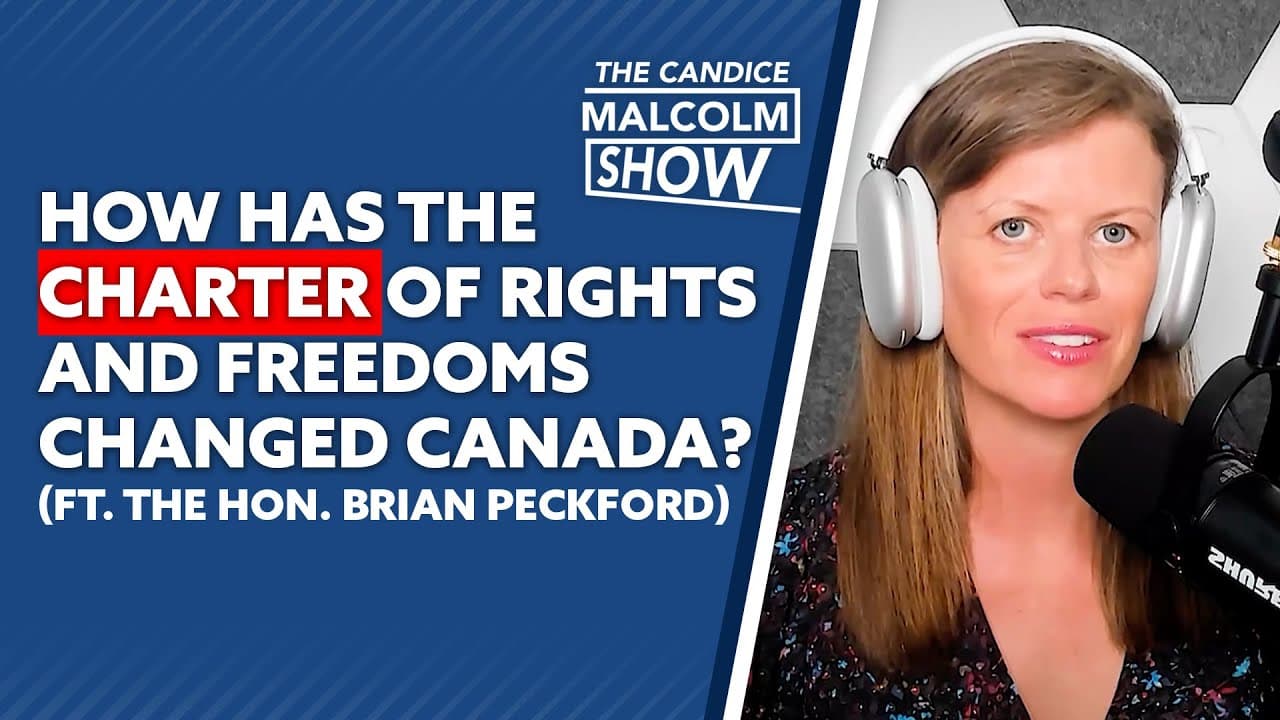
How has the Charter of Rights and Freedoms changed Canada? (Ft. The Hon. Brian Peckford)
TL;DR
The interview discusses the evolution and significance of the Canadian Charter of Rights and Freedoms over 40 years.
Transcript
the canadian charter of rights and freedoms is 40 years old this year how has this document changed our country how has it changed canada well joining me today is one of the original signers of the charter the honorable brian peckford i'm candace malcolm and this is the canis welcome show hi everyone thank you so much for tuning into the program so... Read More
Key Insights
- 🗯️ The Canadian Charter of Rights and Freedoms emerged as a response to the inadequacies of the British common law system, establishing a written document for protecting individual rights across Canada.
- 👻 Section 1 of the Charter allows certain rights to be limited under specific conditions, but many argue that the federal government has not met the burden of proof required to justify these limitations during the pandemic.
- 👮 The intent of the Charter’s creators, particularly regarding the supremacy of God and the rule of law, is often overlooked in current legal discussions and interpretations.
- 😨 Peckford warns against the dangers of government overreach during crises, indicating that fear has influenced public responses and the interpretations of rights during the pandemic.
- 🗯️ The negotiation process of the Charter was complex; freedom was one of several items debated along with Indigenous rights, jurisdictional frameworks, and economic considerations, demonstrating the challenges of constitutional reform.
- ⚠️ Peckford maintains that changes and improvements to the Charter can be made, but warns that they should be approached carefully to avoid unintended consequences.
- 🗯️ The ongoing legal battles and challenges presented to the Charter highlight the need for vigilance among Canadians to protect their constitutional rights and freedoms.
Install to Summarize YouTube Videos and Get Transcripts
Explore YouTube Video Summarizer or Get YouTube Transcript Extractor
Questions & Answers
Q: Why was the Canadian Charter of Rights and Freedoms created?
The Canadian Charter was created to formally outline individual rights and freedoms in a written document, addressing the historical reliance on unwritten British common law that left many rights unprotected. The push for a charter began in the 1960s, culminating in its establishment in 1982 as part of Canada's patriation of the constitution. This was important to ensure that all Canadians, and not just those in federal jurisdiction, had protected rights.
Q: How has the government’s usage of emergency powers during the pandemic impacted Charter rights?
During the pandemic, many have argued that the government's invocation of emergency powers has violated several rights enshrined in the Charter. Peckford contends that the government has not demonstrated the “demonstrably justified” standard required under Section 1 of the Charter for limiting rights, particularly given that an extreme situation, as intended for invoking such powers, was not present.
Q: What key insights can be taken from the drafting of the Charter?
Peckford notes that the Charter was part of a larger constitutional negotiation that included various rights and frameworks such as Indigenous peoples’ rights. The negotiations involved compromises that reflect the political landscape of Canada. The significance of not just the rights themselves but the broader context of governance and compromise is crucial to understanding the Charter’s impacts.
Q: Did the Charter meet Peckford’s expectations after 40 years?
While Peckford believes the Charter has been successful in affirming many individual rights, he acknowledges that it is not perfect. He argues for continuous improvement, recognizing that constitutional documents often require updates to respond adequately to societal changes and evolving political contexts.
Q: What does Peckford argue about the historical context of government actions during the pandemic?
Peckford claims there is a critical historical precedent regarding the interpretation of Section 1 of the Charter and its application in emergencies. He emphasizes that governmental actions must align with the Charter's intended purpose, which was meant to be invoked only in situations of state emergency and not for regular governance or political opposition.
Q: How does Peckford view the future of judicial interpretations of the Charter?
Peckford expresses cautious optimism, stressing that the higher courts have an opportunity to correct misinterpretations made at the lower levels. He believes that as cases move through the judicial system, there is the potential for reaffirming the Charter’s core principles and addressing any violations that have occurred.
Q: What was the significance of the Supreme Court's decision regarding the Charter's patriation?
The Supreme Court's decision underscored the necessity of involving the provinces in the patriation process of the Constitution. It highlighted the federal nature of Canada and emphasized that unilateral actions taken by the federal government regarding the Constitution are not permitted without provincial consent, setting a precedent for collaborative governance.
Summary & Key Takeaways
-
Brian Peckford, the last living signatory of the Canadian Charter of Rights and Freedoms, reflects on its creation and evolution since 1982. He highlights the importance of a written charter in safeguarding individual rights compared to unwritten laws.
-
The interview delves into the implications of the charter during recent government actions, particularly during the COVID-19 pandemic, where Peckford argues that many rights have been violated under the government’s emergency measures.
-
Peckford discusses the importance of the rule of law and the supremacy of God as foundational principles of the charter, arguing that these have been overlooked in contemporary legal interpretations and actions taken by the government.
Read in Other Languages (beta)
Share This Summary 📚
Summarize YouTube Videos and Get Video Transcripts with 1-Click
Try YouTube Summary with ChatGPT & Claude or YouTube Transcript Generator
Explore More Summaries from True North 📚



Summarize YouTube Videos and Get Video Transcripts with 1-Click
Try YouTube Summary with ChatGPT & Claude or YouTube Transcript Generator