Commutators, matrices, and 3-dimensional Schrödinger equation
TL;DR
This video explores the concept of matrices, operators, and the Schrodinger equation in quantum mechanics, highlighting their importance in understanding quantum phenomena.
Transcript
PROFESSOR: This is very important. This is the beginning of the uncertainty principle, the matrix formulation of quantum mechanics, and all those things. I want to just tabulate the information of matrices. We have an analog, so we have operators. And we think of them as matrices. Then in addition to operators, we have wave functions. And we think ... Read More
Key Insights
- 🦾 Matrices and operators are fundamental in understanding quantum mechanics and making predictions about quantum systems.
- 🚱 The Pauli matrices encode the properties of spin 1/2 particles and demonstrate non-commutation.
- 👻 The Schrodinger equation, represented with matrices, allows us to study wave functions and their behavior in quantum systems.
- 🦾 Matrices may commute to give a number or another matrix, each with different implications in quantum mechanics.
- 😌 The complexity of quantum mechanics lies in understanding the physical interpretations of matrix operations and their commutation properties.
Install to Summarize YouTube Videos and Get Transcripts
Explore YouTube Video Summarizer or Get YouTube Transcript Extractor
Questions & Answers
Q: What is the relationship between matrices and operators in quantum mechanics?
In quantum mechanics, operators represent physical quantities, while matrices represent these operators' actions on wave functions. This allows us to make calculations and predictions about quantum systems.
Q: What is the significance of the Pauli matrices and spin 1/2?
The Pauli matrices—sigma 1, sigma 2, and sigma 3—encode the properties of spin 1/2 particles. These matrices do not commute and demonstrate the non-classical behavior of quantum systems.
Q: How do matrices relate to the Schrodinger equation?
Matrices are used to represent operators in the Schrodinger equation. By solving the Schrodinger equation, we can determine the behavior of wave functions and understand quantum phenomena.
Q: Why is it more complex to study the commutation of matrices compared to simple matrix calculations?
The commutation of matrices in quantum mechanics involves understanding their underlying physical implications. A commutation that results in a number is simpler, while a commutation that gives another matrix, as seen with sigma 1 and sigma 2, requires deeper analysis and interpretation.
Summary & Key Takeaways
-
The video explains the connection between matrices and operators in quantum mechanics, where operators act on wave functions represented as vectors.
-
The example of spin 1/2 and the Pauli matrices is given to illustrate the concept of matrices encoding quantum properties.
-
The commutation of matrices and the complexity in understanding their implications compared to simple matrix calculations is discussed.
-
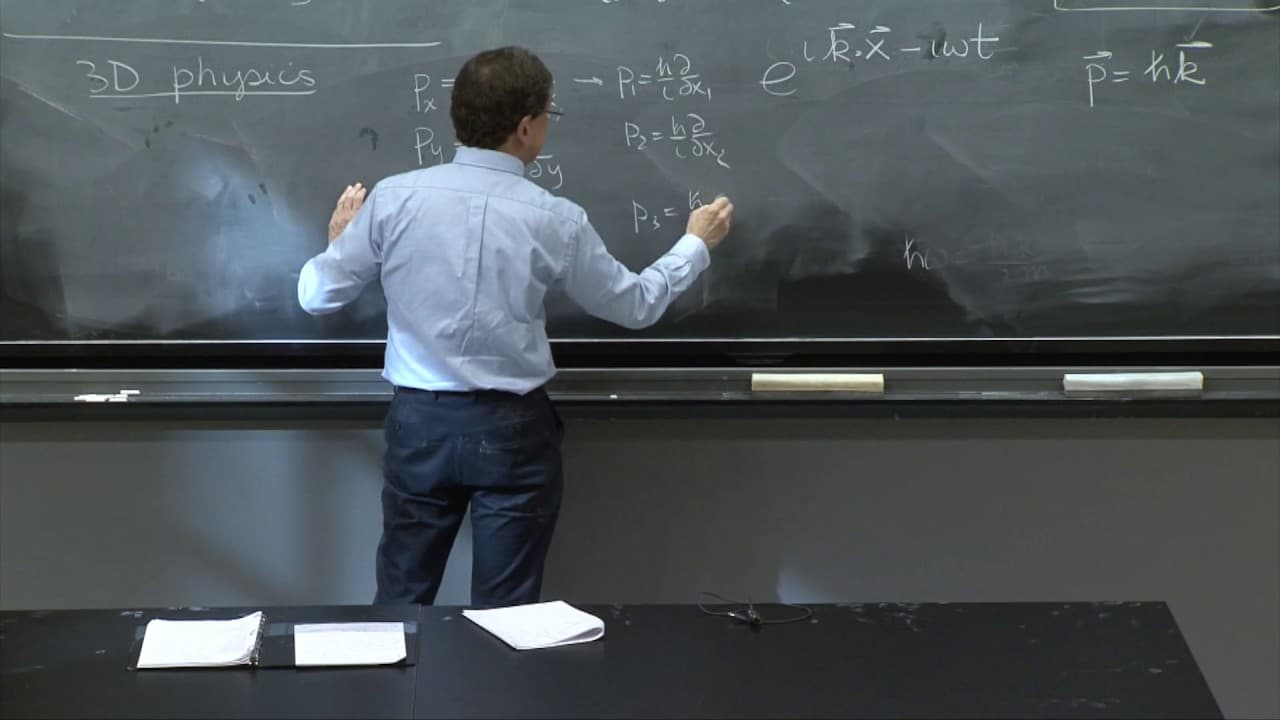
The video introduces the three-dimensional Schrodinger equation and the momentum operator as the gradient.
Read in Other Languages (beta)
Share This Summary 📚
Summarize YouTube Videos and Get Video Transcripts with 1-Click
Try YouTube Summary with ChatGPT & Claude or YouTube Transcript Generator
Explore More Summaries from MIT OpenCourseWare 📚



Summarize YouTube Videos and Get Video Transcripts with 1-Click
Try YouTube Summary with ChatGPT & Claude or YouTube Transcript Generator