k map | Example 6 - variable | STLD | Lec-54
TL;DR
This content explains how to simplify six-variable expressions using K-maps by identifying sum of products and product of sums.
Transcript
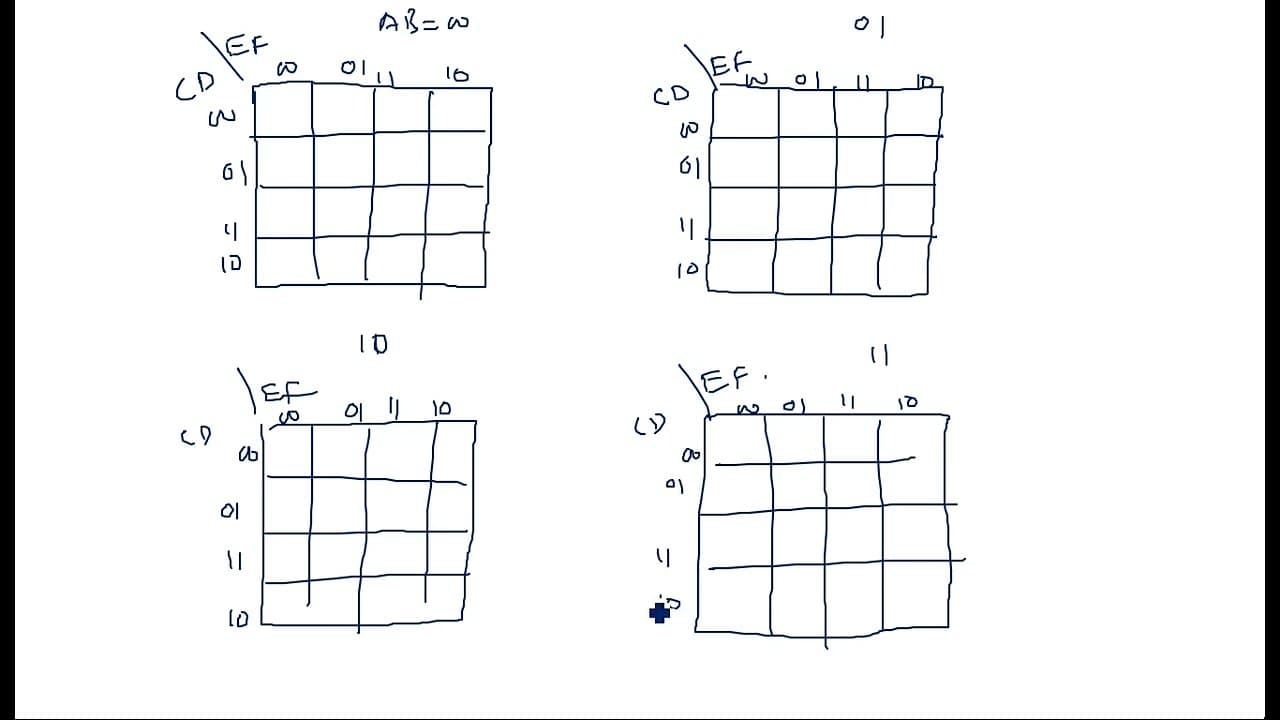
hi everyone let us simplify the volan expression using six variable Kap let us see one example in the previous video I have given you the introduction of six variable KF how to simplify and how to identify the adjacent ones and how to simplify them as a group let us see one example reduce the expression reduce the expression for f is equal to summa... Read More
Key Insights
- 😉 K-maps serve as a powerful tool for simplifying Boolean expressions involving multiple variables through visual groupings.
- 🍹 The identification of minterms and maxterms is vital for creating both sum of products and product of sums expressions in circuit design.
- 🥺 The process involves strategically grouping terms to identify commonalities that lead to simplifications, ensuring minimal representation of logical functions.
Install to Summarize YouTube Videos and Get Transcripts
Explore YouTube Video Summarizer or Get YouTube Transcript Extractor
Questions & Answers
Q: What is the primary purpose of using K-maps in this content?
K-maps are utilized to simplify complex Boolean expressions involving multiple variables effectively. By visually organizing minterms and identifying adjacent terms, K-maps allow for efficient reduction into simpler forms, enabling easier analysis and implementation of logical functions in digital circuits.
Q: How are minterms and maxterms identified in a K-map?
In the context of K-maps, minterms correspond to the '1' values in the truth table, while maxterms represent the '0' values. By identifying which minterms are present and absent, you can derive the corresponding Boolean expressions for both sum of products and product of sums.
Q: Can you explain the significance of grouping in K-map simplification?
Grouping in K-map simplification is crucial because it enables the identification of common factors among adjacent minterms or maxterms. By combining one’s in groups of 1, 2, 4, or even 8, simplifications can be achieved that lead to a more compact and manageable Boolean expression without changing the function.
Q: What are the steps to derive the product of sums expression from K-maps?
To derive a product of sums expression from a K-map, identify the positions where minterms are not present (the zeros). These zeros are then represented as maxterms. By grouping these zeros appropriately and writing the corresponding Boolean expressions, you can create the final product of sums expression.
Q: What challenges might arise when working with six-variable K-maps?
One challenge is the increased complexity as more variables lead to more minterms and potential groupings. This can make visual representation a bit cumbersome, requiring careful organization to avoid errors. Additionally, identifying all possible groupings strategically becomes crucial to ensure a simplified and accurate expression.
Q: How does the visual representation aid in the simplification process?
Visual representation, such as drawing K-maps, significantly aids in the simplification process by allowing quick identification of which terms can be combined. It provides clarity on adjacency and overlaps, which are key for grouping minterms or maxterms effectively, thus simplifying expressions more intuitively.
Q: Why is it essential to consider both sum of products and product of sums?
Considering both sum of products and product of sums is essential as it provides flexibility in designing digital circuits. Depending on the implementation needs, one form may be more efficient than the other. Having both expressions allows designers to choose the most suitable configuration for their circuit requirements.
Q: Can you describe the importance of adjacent mapping in K-map simplification?
Adjacent mapping is important because it enables the combination of terms that share common variables, resulting in a more simplified form. Each pair or group of adjacent ones or zeros contributes to reducing the overall complexity of the expression. Proper grouping ensures that no potential simplification is overlooked.
Summary & Key Takeaways
-
The video introduces a method for simplifying expressions involving six variables using Karnaugh maps (K-maps), emphasizing the identification of adjacent terms.
-
It provides a detailed example of how to reduce a given expression by identifying minterms and deriving both the sum of products and product of sums expressions.
-
Visual aids are used to illustrate the grouping of terms, ensuring clarity in how the simplification process is executed through various combinations of K-map configurations.
Read in Other Languages (beta)
Share This Summary 📚
Summarize YouTube Videos and Get Video Transcripts with 1-Click
Try YouTube Summary with ChatGPT & Claude or YouTube Transcript Generator