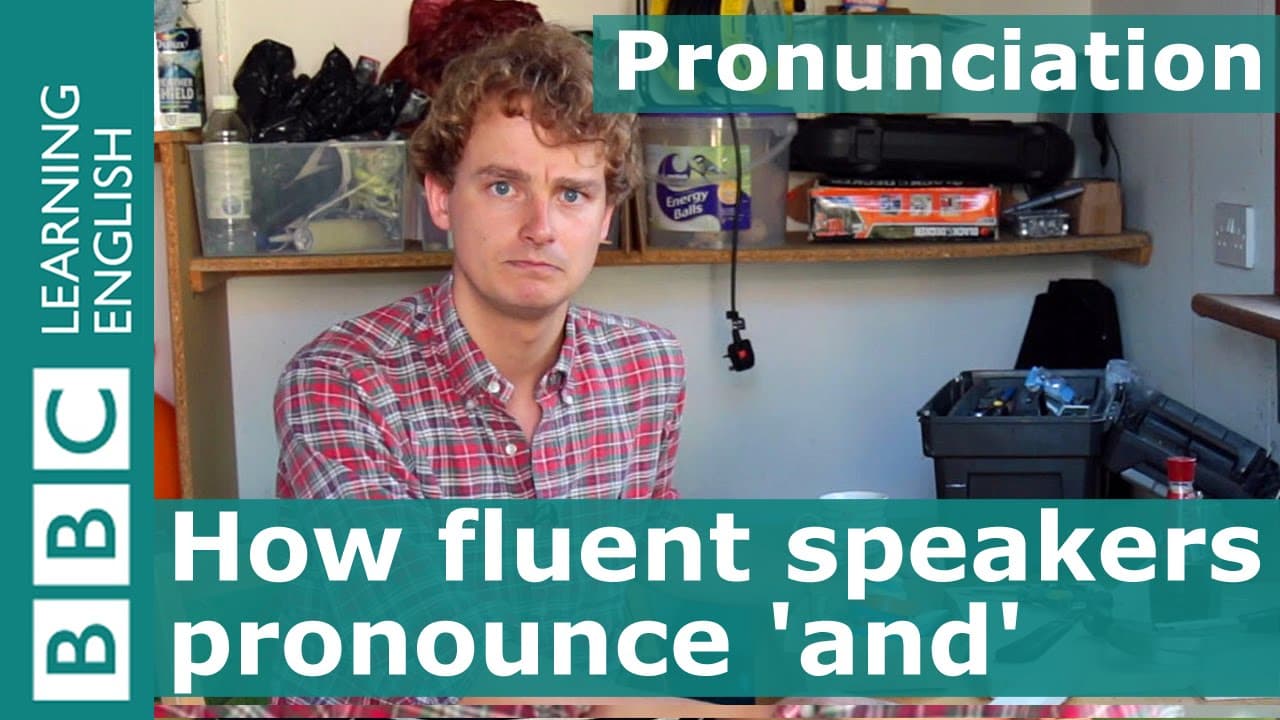
Pronunciation: How do fluent speakers pronounce 'and'?
TL;DR
Fluent speakers often pronounce 'and' as /ən/ or /n/.
Transcript
Hi. I'm Tim and this is my Pronunciation Workshop. Here, I'm going to show you how English is really spoken. Come on, let's go inside. Hey, look at this: a present. All wrapped up in paper. Now, do you know what this is? Well, if you could smell it, it might give you a clue. Is it your old socks? Very funny - No. No, it's not my old socks. It's som... Read More
Key Insights
- The word 'and' is typically pronounced with the sounds /æ/, /n/, /d/, but often changes in casual speech.
- In everyday conversation, the word 'and' often becomes unstressed, leading to the disappearance of the /d/ sound.
- The vowel sound in 'and' often changes to a schwa /ə/, resulting in pronunciations like /ən/ or /n/.
- Examples like 'fish and chips' demonstrate how 'and' is commonly reduced in speech.
- Tim uses examples such as 'apples and oranges' to illustrate the reduced pronunciation of 'and'.
- Listeners are encouraged to practice this pronunciation by repeating example sentences.
- The content emphasizes that understanding these subtle pronunciation changes can aid in comprehending fluent English speakers.
- Tim humorously concludes with a joke about fish 'n' ships, highlighting the reduced form of 'and'.
Install to Summarize YouTube Videos and Get Transcripts
Explore YouTube Video Summarizer or Get YouTube Transcript Extractor
Questions & Answers
Q: How is the word 'and' typically pronounced in everyday English?
In everyday English, the word 'and' is often pronounced in a reduced form, where the /d/ sound disappears, and the vowel sound changes to a schwa /ə/. This results in pronunciations like /ən/ or even just /n/. This reduction happens because 'and' is usually an unstressed word in sentences.
Q: What examples does Tim provide to demonstrate the pronunciation of 'and'?
Tim provides examples such as 'I'm going to go and get the shopping', 'Apples and oranges are my favourite fruits', 'I've been thinking and thinking but I can't decide', and 'We went for a coffee and something to eat'. These examples illustrate how 'and' is reduced in everyday speech.
Q: Why does the pronunciation of 'and' change in casual speech?
The pronunciation of 'and' changes in casual speech because it is often an unstressed word. In natural conversation, speakers tend to reduce unstressed words to make speech more efficient and fluid. As a result, the /d/ sound in 'and' is dropped, and the vowel sound shifts to a schwa /ə/.
Q: What humorous element does Tim include in his workshop?
Tim includes a humorous element by presenting a wrapped gift, which turns out to be fish and chips, and making a joke about 'fish 'n' ships'. This play on words highlights the reduced form of 'and' and adds a lighthearted touch to the pronunciation lesson.
Q: How does Tim encourage listeners to practice pronunciation?
Tim encourages listeners to practice pronunciation by providing example sentences and instructing them to listen and repeat. This method allows learners to mimic the reduced pronunciation of 'and' in various contexts, helping them become more familiar with how fluent speakers naturally use the word in conversation.
Q: What is the educational purpose of Tim's Pronunciation Workshop?
The educational purpose of Tim's Pronunciation Workshop is to help learners understand how English is spoken in real-life situations, focusing on the natural reductions and changes that occur in everyday speech. By learning these nuances, learners can improve their listening comprehension and speaking skills, making their English sound more fluent and natural.
Q: What website does Tim recommend for further learning?
Tim recommends visiting the BBC Learning English website for further learning. The website offers additional resources and lessons on English pronunciation and other language skills, providing learners with a comprehensive platform to enhance their understanding and proficiency in English.
Q: What does the joke about fish 'n' ships illustrate about pronunciation?
The joke about fish 'n' ships illustrates the reduced pronunciation of 'and' in a playful context. By using the phrase 'fish 'n' ships', Tim demonstrates how the word 'and' is commonly shortened to /n/ in casual speech, highlighting the importance of understanding these reductions for effective communication and comprehension in English.
Summary & Key Takeaways
-
Tim's Pronunciation Workshop explores how the word 'and' is often reduced in everyday English speech, typically pronounced as /ən/ or /n/. He provides examples and encourages listeners to practice these pronunciations to better understand fluent speakers.
-
The workshop includes a humorous segment where Tim presents a wrapped gift, which turns out to be fish and chips, using this as a context to discuss the pronunciation of 'and'. He also shares a joke involving fish 'n' ships.
-
Tim provides practical examples such as 'apples and oranges' and 'coffee and something to eat' to illustrate how 'and' is often unstressed and reduced in casual conversation. Listeners are guided to repeat these examples for practice.
Read in Other Languages (beta)
Share This Summary 📚
Summarize YouTube Videos and Get Video Transcripts with 1-Click
Try YouTube Summary with ChatGPT & Claude or YouTube Transcript Generator
Explore More Summaries from BBC Learning English 📚

Summarize YouTube Videos and Get Video Transcripts with 1-Click
Try YouTube Summary with ChatGPT & Claude or YouTube Transcript Generator