L21.7 The Time of the K-th Arrival
TL;DR
The time of the kth success or arrival in a Bernoulli process can be understood by studying the inter-arrival times and properties of the random variables involved.
Transcript
An interesting random variable associated with the Bernoulli process is the time of the kth success or the time of the kth arrival, depending on what kind of context we have in mind. So the picture is as follows. The process starts and we wait until the first arrival occurs, and the time that it occurs, we call that time Y1. Then we keep observing ... Read More
Key Insights
- 🛬 The time of the kth arrival, Yk, in a Bernoulli process can be understood by studying the inter-arrival times and their properties.
- 👨🎨 The inter-arrival times are geometrically distributed with parameter p and are independent of each other.
- 😜 The expected value of Yk is k/p, and the variance of Yk can be calculated by adding the variances of the inter-arrival times.
Install to Summarize YouTube Videos and Get Transcripts
Explore YouTube Video Summarizer or Get YouTube Transcript Extractor
Questions & Answers
Q: What is the time of the kth arrival in a Bernoulli process?
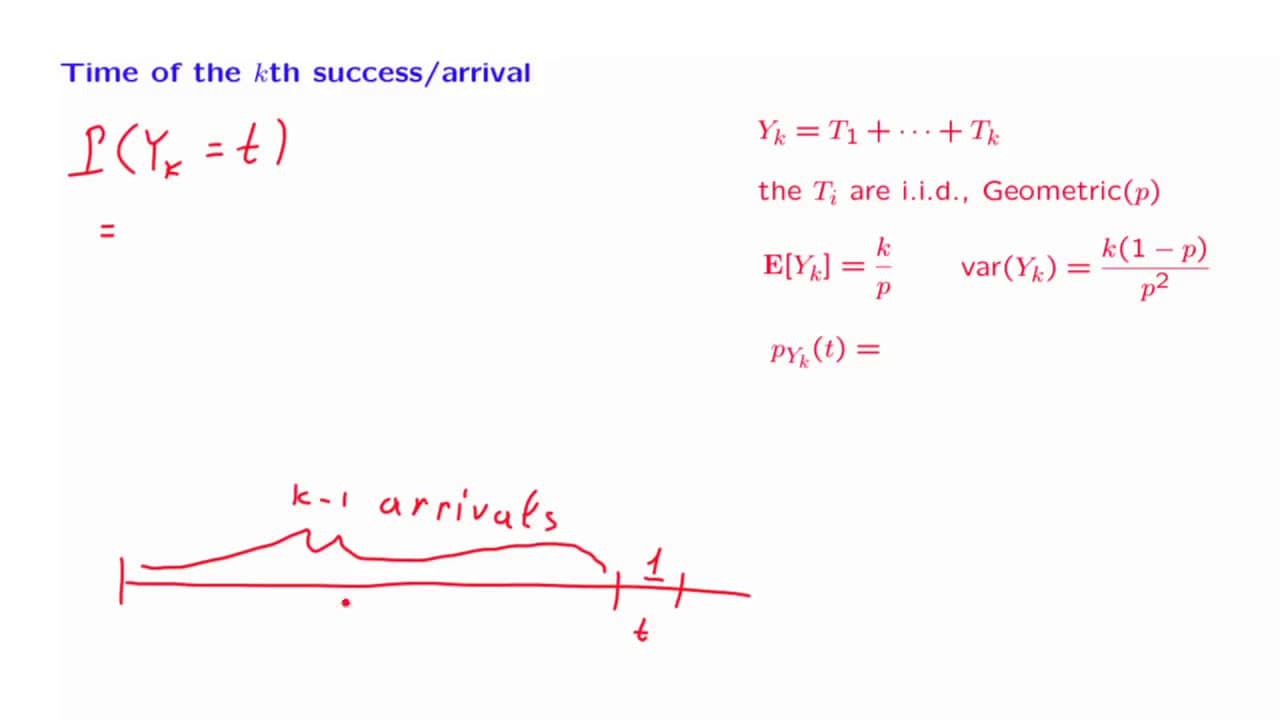
The time of the kth arrival, denoted as Yk, is the sum of k inter-arrival times. It represents the time it takes for the kth success to occur in the process.
Q: How are the inter-arrival times related to the time of arrivals in a Bernoulli process?
The inter-arrival times, denoted as Ti, are the differences between two consecutive arrival times. They follow a geometric distribution with parameter p and are independent of each other.
Q: How can the expected value of Yk be calculated?
The expected value of Yk is calculated by summing the expected values of the inter-arrival times (Ti). Each Ti has a mean of 1/p, so the mean of Yk is k/p.
Q: How can the PMF of Yk be determined?
The PMF of Yk can be determined using the binomial formula. It involves calculating the probability of k-1 arrivals in t-1 time slots (following a binomial distribution) multiplied by the probability of an arrival at time t (which is equal to p).
Summary & Key Takeaways
-
The time of the kth arrival in a Bernoulli process is denoted as Yk and is calculated as the sum of inter-arrival times.
-
The inter-arrival times, denoted as Ti, are geometrically distributed with parameter p and are independent of each other.
-
The expected value of Yk is k/p, the variance of Yk is calculated by adding the variances of the inter-arrival times, and the PMF of Yk can be determined using the binomial formula.
Read in Other Languages (beta)
Share This Summary 📚
Summarize YouTube Videos and Get Video Transcripts with 1-Click
Try YouTube Summary with ChatGPT & Claude or YouTube Transcript Generator
Explore More Summaries from MIT OpenCourseWare 📚


Summarize YouTube Videos and Get Video Transcripts with 1-Click
Try YouTube Summary with ChatGPT & Claude or YouTube Transcript Generator