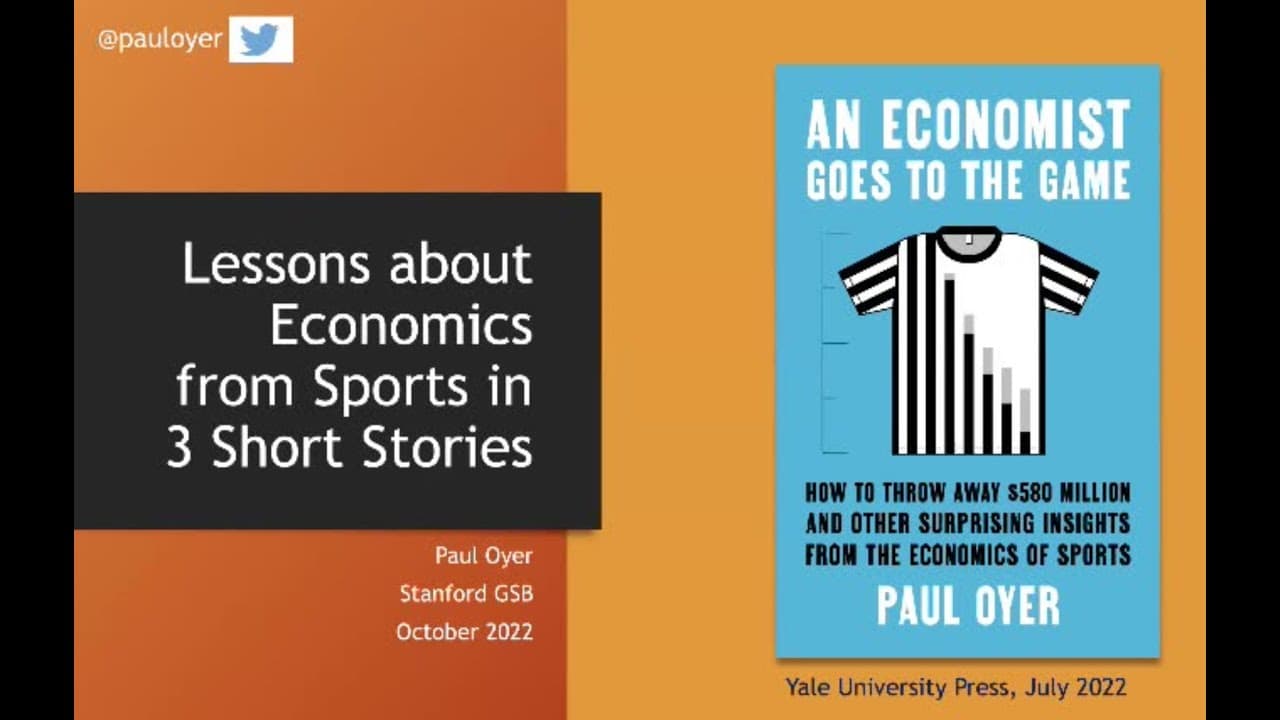
“An Economist Goes to the Game,” Professor Paul Oyer & Alumni Athlete Guests
TL;DR
This comprehensive analysis explores the economics of sports and the decision-making processes of athletes, focusing on topics such as contracts, incentives, game theory, and the future of athlete earnings.
Transcript
[FOREIGN] >> Change lives. >> Change organizations. >> [FOREIGN] >> [FOREIGN] >> [FOREIGN] >> Change the world. [MUSIC] >> Professor Paul Oyer is the Mary and Rankine Van Anda Professor of Economics at the Stanford Graduate School of Business. He's Senior Associate Dean for Academic Affairs, and a Senior Fellow at the Stanford Institute for Economi... Read More
Key Insights
- 😀 Athletes face trade-offs between financial incentives, guarantees, and risk. Negotiating contracts requires finding a balance that motivates performance while accounting for potential injuries and uncertain future earnings.
- 👀 Sports contracts have evolved in response to technological advancements and increased income inequality. Technology has made it easier to watch and follow top athletes, increasing their value and income potential.
- 👾 Strategies from game theory, such as mixed strategies in penalty kicks or deceptive moves in volleyball, are used by athletes to maximize success and keep opponents guessing.
- 😉 Factors like state taxes can play a role in athletes' decisions, but there are other critical considerations, including team fit, winning potential, and overall career trajectory.
Install to Summarize YouTube Videos and Get Transcripts
Explore YouTube Video Summarizer or Get YouTube Transcript Extractor
Questions & Answers
Q: How do athletes and teams negotiate contracts to balance financial incentives and risk?
Athletes, with the help of their agents, negotiate contracts that balance upfront money and guarantees with incentives, taking into account the risk of injury and the potential for future earnings.
Q: How does game theory affect decision-making in sports, such as in penalty kicks in soccer or spiking the ball in volleyball?
Game theory principles come into play when athletes have to strategically decide their moves based on the anticipated responses of their opponents. The goal is to maximize their chances of success while keeping the opposition guessing.
Q: How do factors like state taxes and location impact decision-making for athletes?
Athletes may consider state taxes and location as secondary factors in their decision-making process, alongside other important aspects such as team fit, longevity, winning potential, and role within the team.
Q: What are the future trends in athlete earnings and investing in athletes as securities?
The future of athlete earnings may involve innovative approaches such as companies offering financial support to athletes in exchange for a share of their future income. However, there are moral hazard concerns and unintended consequences that need to be carefully addressed to ensure fairness and incentives to perform.
Summary & Key Takeaways
-
The content discusses the motivations behind writing a book about the economics of sports, including personal experiences as an athlete and fan.
-
The first chapter argues that investing in youth sports should be done for fun rather than as a financial strategy, as there is no clear evidence of long-term benefits.
-
The analysis also delves into the economics of professional sports contracts, including negotiating guaranteed money, incentives, and the trade-off between risk and financial reward.
Read in Other Languages (beta)
Share This Summary 📚
Summarize YouTube Videos and Get Video Transcripts with 1-Click
Try YouTube Summary with ChatGPT & Claude or YouTube Transcript Generator
Explore More Summaries from Stanford Graduate School of Business 📚




Summarize YouTube Videos and Get Video Transcripts with 1-Click
Try YouTube Summary with ChatGPT & Claude or YouTube Transcript Generator