How to Calculate Characteristic Impedance and Propagation Constant in Microwave Lines
TL;DR
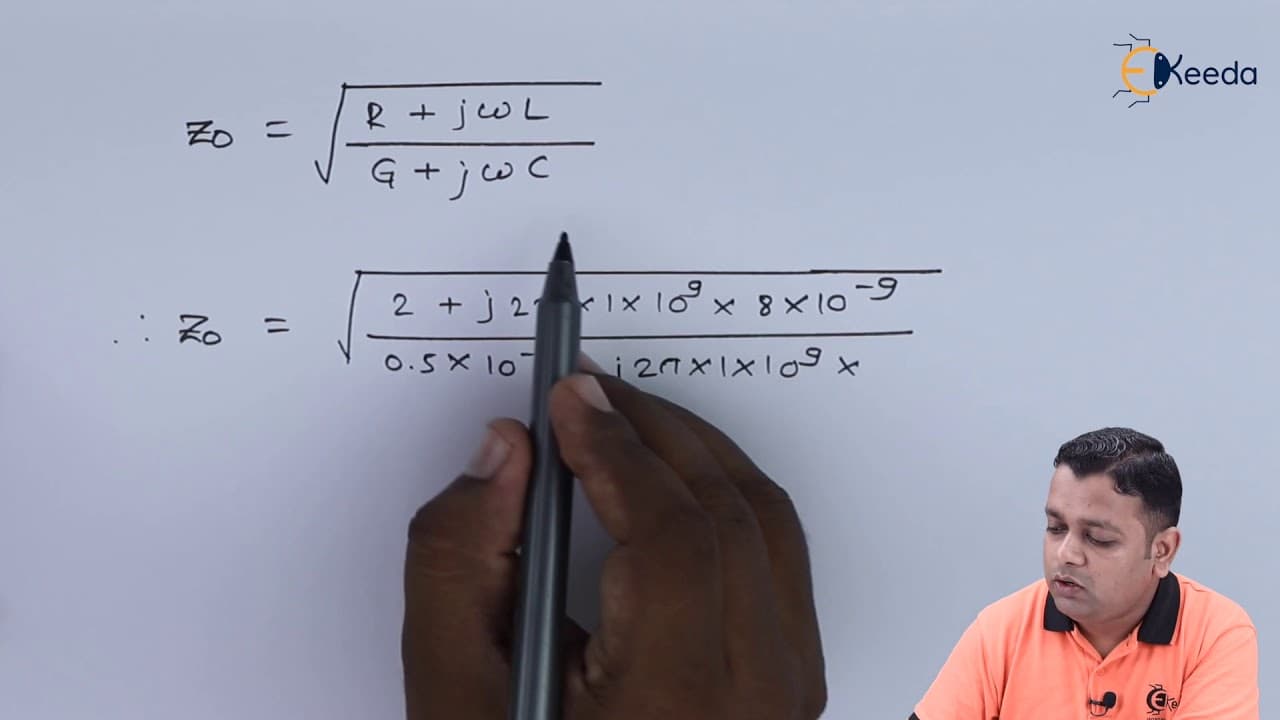
To calculate characteristic impedance and propagation constant in microwave transmission lines, substitute the given lumped parameters (resistance, conductance, inductance, capacitance, and frequency) into the transmission line equations. This yields the values in both polar and complex forms, which are essential for analyzing signal behavior in microwave circuits.
Transcript
click the Bell icon to get latest videos from akira hello parents I welcome you all here we are with chapter 7 of microwave engineering where the microwave transmission lines we are addressing so up till now into the subject we have generated the microwave energy based one to the vacuum tube platform with the principle of velocity modulation and th... Read More
Key Insights
- 🫥 Microwave engineering chapter 7 focuses on solving transmission line problems for characteristic impedance and propagation constant.
- 🫥 The problem statement provides lumped parameters for resistance, conductance, frequency, inductance, and capacitance in the transmission line.
- ❓ Calculations involve substituting the given values into equations to determine characteristic impedance and propagation constant.
- 📡 Characteristic impedance and propagation constant are crucial for understanding signal behavior in microwave circuits.
- 🫥 Microwave engineering concepts involve dealing with transmission lines, impedance matching, and signal propagation characteristics.
- 🎨 Accurate calculations of characteristic impedance and propagation constant are essential for designing efficient microwave circuits.
- 📡 Understanding transmission line equations aids in optimizing signal transmission and minimizing signal losses in microwave systems.
Install to Summarize YouTube Videos and Get Transcripts
Explore YouTube Video Summarizer or Get YouTube Transcript Extractor
Questions & Answers
Q: What are the key parameters provided in the transmission line problem statement for calculation?
The problem statement gives lumped parameters like resistance, conductance, frequency, inductance, and capacitance per unit length for the transmission line.
Q: How is the characteristic impedance calculated in the transmission line problem?
The characteristic impedance is calculated using the formula involving resistance, inductance, conductance, and capacitance per unit length, which are substituted into the equation to determine the impedance.
Q: What is the significance of calculating the characteristic impedance in microwave engineering?
Characteristic impedance determines the behavior of the transmission line and plays a crucial role in efficiently transferring microwave energy without reflections, aiding in proper signal transmission.
Q: Why is the propagation constant important in microwave transmission lines?
The propagation constant signifies the rate at which electromagnetic waves propagate along the transmission line, affecting signal attenuation and phase shifts, crucial for signal integrity in microwave circuits.
Summary & Key Takeaways
-
Microwave engineering chapter 7 delves into solving transmission line problems for characteristic impedance and propagation constant calculations.
-
The problem statement provides lumped parameters like resistance, conductance, frequency, inductance, and capacitance to solve the transmission line equations.
-
By substituting the given values into the transmission line equations, characteristic impedance and propagation constant are calculated in polar and complex domains.
Read in Other Languages (beta)
Share This Summary 📚
Summarize YouTube Videos and Get Video Transcripts with 1-Click
Try YouTube Summary with ChatGPT & Claude or YouTube Transcript Generator
Explore More Summaries from Ekeeda 📚





Summarize YouTube Videos and Get Video Transcripts with 1-Click
Try YouTube Summary with ChatGPT & Claude or YouTube Transcript Generator