State space analysis | ZIR | Unit step i/p | Part-1/2 | CS | Control Systems | Lec-123
TL;DR
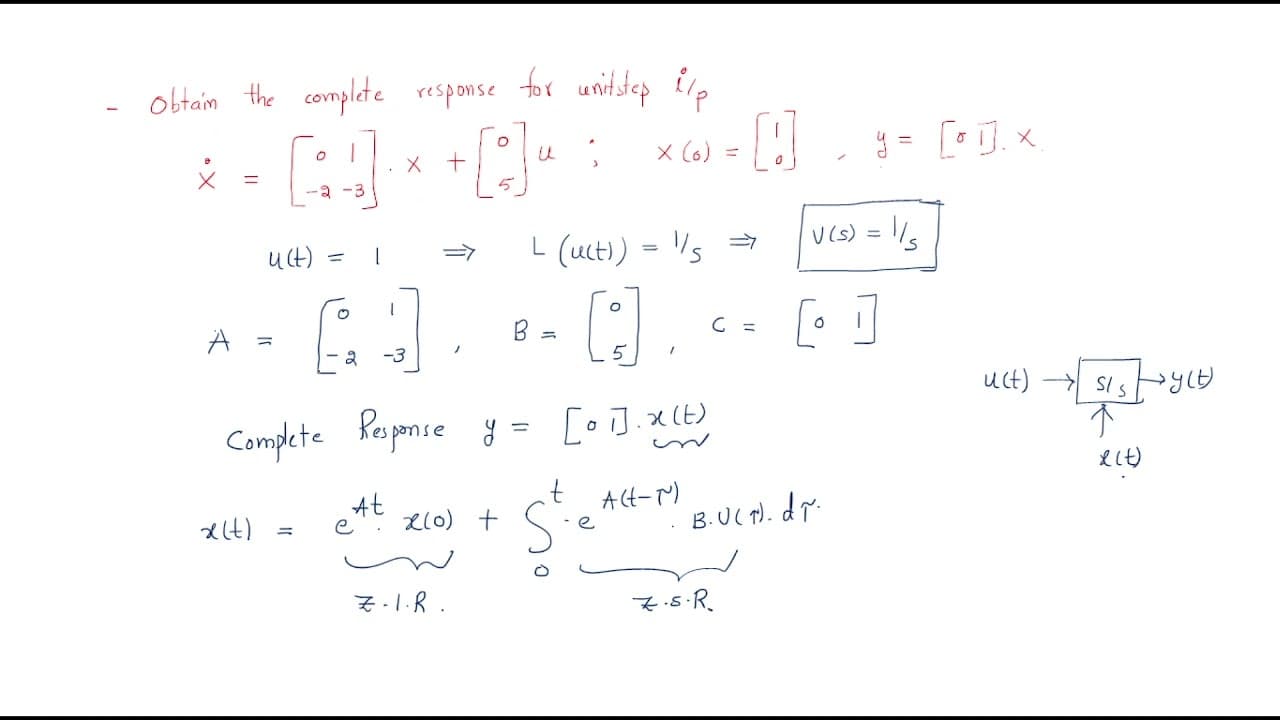
This session discusses obtaining the complete response for a unit step input using Laplace transformation.
Transcript
hello everyone in this session we will discuss the another problem the problem is obtain the complete response for unit step input so he he given the input also that he mentioned the input is unit step so the input is is u of t and whatever laplace transform of input lapses transform of input unistep input so input is simply u of t equal to 1 and l... Read More
Key Insights
- 🔠 A unit step input serves as a standard test input in control system analysis, revealing system dynamics.
- ⌛ The Laplace transformation is essential for converting time-domain differential equations into algebraic equations in the s-domain.
- 0️⃣ Understanding zero input and zero state responses enhances comprehension of overall system behavior under both initial conditions and external inputs.
- 👾 Matrix operations play a pivotal role in deriving system responses and are foundational in state-space analysis.
- 🍉 The e^(At) term captures the natural evolution of states in linear systems, crucial for stability analysis.
- 😑 Partial fraction decomposition is a powerful technique for simplifying expressions in actuarial analysis of system responses.
- 0️⃣ The initial condition significantly influences both zero input response and overall system dynamics.
Install to Summarize YouTube Videos and Get Transcripts
Explore YouTube Video Summarizer or Get YouTube Transcript Extractor
Questions & Answers
Q: What is a unit step input in control systems?
A unit step input is a fundamental signal often used in control systems to test the response of a system. It is defined as an input that is zero for t < 0 and one for t >= 0, typically denoted as u(t). This input helps assess how a system reacts to a sudden change, providing insight into its stability and dynamic behavior.
Q: How is the Laplace transform applied to the unit step input?
The Laplace transform for the unit step input u(t) is calculated as L{u(t)} = 1/s. This transformation simplifies the analysis of linear time-invariant systems by converting differential equations into algebraic equations, enabling easier manipulation and solution of system dynamics in the s-domain.
Q: What are the zero input and zero state responses?
The zero input response refers to the system's behavior when the initial conditions are considered, but no external input is applied. In contrast, the zero state response describes the system's output due solely to external inputs while assuming all initial conditions are zero. Both responses are critical for understanding the complete behavior of a system.
Q: How are the matrices A and B used in this analysis?
The A matrix defines the system dynamics, while the B matrix characterizes how the input affects the state of the system. In the discussion, the specific matrices provided help formulate and solve the state-space representation, allowing for analysis of the output response to a given input.
Q: What is the significance of the expression e^(At) in the solution?
The expression e^(At) represents the state transition matrix that governs how the state of a linear system evolves over time, influenced by its initial state. It is fundamental in determining the zero input response, showing how the system reacts to initial conditions without external inputs through exponential growth or decay behaviors.
Q: Why is partial fraction decomposition used in the analysis?
Partial fraction decomposition simplifies complex rational expressions into simpler fractions, which can be more easily transformed back into the time domain from the Laplace domain. This method facilitates finding the inverse Laplace transform, allowing for straightforward computation of the system's response over time.
Q: What role does the initial condition x(0) play in the response analysis?
The initial condition x(0) is crucial as it sets the starting state of the system, influencing the system's response over time. It directly affects the zero input response, determining how the system behaves before any external inputs are applied, thus shaping the overall output.
Summary & Key Takeaways
-
The content explains how to obtain the complete response of a system given a unit step input using the Laplace transform and matrix operations.
-
It details the procedure to derive the zero input response through the Laplace inverse and discusses the necessary matrices and operations involved in the process.
-
The session introduces the concepts of zero input and zero state responses, setting up a foundation for further exploration in future sessions.
Read in Other Languages (beta)
Share This Summary 📚
Summarize YouTube Videos and Get Video Transcripts with 1-Click
Try YouTube Summary with ChatGPT & Claude or YouTube Transcript Generator