What Is the Tracking Theory of Knowledge?
TL;DR
The tracking theory of knowledge asserts that true belief involves not just accuracy but also the ability to track truth across different scenarios. This theory introduces 'sensitivity' and 'adherence' requirements, ensuring that if something is false, one wouldn't believe it, and if true, one would consistently hold that belief. It addresses challenges presented by the causal theory and has significant implications for understanding knowledge.
Transcript
My name is Jeff Pin. I teach philosophy at Northern Illinois University and today I'm going to talk about the tracking theory of knowledge. Let's start by reviewing the causal theory of knowledge which Jennifer Nagel discussed in the previous video in this series. The causal theory invented by Alvin Goldman says that to know a fact is to have a bel... Read More
Key Insights
- The causal theory of knowledge, proposed by Alvin Goldman, suggests that knowledge is based on a belief caused by the fact itself. However, it faces challenges from environmental factors that don't causally impact belief.
- The tracking theory, developed by Fred Dretske and Robert Nozick, addresses issues in the causal theory by introducing counterfactual conditions to determine if a belief tracks the truth.
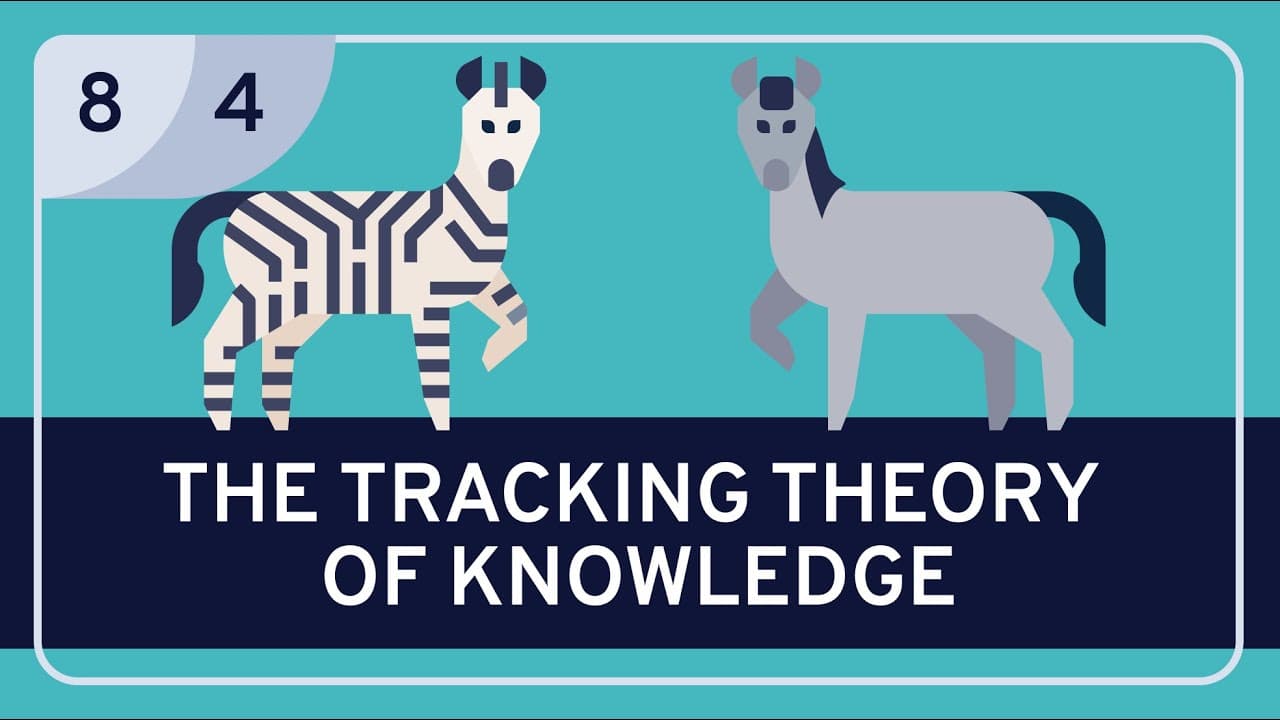
- In an honest zoo, if there weren't a zebra in front of you, you wouldn't believe there was, highlighting the sensitivity requirement of tracking theory.
- The adherence requirement of the tracking theory ensures that if something is true, the belief in it would persist, avoiding random guesses.
- The tracking theory is related to reliabilism but resolves issues like the lottery ticket scenario by emphasizing belief sensitivity to truth.
- Challenges to the tracking theory include cases where it seems too demanding, such as the alien grandmother example, which questions the sensitivity requirement.
- The closure principle states that knowing P and knowing P implies Q should allow one to know Q. The tracking theory initially conflicts with this principle, but newer versions attempt to reconcile them.
- Despite challenges, the tracking theory is valued for capturing the essence of knowledge as the ability to discern truth across various circumstances.
Install to Summarize YouTube Videos and Get Transcripts
Explore YouTube Video Summarizer or Get YouTube Transcript Extractor
Questions & Answers
Q: What is the main idea behind the tracking theory of knowledge?
The tracking theory of knowledge, proposed by Fred Dretske and Robert Nozick, is designed to address shortcomings in the causal theory by introducing counterfactual conditions that determine if a belief tracks the truth. It emphasizes two key requirements: sensitivity, where a belief would not be held if it were false, and adherence, where a belief would be held if it were true. This approach aims to ensure that knowledge involves the ability to discern truth across different scenarios.
Q: How does the tracking theory differ from the causal theory of knowledge?
The causal theory of knowledge, proposed by Alvin Goldman, suggests that knowledge arises from beliefs caused by the facts themselves. However, it struggles with environmental factors that don't causally impact belief. In contrast, the tracking theory introduces counterfactual conditions, emphasizing the need for beliefs to track truth across different scenarios. This involves sensitivity and adherence requirements, which address weaknesses in the causal theory by ensuring beliefs are not only true but also reliable under varied conditions.
Q: What are the sensitivity and adherence requirements in the tracking theory?
In the tracking theory, the sensitivity requirement ensures that if a belief is false, one would not hold it, meaning the belief is sensitive to the truth. The adherence requirement ensures that if a belief is true, one would hold it, meaning the belief adheres to the truth. These requirements help distinguish between merely having a true belief and actually knowing something, ensuring that knowledge involves the ability to discern truth across various scenarios.
Q: What challenges does the tracking theory face?
The tracking theory faces challenges including cases where it seems too demanding, such as the alien grandmother example. This example questions the sensitivity requirement, as the grandmother's belief about her grandson's health wouldn't change even if he were ill. Another challenge is its initial incompatibility with the closure principle, which states that knowing P and knowing P implies Q should allow one to know Q. These challenges have prompted revisions to the theory to address these issues.
Q: How does the tracking theory handle the lottery ticket scenario?
The tracking theory addresses the lottery ticket scenario by emphasizing the sensitivity requirement. In this scenario, one might believe a lottery ticket is a loser based on odds, but the belief isn't sensitive to the truth. If the ticket were a winner, one would still believe it's a loser. Thus, the tracking theory correctly implies that one doesn't know the ticket is a loser, highlighting the importance of sensitivity in distinguishing knowledge from mere belief.
Q: What is the closure principle and how does it relate to the tracking theory?
The closure principle posits that if one knows P and knows that P implies Q, then one should also know Q. The original tracking theory, as formulated by Dretske and Nozick, conflicts with this principle, as it allows for scenarios where one knows P but not Q, even if P implies Q. This conflict arises because a belief in Q might not track the truth. Despite this, newer versions of the tracking theory attempt to reconcile with the closure principle, acknowledging its importance in epistemology.
Q: Why do some epistemologists find value in the tracking theory despite its challenges?
Despite its challenges, many epistemologists find value in the tracking theory because it captures the essence of knowledge as the ability to discern truth across various circumstances. By emphasizing sensitivity and adherence requirements, the theory offers a nuanced approach to understanding knowledge, distinguishing it from mere true belief. It provides a framework for addressing complex epistemological issues, such as skepticism and the closure principle, making it a valuable contribution to philosophical discussions on knowledge.
Q: How have proponents of the tracking theory addressed its initial incompatibility with the closure principle?
Proponents of the tracking theory have addressed its initial incompatibility with the closure principle by developing new versions that respect this principle. Cherylyn Roush, for example, has proposed a 'tracking with closure' theory, which aims to reconcile the tracking theory's emphasis on sensitivity and adherence with the closure principle's requirement that knowing P and knowing P implies Q should allow one to know Q. These efforts reflect ongoing attempts to refine the tracking theory, ensuring its relevance and applicability in epistemological discussions.
Summary & Key Takeaways
-
The tracking theory of knowledge, developed by Fred Dretske and Robert Nozick, aims to improve upon the causal theory by focusing on counterfactual conditions that ensure beliefs track the truth. This theory introduces sensitivity and adherence requirements to differentiate between knowing and merely having a true belief.
-
The sensitivity requirement ensures that if a belief is false, one would not hold it, while the adherence requirement ensures that if a belief is true, one would hold it. These requirements address issues like the lottery ticket scenario and the closure principle, which the original tracking theory struggled with.
-
Challenges to the tracking theory include cases where it appears too demanding, such as the alien grandmother example. Despite this, the theory remains influential in epistemology for its ability to capture the essence of knowledge as discerning truth in various scenarios.
Read in Other Languages (beta)
Share This Summary 📚
Summarize YouTube Videos and Get Video Transcripts with 1-Click
Try YouTube Summary with ChatGPT & Claude or YouTube Transcript Generator
Explore More Summaries from Wireless Philosophy 📚
Summarize YouTube Videos and Get Video Transcripts with 1-Click
Try YouTube Summary with ChatGPT & Claude or YouTube Transcript Generator