The Terrifying Theory Scientists Don’t Even Want to Talk About
TL;DR
CTMU proposes the universe as a self-simulation within a universal mind.
Transcript
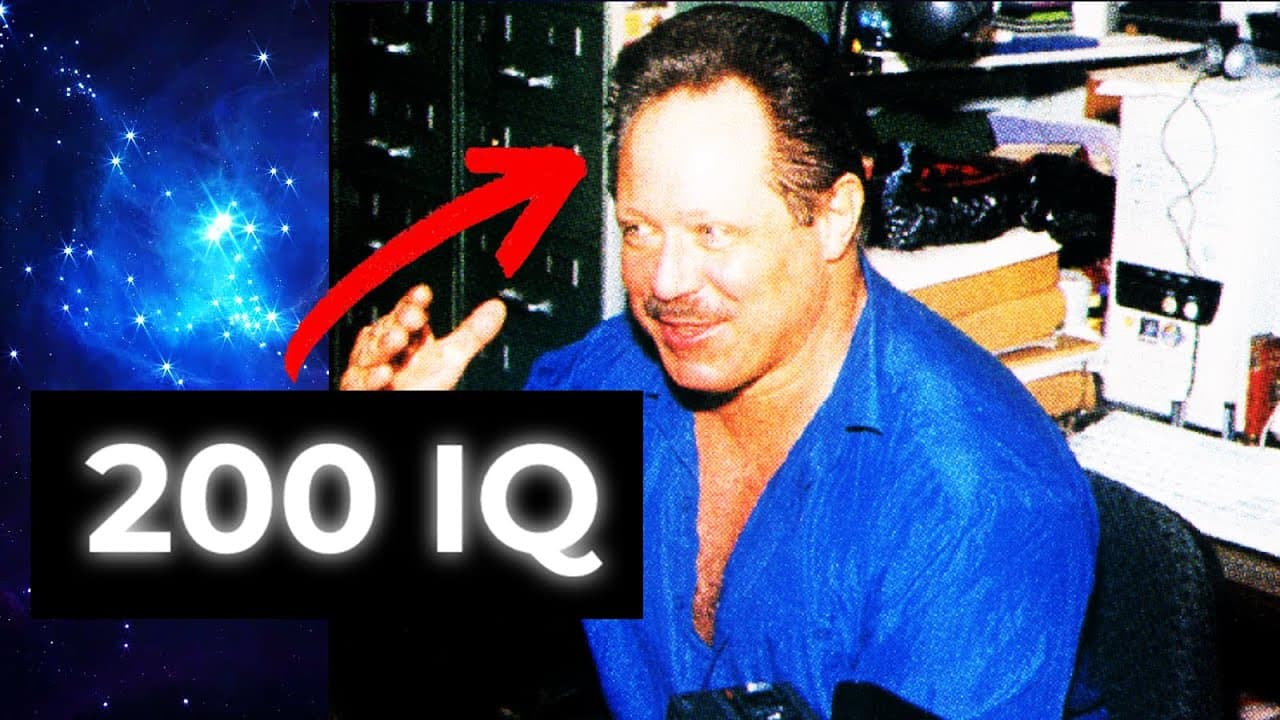
what if I told you that the most complete and advanced theory of reality was written by a guy you've probably never heard of Christopher Langan came up with the ctmu the cognitive theoretic model of the universe a theory of reality that described the universe as a self- simulation occurring in the universal mind when he was a teenager livin... Read More
Key Insights
- Christopher Langan developed the CTMU, a theory combining physical and logical perspectives of the universe, proposing it as a self-simulation.
- Langan's theory challenges traditional academic views, suggesting that human perception shapes reality, making us active participants.
- The CTMU posits that the universe intelligently self-organizes, merging probabilistic and deterministic rules through a process called t-recursion.
- Quantum mechanics supports CTMU's idea of a participatory universe, where observation plays a crucial role in reality's structure.
- The theory suggests that human observers are essential for the universe's existence, aligning with Wheeler's participatory anthropic principle.
- CTMU proposes a holographic universe, where reality is a projection from a deeper metaphysical reality, challenging classical physics.
- The theory redefines gravity as a result of the universe's will, aligning with the anthropic principle of observer necessity.
- CTMU emphasizes human beings' integral role in reality, proposing a new worldview where spiritual and scientific realms converge.
Install to Summarize YouTube Videos and Get Transcripts
Explore YouTube Video Summarizer or Get YouTube Transcript Extractor
Questions & Answers
Q: What is the CTMU theory?
The CTMU, or Cognitive-Theoretic Model of the Universe, is a theory developed by Christopher Langan that combines physical and logical perspectives to propose that the universe is a self-simulation occurring within a universal mind. It challenges traditional academic views by suggesting that human perception shapes reality, making us active participants rather than passive observers.
Q: How does the CTMU challenge traditional academic views?
The CTMU challenges traditional academic views by proposing that reality is not solely based on physical observations but is also shaped by human perception and cognition. It suggests that humans are active participants in reality's structure, and the universe self-organizes intelligently, merging probabilistic and deterministic rules, which contradicts the deterministic view of classical physics.
Q: What role does human perception play in the CTMU?
In the CTMU, human perception is crucial as it shapes reality. The theory suggests that we are not passive observers but active participants in the universe's structure. Our perception, cognition, and emotions contribute to how we experience reality, and our observations play a vital role in collapsing potentiality into actual events, aligning with quantum mechanics' participatory universe concept.
Q: How does the CTMU relate to quantum mechanics?
The CTMU relates to quantum mechanics by supporting the idea of a participatory universe, where observation is integral to reality's structure. It aligns with the concept that quantum events exist in potentiality until observed, and human observers play a crucial role in collapsing this potentiality into reality, thus actively participating in the universe's structure and dynamics.
Q: What is the significance of the participatory anthropic principle in the CTMU?
The participatory anthropic principle in the CTMU suggests that human-like observers are necessary for the universe's existence. It aligns with Wheeler's idea that observers collapse potentiality into reality, making the universe appear finely tuned for life. This principle emphasizes the essential role of human perception and cognition in structuring reality, highlighting our active participation in the universe.
Q: How does the CTMU redefine gravity?
The CTMU redefines gravity by suggesting it results from the universe's will, recognizing when gravitational force is needed between massive objects. This view aligns with the anthropic principle that the universe must exist in a way that allows for observers. It challenges the classical view that gravity is merely a curvature of spacetime, proposing instead that it's a necessary construct for the universe's self-organization.
Q: What is the CTMU's view on the holographic universe?
The CTMU views the universe as a holographic projection from a deeper metaphysical reality, aligning with the idea that our perceived reality is a simulation. This challenges classical physics by suggesting that what we experience as reality is a display of a more profound structure, where physical events are projections from a two-dimensional boundary, such as black holes, into our three-dimensional perception.
Q: How does the CTMU propose a new worldview?
The CTMU proposes a new worldview by emphasizing human beings' integral role in reality, suggesting that we are essential agents within the cosmic self-simulation. It merges spiritual and scientific realms, challenging materialistic views and proposing that human perception and cognition are crucial for the universe's structure. This worldview highlights the necessity of human observers and their active participation in constructing and organizing reality.
Summary & Key Takeaways
-
Christopher Langan's CTMU theory proposes that the universe is a self-simulation within a universal mind, combining physical and logical perspectives. It challenges traditional academic views by suggesting that human perception shapes reality, making us active participants rather than passive observers.
-
The CTMU posits that the universe intelligently self-organizes, merging probabilistic and deterministic rules through a process called t-recursion. It aligns with quantum mechanics, suggesting a participatory universe where observation plays a crucial role in structuring reality.
-
The theory redefines gravity and proposes a holographic universe, challenging classical physics. It emphasizes the integral role of human beings in reality, suggesting a new worldview where spiritual and scientific realms converge, highlighting the necessity of human observers for the universe's existence.
Read in Other Languages (beta)
Share This Summary 📚
Summarize YouTube Videos and Get Video Transcripts with 1-Click
Try YouTube Summary with ChatGPT & Claude or YouTube Transcript Generator