Simple MNIST Convnet - Keras Code Examples
TL;DR
A detailed explanation of Keras code examples for deep learning concepts.
Transcript
welcome to the henry ai labs walkthrough of keras code examples keras has provided 56 code examples implementing popular ideas in deep learning this ranges from the basics such as simple mnist and imdb text classification all the way to cutting-edge research ideas such as knowledge distillation supervised contrastive learning and transformers we'll... Read More
Key Insights
- 👤 Keras offers an accessible platform for deep learning with numerous built-in datasets, facilitating easy data loading essential for beginners and experienced users alike.
- 😅 Preprocessing techniques such as dimension expansion and one-hot encoding are crucial steps when preparing data for deep learning models, particularly for tasks involving multiple classes.
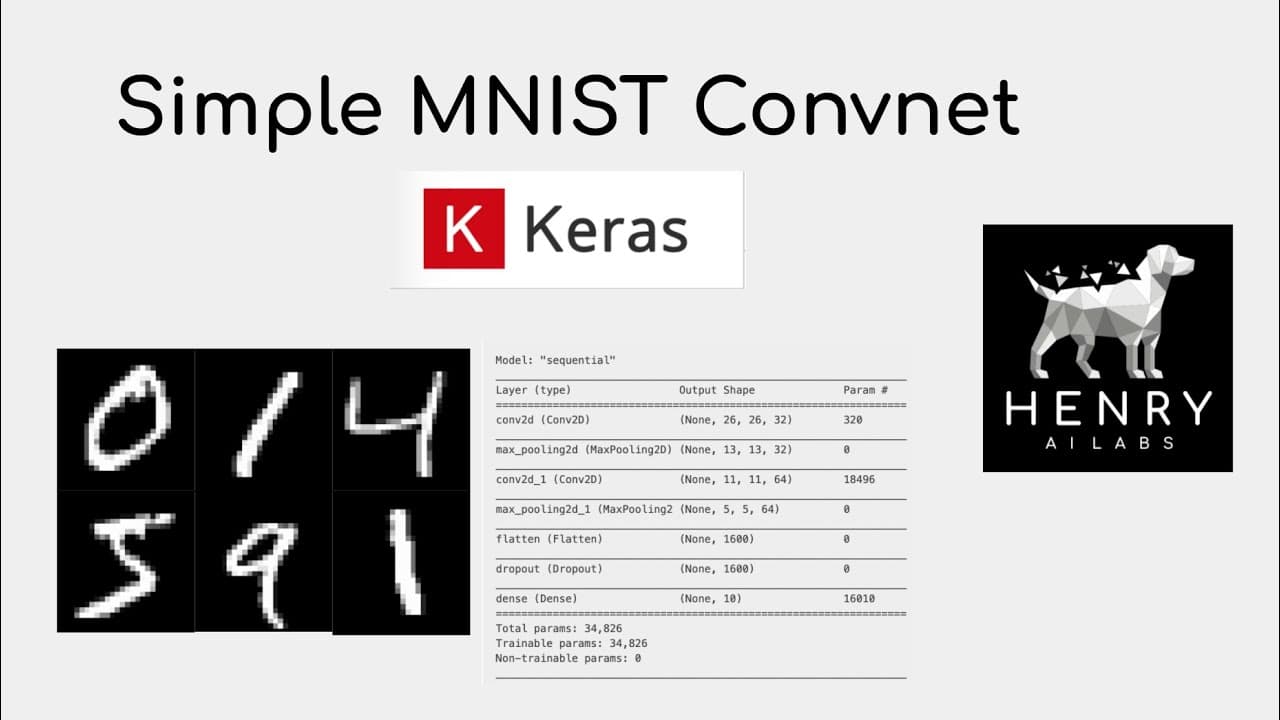
- ✊ The architecture of convolutional networks, while being straightforward in this case, showcases the power of filters and pooling layers in extracting relevant features from image data.
- 🍵 The substantial reduction in training time when utilizing GPUs highlights the importance of hardware acceleration in handling deep learning tasks.
- 👻 Efficient model evaluation in Keras allows for quick performance insights, making it easier to gauge the success of training efforts.
- 💨 Deep learning frameworks like Keras are trending towards user-friendliness through improved APIs and resources, paving the way for broader adoption and experimentation across various domains.
- 👤 The focus on generative models such as variational autoencoders illustrates Keras' versatility, providing users with the tools to explore both discriminative and generative learning paradigms.
Install to Summarize YouTube Videos and Get Transcripts
Explore YouTube Video Summarizer or Get YouTube Transcript Extractor
Questions & Answers
Q: What are some popular deep learning concepts covered in the Keras examples?
The Keras examples feature a wide variety of deep learning concepts, including simple applications like MNIST and IMDB text classification, as well as advanced techniques like knowledge distillation, supervised contrastive learning, and generative models like variational autoencoders and CycleGANs, allowing users to explore both fundamental and cutting-edge areas of deep learning.
Q: How does Keras simplify the process of loading datasets?
Keras simplifies dataset loading by providing built-in datasets that can be easily accessed through simple API calls, like keras.datasets.mnist.load_data(). This approach contrasts with previous methods of manually downloading and processing datasets, making it quicker and easier to get started with training models using popular datasets in both computer vision and NLP.
Q: What preprocessing steps are involved in preparing the MNIST dataset for a neural network?
Preparing the MNIST dataset involves a few key steps: first, loading the dataset and expanding its dimensions using numpy to fit the required input shape of the model. The dataset's labels are then converted into categorical one-hot encoded format, which is essential for categorical cross-entropy loss calculation during model training, ensuring the model can handle multi-class classification tasks effectively.
Q: Can you explain the architecture of the convolutional neural network used for MNIST?
The architecture comprises two convolutional layers with 32 filters using 3x3 convolutions, each paired with max-pooling to reduce spatial dimensions. Following flattening, a dropout layer is applied, and finally, a dense layer directs the output to ten classes. The model has approximately 34,826 parameters, most concentrated in the second convolutional layer, allowing for effective representation learning from input images.
Q: What is the impact of using a GPU instead of a CPU for model training in Keras?
Utilizing a GPU significantly accelerates the training process in Keras; in the example, running a convolutional network for MNIST on a CPU takes about 33 seconds, while switching to a GPU reduces this time to just one second. This improvement is crucial when handling larger datasets or more complex models, as it enhances productivity and experiment iteration speeds in deep learning development.
Q: How are the accuracy and loss evaluated for the trained model in Keras?
After training, the model's performance can be evaluated using Keras's succinct syntax, which allows for direct assessment of the model on previously loaded test data. By normalizing the test images and one-hot encoding the labels, the evaluation outputs a loss score and accuracy score, demonstrating the model's effectiveness. In the case of MNIST, the trained model achieves an impressive accuracy of 99%.
Q: What kind of datasets can be loaded using Keras's built-in functionality?
Keras provides access to several academic datasets through its built-in functionalities, notably popular ones like MNIST for handwritten digits, CIFAR-10 for object recognition in images, and text datasets like IMDB for sentiment analysis. These datasets serve as fundamental resources for both learners and practitioners in deep learning, enabling straightforward experimentation and model training.
Summary & Key Takeaways
-
The content provides a comprehensive walkthrough of Keras code examples, focusing on various deep learning methodologies, from basic datasets like MNIST to more complex topics like knowledge distillation and transformers.
-
Key functionalities of Keras are explored, including easy dataset loading, image preprocessing, and the structure of convolutional neural networks, highlighting how to efficiently build and train models.
-
The video emphasizes the speed advantages of running models on GPUs compared to CPUs, showcases the syntax for model evaluation, and discusses the significant accuracy achievements using the MNIST dataset.
Read in Other Languages (beta)
Share This Summary 📚
Summarize YouTube Videos and Get Video Transcripts with 1-Click
Try YouTube Summary with ChatGPT & Claude or YouTube Transcript Generator
Explore More Summaries from Connor Shorten 📚
Summarize YouTube Videos and Get Video Transcripts with 1-Click
Try YouTube Summary with ChatGPT & Claude or YouTube Transcript Generator