Final Temperature Calorimetry Practice Problems - Chemistry
TL;DR
When two samples of water at different temperatures are mixed, the final temperature is determined by the mass and initial temperatures of the water samples. The heat released and absorbed during the process is equal, and the temperature calculation can be done using the specific heat capacity equation.
Transcript
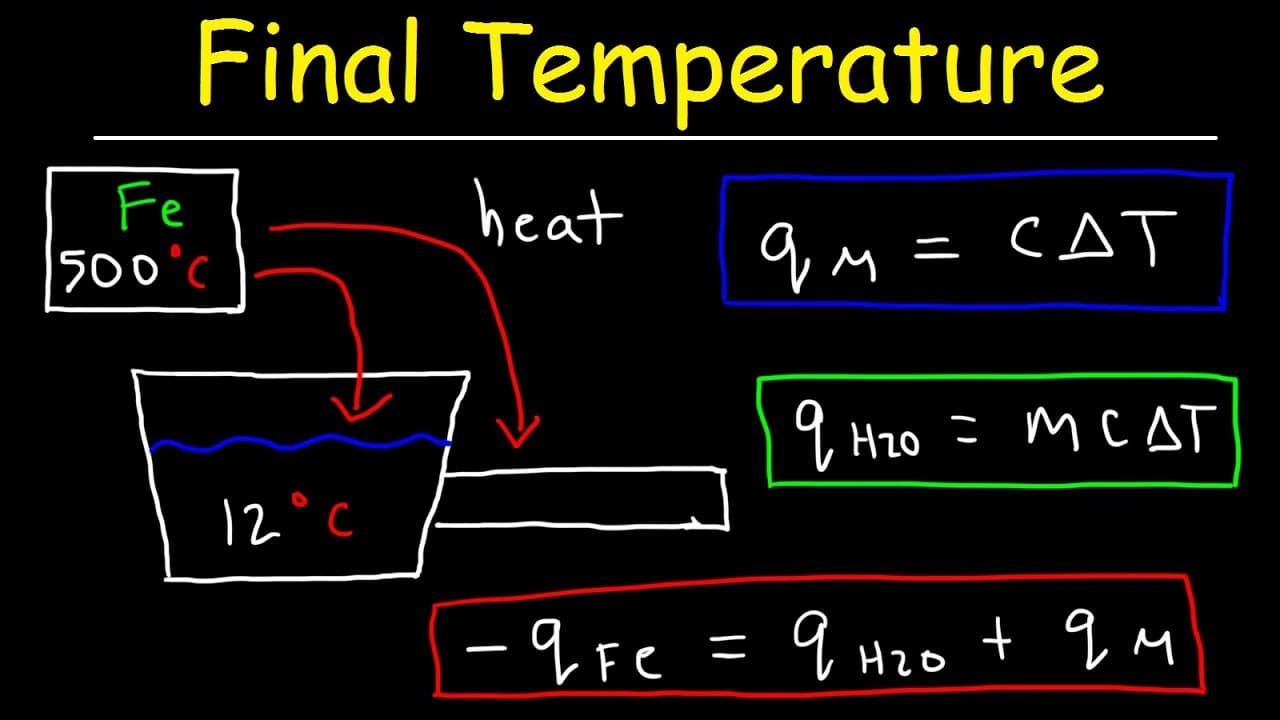
consider this problem if we mix two samples of water at different temperatures what's going to be the final temperature of the mixture so let's say if we have 50 grams of water at 25 degrees celsius and then we're going to pour some hot water to it let's say the hot water is at 90 degrees celsius when these two are mixed what's going to be the fina... Read More
Key Insights
- ❓ The final temperature of a mixture depends on the initial temperatures and masses of the substances involved.
- 🥵 In heat transfer problems, the heat released and absorbed must be equal to achieve thermal equilibrium.
- 🥵 Specific heat capacity equations are used to calculate heat absorbed or released during temperature changes.
- 💆 The mass of the substances involved influences the final temperature.
- 🥵 Heat capacities differ based on the units used (gram, mole, or Celsius).
- 🥵 The temperature calculation can be done by setting up equations that balance the heat released and absorbed by the substances.
- 🥵 Insulation, such as a styrofoam cup, can prevent heat from being radiated to the environment, minimizing heat loss.
Install to Summarize YouTube Videos and Get Transcripts
Explore YouTube Video Summarizer or Get YouTube Transcript Extractor
Questions & Answers
Q: How does the mass of the water samples influence the final temperature?
The mass of the water samples plays a role in determining the final temperature. If one sample has a higher mass, the final temperature will be closer to the initial temperature of that sample.
Q: What factors need to be considered when setting up equations for heat transfer problems?
To set up equations correctly, it is important to identify the substances releasing and absorbing heat energy. Mapping out the transfer of heat energy will help in determining the proper equation.
Q: What is the importance of using the specific heat capacity equation in temperature calculations?
The specific heat capacity equation allows for the calculation of heat absorbed or released during a temperature change. By considering the specific heat capacity and mass of the substances involved, the final temperature can be determined.
Q: How does the heat capacity equation differ from the specific heat capacity equation?
The heat capacity equation, q = c * Δt, is used when the heat capacity of a substance is given. It does not include the mass term, unlike the specific heat capacity equation, which is q = mcΔt.
Summary & Key Takeaways
-
When mixing two samples of water at different temperatures, the final temperature lies between the initial temperatures of the samples.
-
The final temperature is influenced by the mass of the water samples. If one sample has more mass, the final temperature will be closer to the initial temperature of that sample.
-
In heat transfer problems, it is important to identify the substances releasing and absorbing heat energy and set up the appropriate equations to calculate the final temperature.
Read in Other Languages (beta)
Share This Summary 📚
Summarize YouTube Videos and Get Video Transcripts with 1-Click
Try YouTube Summary with ChatGPT & Claude or YouTube Transcript Generator
Explore More Summaries from The Organic Chemistry Tutor 📚




Summarize YouTube Videos and Get Video Transcripts with 1-Click
Try YouTube Summary with ChatGPT & Claude or YouTube Transcript Generator