12.4 Solve the System of Equations
TL;DR
The video discusses how to solve a system of equations to find the accelerations and tension in a physics problem.
Transcript
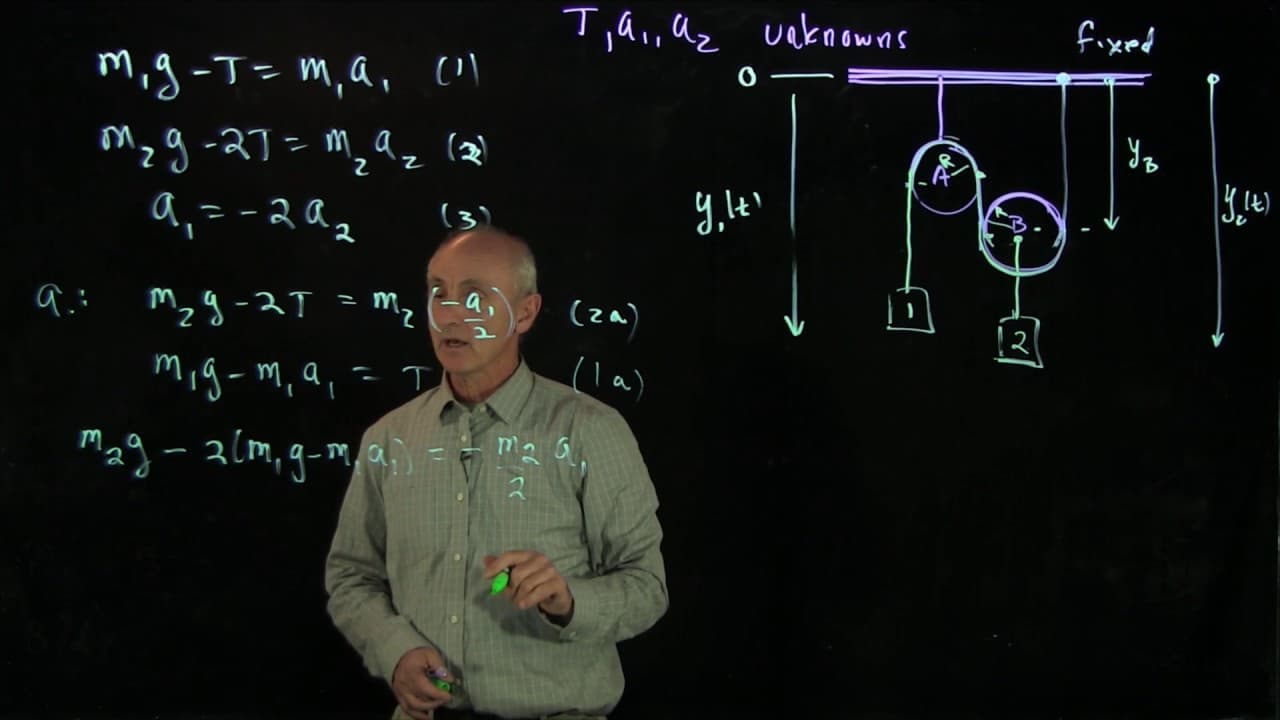
We are now in position to find the accelerations a1, a2, and the tension, because we have Newton's second law and our constraint condition for the acceleration. Let's recall the equations that we found. We had m1g minus t was m1a1. And we had m2g minus 2t was equal to m2a2. And we also had the condition-- constraint condition between the accelerati... Read More
Key Insights
- ❓ The problem involves a system of three equations that connect the accelerations and tension.
- ❓ The constraint condition provides a relationship between the accelerations.
- ❓ By selecting an equation and solving for an unknown, the other unknowns can be determined.
- 😑 The derived expression for a1 can be used to find the values of a2 and t.
- 🔨 Algebraic manipulation and substitution are essential tools in solving the system.
- 🤩 The key to solving the system lies in strategically selecting an equation and unknown to solve for initially.
- 🍉 The solution process involves making substitutions and collecting terms to isolate the desired unknown.
Install to Summarize YouTube Videos and Get Transcripts
Explore YouTube Video Summarizer or Get YouTube Transcript Extractor
Questions & Answers
Q: What is the purpose of the constraint condition in the problem?
The constraint condition relates the accelerations a1 and a2 by stating that a1 is negative two times a2. This condition helps establish the relationship between the accelerations and simplifies the system of equations.
Q: How does the video suggest solving for a1 in the system of equations?
The video suggests selecting equation 1 as the backbone equation and expressing t in terms of a1 in equation 1a. Then, the value of t can be substituted into equation 2a to obtain an equation solely in terms of a1.
Q: What is the expression for a1 derived in the video?
The expression for a1 is (2m1g - m2g) / (2m1 + m2/2). This expression represents the acceleration of object 1 in the problem.
Q: Can the expressions for a2 and t be easily determined using the derived expression for a1?
Yes, once the expression for a1 is obtained, it can be substituted back into the original equations to find the values of a2 and t. This can be done by either substitution or algebraic manipulation.
Summary & Key Takeaways
-
The video introduces a system of three equations that relate the accelerations (a1 and a2) and tension (t) in a problem.
-
By manipulating the equations and making substitutions, the video shows how to solve for a specific unknown, such as a1.
-
Once one unknown is determined, it becomes easier to find the values of the remaining unknowns (a2 and t).
Read in Other Languages (beta)
Share This Summary 📚
Summarize YouTube Videos and Get Video Transcripts with 1-Click
Try YouTube Summary with ChatGPT & Claude or YouTube Transcript Generator
Explore More Summaries from MIT OpenCourseWare 📚



Summarize YouTube Videos and Get Video Transcripts with 1-Click
Try YouTube Summary with ChatGPT & Claude or YouTube Transcript Generator