L8.3 Deriving the connection formulae
TL;DR
A professor explains the connections formula and the WKB approximation for linear potentials in quantum mechanics.
Transcript
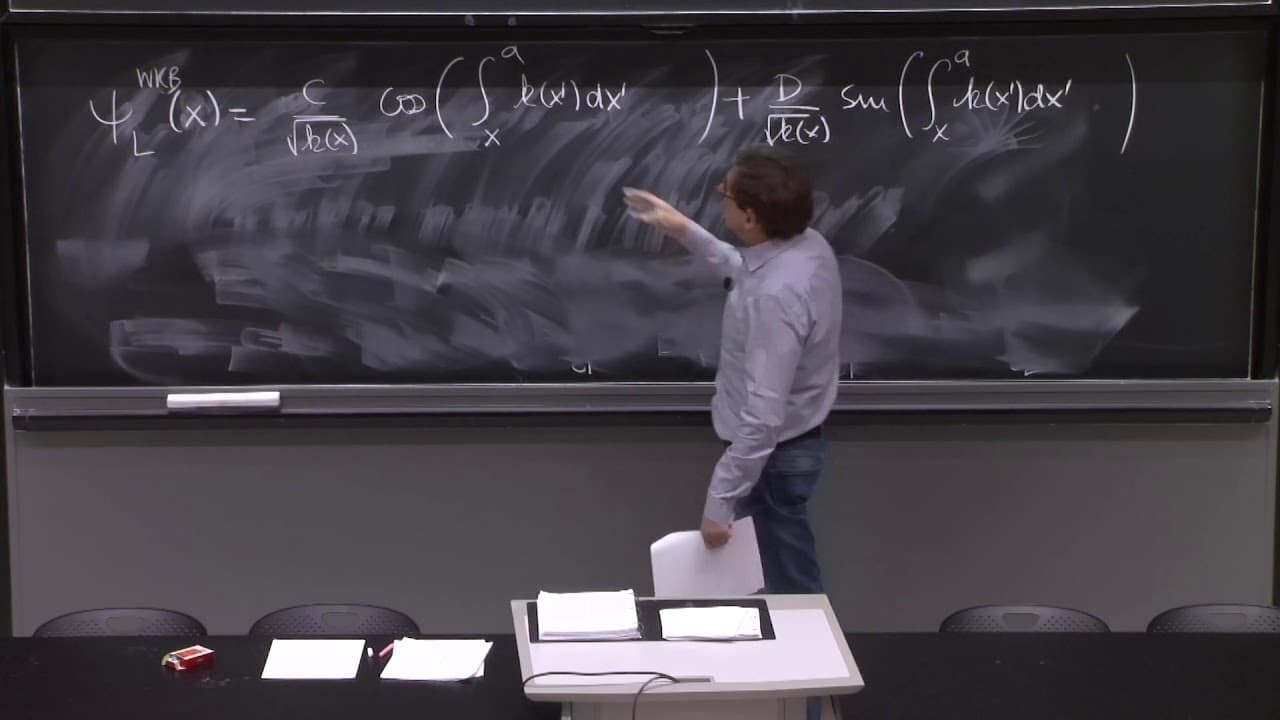
PROFESSOR: So here it is, connections formula, connection. So we'll take a situation as follows. Here is the point of x equals a. I'll put just a here. Here is the x-axis. And I will imagine that I have a linear potential. So we have a linear potential here. Why do we imagine a linear potential? It's because the thing we would really kind of want t... Read More
Key Insights
- 🦾 The WKB approximation is a useful method for solving the Schrodinger equation for certain potentials in quantum mechanics.
- 😥 In the WKB approximation, a linear potential is assumed to approximate the behavior near the turning point.
- ❓ The connections formula is used to match the WKB solution to the exact solution for a given potential.
Install to Summarize YouTube Videos and Get Transcripts
Explore YouTube Video Summarizer or Get YouTube Transcript Extractor
Questions & Answers
Q: What is the purpose of using a linear potential in the WKB approximation?
The linear potential is used because it allows us to analyze the behavior of the solution near the turning point, where the WKB approximation fails. By assuming a linear potential, we can find valid WKB solutions in both the left and right regions of the potential.
Q: What is the significance of the "connection" in the connections formula?
The connection refers to the matching condition that connects the WKB solution to the exact solution for a given potential. This connection ensures that both solutions describe the same physical system and allows us to use the WKB approximation to approximate the exact solution.
Q: How does the WKB solution on the right differ from the one on the left?
The WKB solution on the right describes the behavior of the wavefunction in the region where the potential is greater than the energy. It consists of a decaying exponential and a growing exponential term. The WKB solution on the left, on the other hand, describes the behavior of the wavefunction in the region where the potential is less than the energy and is written in terms of sines and cosines.
Q: What is the relationship between the coefficients in the WKB solution and the matching condition?
The coefficients in the WKB solution, specifically 2a and c, are related by the matching condition. If we choose a=1, then c=2, and this ensures that the WKB solution matches the exact solution for a linear potential.
Summary & Key Takeaways
-
The WKB approximation is an approximation method used in quantum mechanics to solve the Schrodinger equation for certain types of potentials.
-
The professor introduces the concept of a linear potential and explains why it is used in the WKB approximation.
-
The professor derives the WKB solutions for both the right and left regions of the potential and simplifies them using some calculations.
-
The professor shows how the WKB solution can be connected to the exact solution for a linear potential using a matching condition.
Read in Other Languages (beta)
Share This Summary 📚
Summarize YouTube Videos and Get Video Transcripts with 1-Click
Try YouTube Summary with ChatGPT & Claude or YouTube Transcript Generator
Explore More Summaries from MIT OpenCourseWare 📚



Summarize YouTube Videos and Get Video Transcripts with 1-Click
Try YouTube Summary with ChatGPT & Claude or YouTube Transcript Generator