Rob Legato: The art of creating awe
TL;DR
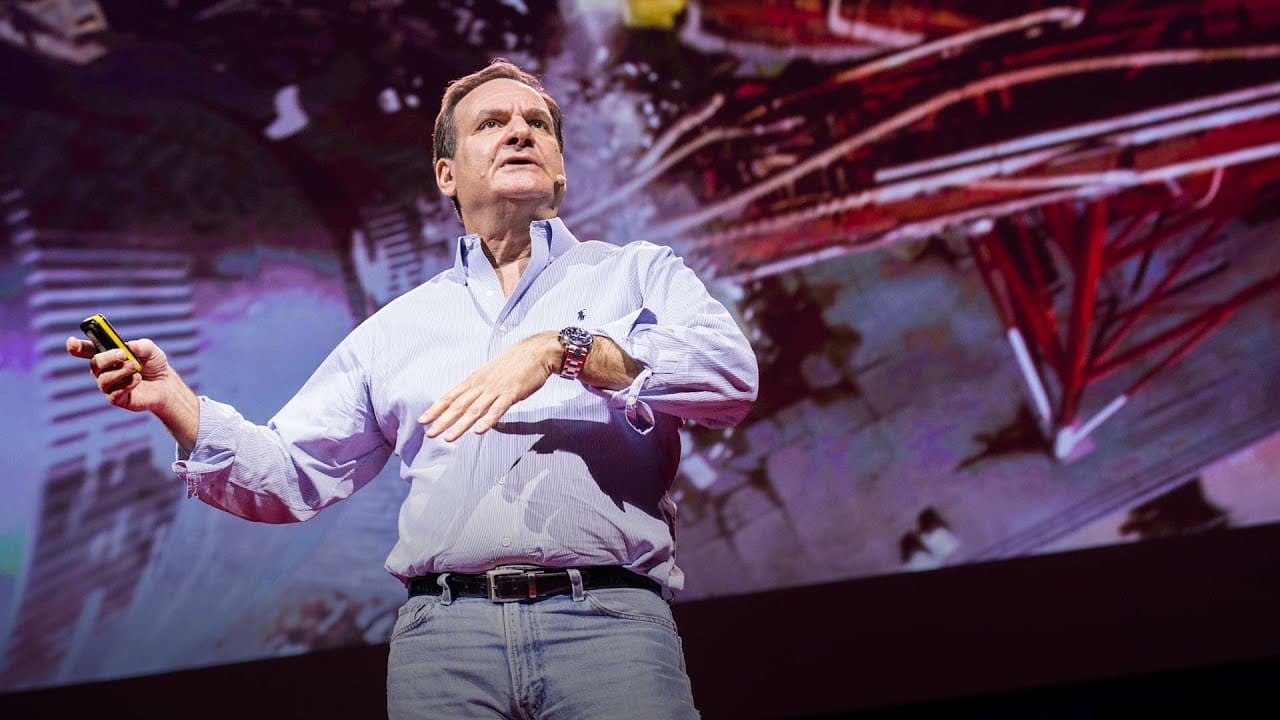
In this TED Talk, visual effects supervisor Rob Legato discusses his experiences working on films like Apollo 13, Titanic, and Hugo and how our brains perceive and remember visual information.
Transcript
Translator: Joseph Geni Reviewer: Morton Bast I worked on a film called "Apollo 13," and when I worked on this film, I discovered something about how our brains work, and how our brains work is that, when we're sort of infused with either enthusiasm or awe or fondness or whatever, it changes and alters our perception of things. It changes what we s... Read More
Key Insights
- 🎥 Our brains are influenced by emotions like enthusiasm and awe, which can alter our perception and memory of things.
- 🚀 When recreating a Saturn V launch for the film "Apollo 13," the focus shifted from replicating what people saw to replicating what they remembered.
- 🔎 Our collective memories and emotions can shape our perception of footage, leading to camera moves and combined shots that didn't actually occur.
- 🎞 The power of illusion in film is demonstrated through the creation of false footage in "Apollo 13" and the use of film tricks in "Titanic."
- 🌊 In "Titanic," the transition from the intact ship to the wreck is achieved by shifting the audience's attention and playing with their expectations.
- 🎭 The film "Hugo" explores the concept of film illusions and uses a one-shot technique to immerse the audience in the protagonist's world.
- 🎥 By creating the illusion of movement through camera techniques, a leg brace getting caught on a train in "Hugo" was achieved without risking danger.
- 🌟 The success of a shot can be attributed to the skillful execution behind the scenes, even if the audience doesn't realize the contributions of specific individuals.
Install to Summarize YouTube Videos and Get Transcripts
Explore YouTube Video Summarizer or Get YouTube Transcript Extractor
Questions & Answers
Q: What did the filmmaker discover about how our brains work while working on the film "Apollo 13"?
The filmmaker discovered that when our brains are infused with enthusiasm, awe, or fondness, it alters our perception of things. It changes what we see and what we remember.
Q: What experiment did the filmmaker conduct to determine what people remembered about the Saturn V launch?
The filmmaker brought a group of people into a projection room and played stock footage of the Saturn V launch. He then asked them what they remembered and what shots were memorable to them.
Q: What did the filmmaker learn from the experiment about what should be replicated in the film?
The filmmaker learned that instead of replicating what people saw, he should replicate what they remembered. The emotions and collective memories associated with the footage shaped people's perception of the launch.
Q: How did the NASA consultant react to the recreated shots of the rocket launch?
The NASA consultant, who was an astronaut and was involved in the Apollo 15 mission, pointed out that the way the rockets were designed in the recreated shots was unrealistic and unsafe. He remembered the launch differently and questioned the filmmaker's interpretation.
Q: How did Buzz Aldrin react when he saw the launch footage from "Apollo 13"?
Buzz Aldrin, who was not involved in the film, saw the launch footage and thought it was authentic. He asked Ron Howard where they found the footage and if they could use it in the movie. Aldrin was fooled by the recreated shots and did not realize they were fabricated.
Q: What technique did the filmmaker use to recreate the sinking of the Titanic in the film?
The filmmaker recreated the sinking of the Titanic by filming shots of a model ship being flipped upside down and using smoke to create the illusion. He wanted to capture the haunting quality of the original footage filmed by James Cameron.
Q: How did the filmmaker create the illusion of Sasha Baron Cohen's leg brace getting caught on a moving train in the film "Hugo"?
The filmmaker used a trick identified by Sergei Eisenstein, which involved filming the train not moving and the floor moving to give the illusion of the leg brace getting caught. This created the desired effect of the leg brace appearing stuck on the moving train.
Q: How did the filmmaker create the illusion of a continuous one-shot in the film "Hugo"?
The filmmaker filmed the scene in five separate sets at different times using two different actors. Different camera rigs and techniques were used to seamlessly merge the shots together and give the impression of a continuous shot. The final result was highly praised by reviewers.
Summary & Key Takeaways
-
Our perception and memory of things can be altered by emotions such as enthusiasm, awe, or fondness.
-
When recreating footage for a film, it is more important to replicate what people remember rather than what they actually saw.
-
Visual tricks, such as using a moving camera to make objects appear still, can create realistic illusions in film.
Read in Other Languages (beta)
Share This Summary 📚
Summarize YouTube Videos and Get Video Transcripts with 1-Click
Try YouTube Summary with ChatGPT & Claude or YouTube Transcript Generator
Explore More Summaries from TED 📚




Summarize YouTube Videos and Get Video Transcripts with 1-Click
Try YouTube Summary with ChatGPT & Claude or YouTube Transcript Generator