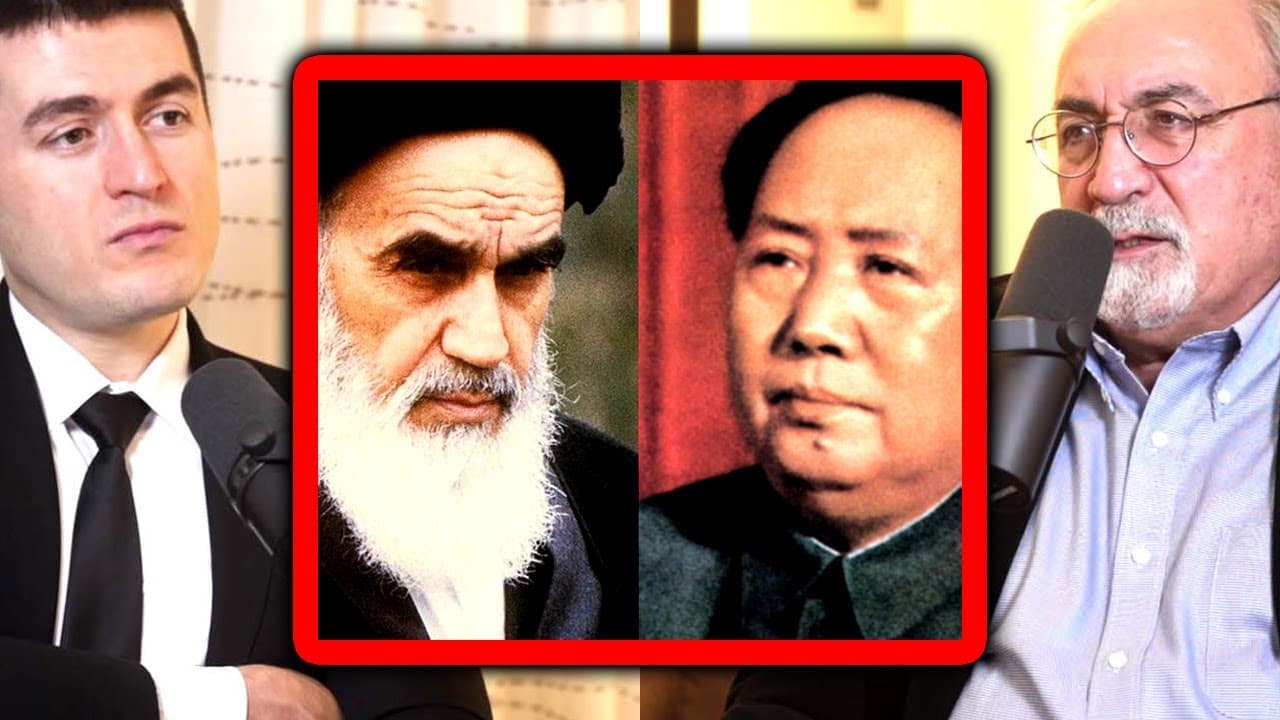
Khomeini vs Mao: The messianic consolidation of power | Abbas Amanat and Lex Fridman
TL;DR
The establishment and consolidation of power in Iran's Revolutionary Guard parallels Stalin's rise to power, but with less brutal tactics.
Transcript
are there some practical games of Power that occurred you know in the way that Stalin took power and held power in the early days was there something like this in terms of the establishment of the Revolutionary guard and all those kinds of stuff yes so it's the the Messianic figure that has some support from the people but uh does he have to crush ... Read More
Key Insights
- 😮 The establishment of the Revolutionary Guard in Iran shows parallels with Stalin's rise to power, although with less brutality.
- 🇨🇳 China's Messianic tradition and Mao's emergence as a Messianic figure offer a comparable context.
- 🇮🇷 The Islamic Revolution in Iran witnessed the destruction of opposing forces, including liberal nationalists, secularists, and guerrilla movements.
- 🎚️ Ayatollah Khomeini's authority as a Messianic figure was elevated to the level of a saintly figure.
- 🪈 The execution of thousands of prisoners by direct order of Ayatollah Khomeini remains a traumatic event in Iranian history.
- 👥 The regime's treatment of minority groups, specifically the Baha'is, reflects fascist tendencies and persecution.
- 👨⚖️ The regime's claim to bring justice and morality through Islam and religion contrasts with the atrocities committed.
Install to Summarize YouTube Videos and Get Transcripts
Explore YouTube Video Summarizer or Get YouTube Transcript Extractor
Questions & Answers
Q: Were there any practical games of power similar to Stalin's rise in the establishment of Iran's Revolutionary Guard?
While the Revolutionary Guard had a Messianic figure with popular support, the level of cruelty was not as severe as in Stalin's Soviet Union. However, the regime did destroy opposing forces during the early years of the Islamic Revolution in Iran.
Q: Was there opposition within the religious establishment in Iran?
Yes, there were various tendencies within the religious establishment, and those opposed to Ayatollah Khomeini faced consequences. Khomeini, as a Messianic figure, had immense authority and became Imam Khomeini.
Q: What was the outcome of a fatwa issued by Ayatollah Khomeini at the end of the Iran-Iraq war?
The fatwa led to the execution of around six to eight thousand prisoners, mostly belonging to political parties, including the left and Marxist groups. This remains a dark part of Iran's history and a trauma for the families involved.
Q: How did the Islamic Republic treat minority groups like the Baha'is?
The regime showed fascist tendencies by persecuting and executing minorities, such as the Baha'is. Their properties were seized, and their rights were taken away. The Baha'i community continues to face discrimination in Iran.
Summary & Key Takeaways
-
The early days of the Revolutionary Guard in Iran involved a Messianic figure supported by the people, but the level of brutality was not as extreme as seen in Stalin's Soviet Union.
-
Similarities can be drawn to China's Messianic tradition and Mao's rise to power.
-
The Islamic Revolution in Iran saw the destruction of opposing forces, including liberal nationalists, secularists, and guerrilla movements.
Read in Other Languages (beta)
Share This Summary 📚
Summarize YouTube Videos and Get Video Transcripts with 1-Click
Try YouTube Summary with ChatGPT & Claude or YouTube Transcript Generator
Explore More Summaries from Lex Clips 📚




Summarize YouTube Videos and Get Video Transcripts with 1-Click
Try YouTube Summary with ChatGPT & Claude or YouTube Transcript Generator