Tabular DI | Data Interpretation | Food grains Produced | Reasoning | Part - 19 | Bharath Kumar
TL;DR
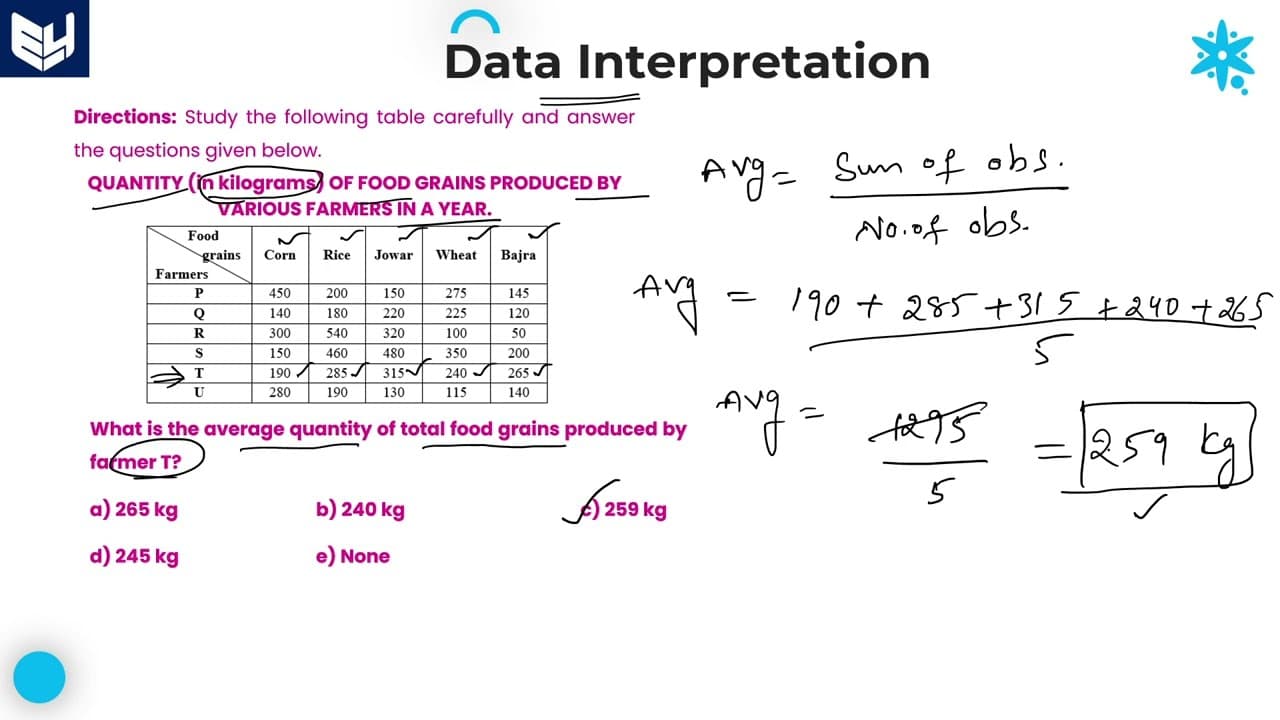
The session covers calculations related to food grain production by various farmers.
Transcript
hi everyone welcome to the session in this session I am continuing tablet date and preparation first of all read the information and based on that you need to solve the questions first of all you need to understand the information which is provided in the question here the information which is provided is the quantity of food food grains produced b... Read More
Key Insights
- 😋 Farmer T produces an average of 259 kg of food grains, highlighting productivity per farmer.
- 😋 Farmer S is identified as the highest producer with 1640 kg of food grains in total.
- 😋 Ratios between different food grain productions provide insights into crop performance and farming effectiveness.
- 🦻 Calculating percentages aids in comparing production capacities of various farmers, emphasizing relative outputs.
- ❓ The session illustrates the importance of accurate data interpretation in agricultural economics.
- 👣 Step-by-step calculations encourage clarity and understanding, ensuring all participants can track the logical process.
- 👻 Knowledge of grain types and their production allows better market positioning and strategic planning among farmers.
Install to Summarize YouTube Videos and Get Transcripts
Explore YouTube Video Summarizer or Get YouTube Transcript Extractor
Questions & Answers
Q: What method is used to calculate the average quantity of food grains produced by farmer T?
To find the average for farmer T, you sum the quantities of corn, rice, joar, wheat, and bajra produced, which are 190, 285, 315, 240, and 265 kg, respectively. The total is 1295 kg. You then divide this sum by the number of food grains (5), yielding an average of 259 kg.
Q: Which farmer produced the highest total quantity of food grains in the year?
After calculating the total production for each farmer, farmer S has the highest quantity, totaling 1640 kg. This surpasses all other farmers, affirming S's status as the top producer among P, Q, R, T, and U.
Q: How is the ratio of corn, rice, and joar to wheat and bajra for farmer U calculated?
For farmer U, the total quantities of corn (280 kg), rice (190 kg), and joar (130 kg) together are summed up. The total for wheat (115 kg) and bajra (140 kg) are also summed. The resulting ratio of corn, rice, and joar to wheat and bajra is 40:17.
Q: What is the difference in wheat production between farmer S and corn production by farmer Q?
To find the difference, we calculate the wheat quantity by farmer S, which is 350 kg, and corn quantity by farmer Q, which is 140 kg. The difference is 350 kg - 140 kg, resulting in a difference of 210 kg.
Q: How do you determine the approximate percentage of rice produced by farmer T in relation to farmer R?
To find the percentage, take the quantity of rice produced by farmer T (285 kg) divided by that produced by farmer R (540 kg), then multiply by 100. This yields approximately 52.77%, which rounds up to about 53%.
Q: Why is understanding the average production important for farmers?
Understanding average production helps farmers assess their output against others, adjust their farming practices as needed, and make informed decisions about resource allocation, crop selection, and market strategies.
Summary & Key Takeaways
-
The session involves analyzing the production of five food grains by six farmers, detailing their quantities in kilograms.
-
Specific questions focus on calculating averages, totals, ratios, and differences in production between different farmers and food grains.
-
The content also emphasizes the step-by-step process of calculating percentages for food grain production.
Read in Other Languages (beta)
Share This Summary 📚
Summarize YouTube Videos and Get Video Transcripts with 1-Click
Try YouTube Summary with ChatGPT & Claude or YouTube Transcript Generator