L7.2 Approximate WKB solutions
TL;DR
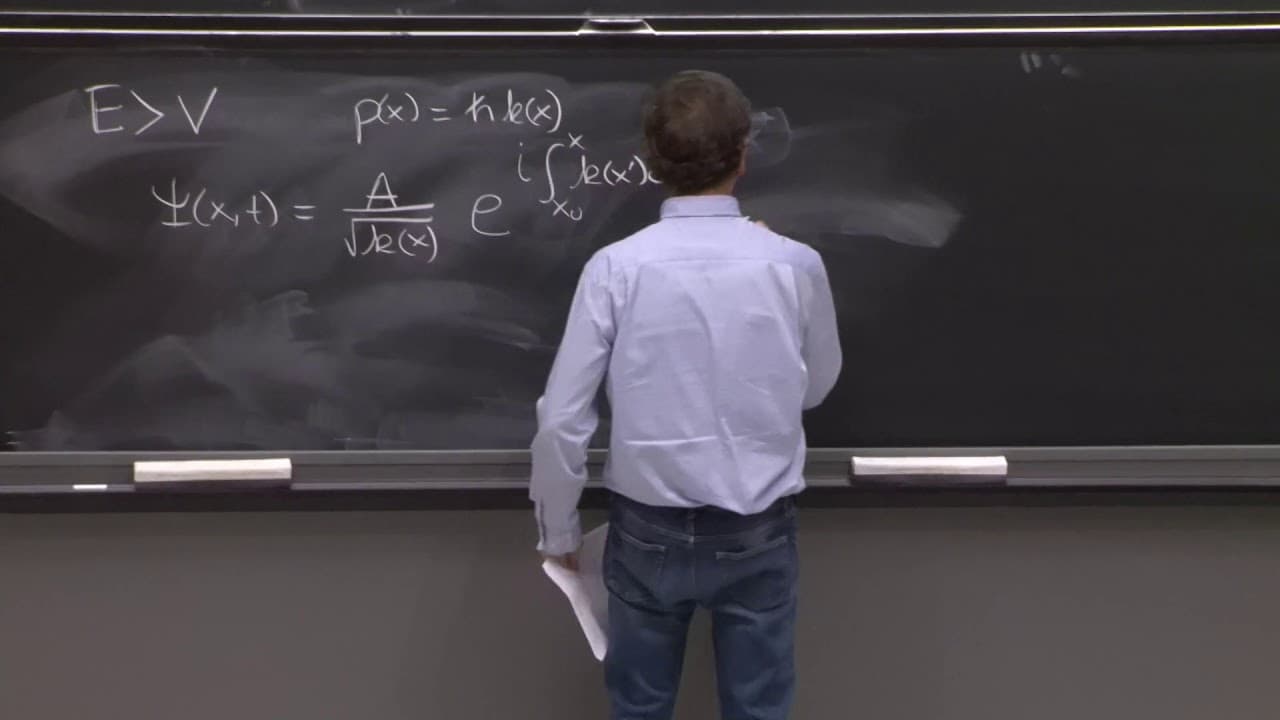
The WKB approximation is a method used to solve certain types of differential equations in quantum mechanics.
Transcript
PROFESSOR: OK. So let's try to solve this. So my classical approximation is about solving these equations. So let's see what we get. Well, the first equation is kind of simple. I think everybody has the temptation there to just take the square root, and that's what we should do, s0 prime is equal to plus minus p of x. And therefore s0 of x is equal... Read More
Key Insights
- 🍉 The WKB approximation relies on solving differential equations in terms of the function p(x).
- 🫚 The first equation involves finding the square root of p(x), while the second equation involves taking the derivative of the logarithm of p(x).
- 💁 The solutions derived using the WKB approximation are of the form e^is, where s is the integral of p(x).
- 👋 The WKB approximation provides a good approximation for the wave function in the classically allowed and classically forbidden regions.
Install to Summarize YouTube Videos and Get Transcripts
Explore YouTube Video Summarizer or Get YouTube Transcript Extractor
Questions & Answers
Q: What is the WKB approximation used for?
The WKB approximation is used to solve differential equations in quantum mechanics.
Q: How do you solve the first equation in the WKB approximation?
The first equation involves finding the square root of the function p(x) and integrating it to obtain the solution.
Q: How do you solve the second equation in the WKB approximation?
The second equation involves taking the derivative of the logarithm of p(x) to find the second solution.
Q: What is the significance of the plus-minus sign in the solutions?
The plus-minus sign represents the ambiguity in the direction of the particle's motion, as it can be moving to the left or right.
Summary & Key Takeaways
-
The WKB approximation is used to solve differential equations in quantum mechanics.
-
The first equation in the WKB approximation involves finding the square root of the function p(x) and integrating it to obtain the solution.
-
The second equation involves taking the derivative of the logarithm of p(x) to find the second solution.
Read in Other Languages (beta)
Share This Summary 📚
Summarize YouTube Videos and Get Video Transcripts with 1-Click
Try YouTube Summary with ChatGPT & Claude or YouTube Transcript Generator
Explore More Summaries from MIT OpenCourseWare 📚



Summarize YouTube Videos and Get Video Transcripts with 1-Click
Try YouTube Summary with ChatGPT & Claude or YouTube Transcript Generator