VHDL Architecture | Declaration | Digital System Design | Lec-02
TL;DR
This content explains the architecture section of VHDL programming and its components.
Transcript
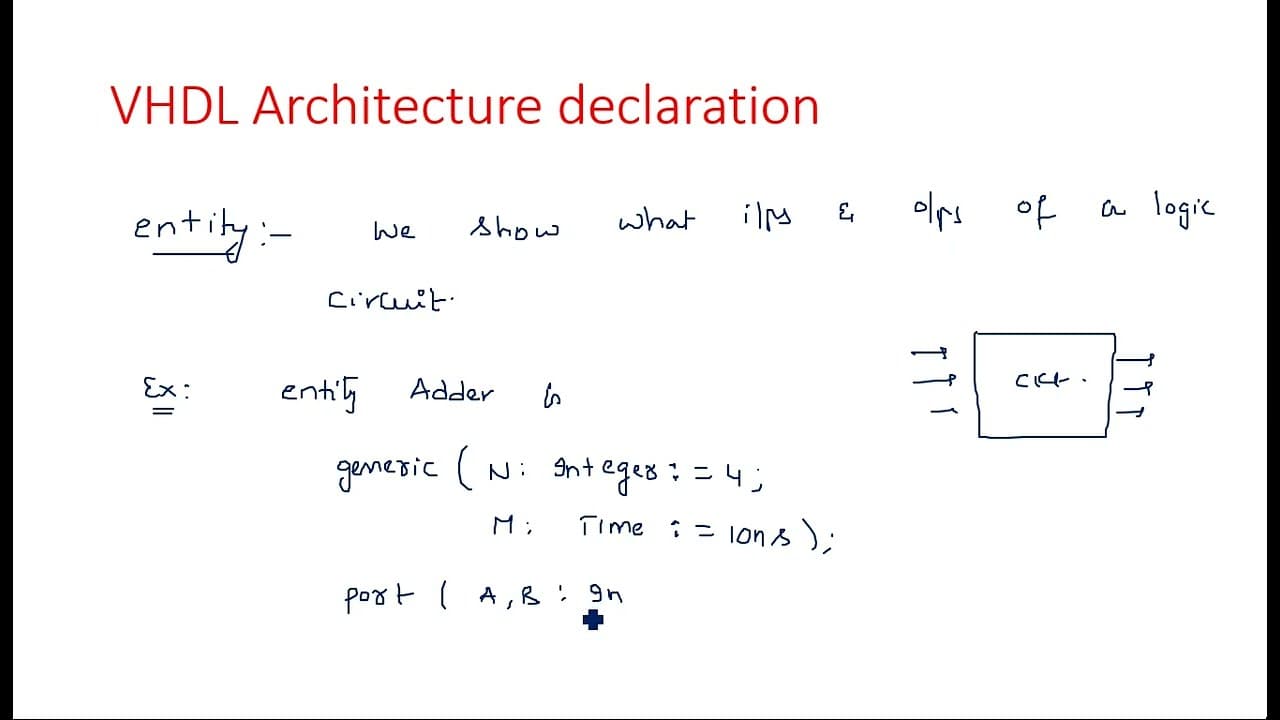
hi everyone in this video I'm going to explain about the architecture of vhdl program architecture is nothing but second part of the programming in the vhdl programming the first part is entity which we have discussed in the previous video entity is the place where we discuss completely about input and output variables suppose for example uh entity... Read More
Key Insights
- 🔠 The architecture section of a VHDL program is critical for defining the interaction between inputs and outputs, ensuring executable logic.
- 🥳 VHDL programs consist of two mandatory parts: the entity, which outlines the interface, and the architecture, which details the implementation.
- 👻 Generics in the entity allow for flexible VHDL code by specifying parameters that can be adjusted while maintaining the same fundamental structure.
- 🕴️ The three abstraction levels in VHDL cater to different programming styles, suited to various design requirements and complexity.
- 💐 Behavioral modeling focuses on the logic’s output as dictated by the inputs, while data flow modeling emphasizes the logical relationships and equations.
- 🎨 Structural modeling involves building complex designs by combining simpler components, allowing for modular and scalable VHDL designs.
- 🫦 Accurate definitions of input/output types (like bit or bit vector) are crucial for successful logic implementation and simulation.
Install to Summarize YouTube Videos and Get Transcripts
Explore YouTube Video Summarizer or Get YouTube Transcript Extractor
Questions & Answers
Q: What is the main purpose of the architecture in a VHDL program?
The architecture serves to describe the behavior of a logic circuit defined in the associated entity. While the entity specifies the inputs and outputs, the architecture outlines how these elements interact, making the VHDL code executable. Without the architecture, the entity alone cannot run, as it lacks operational detail.
Q: What are the three levels of abstraction in VHDL programming?
The three levels of abstraction in VHDL programming are the behavioral model, data flow model, and structural model. The behavioral model is based on truth tables and logical conditions, the data flow model relies on Boolean equations, and the structural model focuses on the internal architecture and connections of components.
Q: How does the entity differ from the architecture in VHDL?
The entity defines the inputs and outputs of a circuit, including types and generics, but does not specify any functionality or behavior. In contrast, the architecture details how inputs and outputs are related and how they interact in a logic circuit, providing the operational context needed to execute the defined functionality.
Q: Why is it important to declare signals and constants in the architecture?
Declaring signals and constants in the architecture is essential because they represent intermediate variables needed to implement the logic circuit's functionality. These declarations provide the necessary parameters for calculations and operations that occur in the concurrent statements, establishing how inputs are processed to produce outputs.
Summary & Key Takeaways
-
The architecture is the second part of a VHDL program, focusing on the behavior and relationships of inputs and outputs, following the entity declaration.
-
An entity specifies input and output variables, including generics and types, while the architecture section outlines how these input and outputs interact in a circuit.
-
There are three levels of abstraction—behavioral, data flow, and structural model—that can be used in VHDL, each defining how the logic circuit's operation can be represented.
Read in Other Languages (beta)
Share This Summary 📚
Summarize YouTube Videos and Get Video Transcripts with 1-Click
Try YouTube Summary with ChatGPT & Claude or YouTube Transcript Generator