Why Are Cold Regions Economically Wealthier?
TL;DR
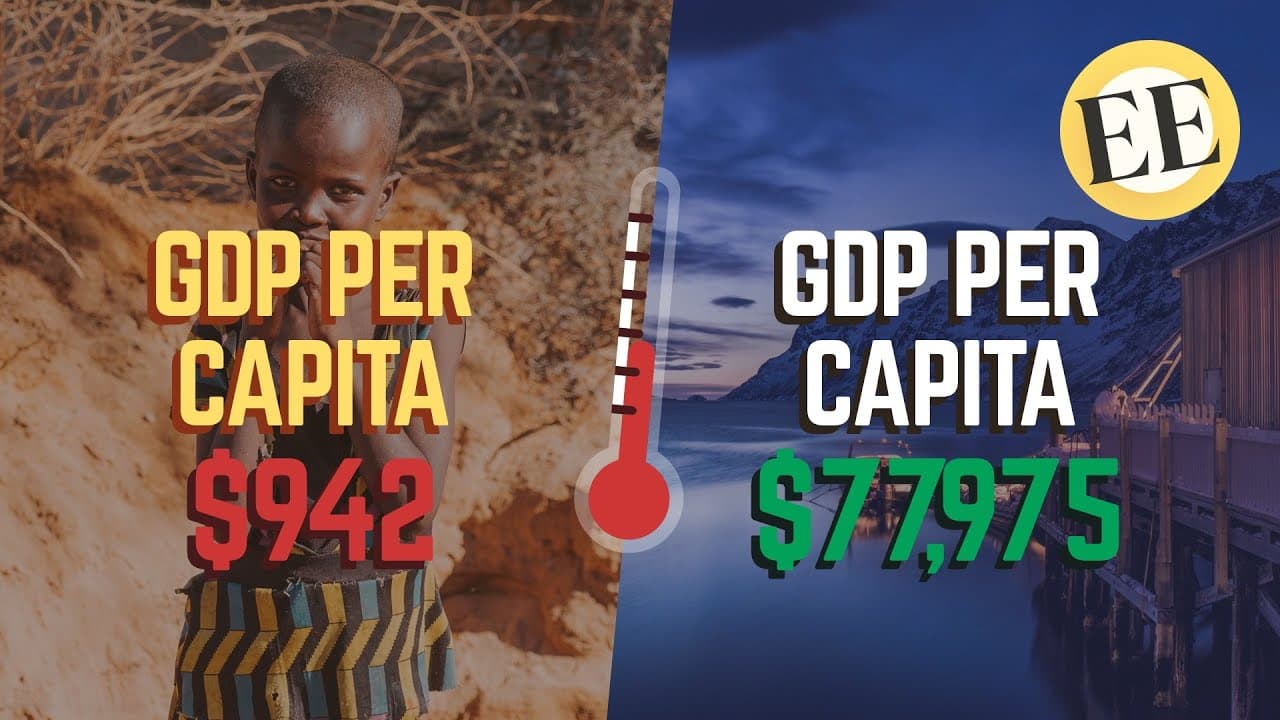
Cold countries tend to be wealthier due to various factors, including historical economic selection and the need for industriousness in harsh climates. Although the correlation between temperature and GDP is not fully understood, it is significant, with colder countries often having higher GDP per capita. This relationship highlights the complex interplay between climate and economic development.
Transcript
When people think about advanced economies they will think of places like, Germany, Switzerland, Norway, Sweden all countries with a very high GDP Per Capita. On the opposite end of the spectrum there are underdeveloped nations, like those in sub-Saharan Africa, Central America, the middle east, and areas of southeast Asia. There are all manner... Read More
Key Insights
- Cold countries generally have higher GDP per capita compared to hot countries.
- A negative correlation exists between average temperature and GDP per capita, with GDP decreasing by $762 per degree Celsius increase.
- R squared value of 0.09 indicates temperature accounts for 9% of GDP variance.
- Economic selection in cold climates fostered industrious societies that stockpiled resources.
- Ancient civilizations in hot regions were once wealthier due to agricultural advantages.
- Modern wealth is driven by industry and innovation rather than agriculture.
- Colder climates may promote social cohesion and less aggressive behavior.
- Outliers like Singapore and resource-rich hot countries challenge the temperature-wealth correlation.
Install to Summarize YouTube Videos and Get Transcripts
Explore YouTube Video Summarizer or Get YouTube Transcript Extractor
Questions & Answers
Q: How does temperature affect GDP per capita?
There is a negative correlation between temperature and GDP per capita, meaning that as the average temperature of a country increases, its GDP per capita tends to decrease. Specifically, for every additional degree Celsius in temperature, the GDP per capita falls by approximately $762. This suggests that colder countries generally have higher economic prosperity.
Q: What historical factors contribute to cold countries being wealthier?
Historically, cold climates required societies to be more industrious to survive harsh winters. This led to economic selection, where communities that stockpiled resources and planned ahead thrived, while less industrious societies did not. Over generations, this industriousness compounded, creating cultures that value capital goods and innovation, contributing to their wealth today.
Q: Why were ancient civilizations in hot regions wealthier?
Ancient civilizations in hot regions, such as Egypt and Mesopotamia, were wealthier due to their agricultural advantages. Warmer climates allowed for more abundant food production, which was the primary determinant of wealth in ancient times. These regions could support larger populations and more complex societies, leading to significant wealth and power.
Q: What is the significance of the R squared value in this context?
The R squared value of 0.09 in the context of temperature and GDP per capita indicates that 9% of the variance in GDP is explained by temperature differences. Although this might seem small, it is significant given the multitude of factors influencing economic prosperity. The remaining 91% is attributed to other variables like infrastructure, political stability, and natural resources.
Q: How do modern industries impact the wealth of colder countries?
In the modern era, wealth is less dependent on agriculture and more on industry and innovation. Cold countries, having developed industrious cultures to survive harsh climates, were well-positioned to lead in industrialization and technological advancement. This shift from agriculture to industry has allowed them to capitalize on their historical industriousness, contributing to their current wealth.
Q: What role does social behavior play in economic success in cold countries?
Colder climates may promote social cohesion and less aggressive behavior, which can be advantageous in modern economies driven by business and negotiation. People in cold climates may learn to cooperate and tolerate one another due to being confined indoors during harsh winters, fostering environments conducive to successful economic interactions.
Q: Are there exceptions to the temperature-wealth correlation?
Yes, there are exceptions to the temperature-wealth correlation. Countries like Singapore, which is hot but economically prosperous, and resource-rich nations like Qatar and the UAE, challenge the general trend. These outliers demonstrate that factors such as natural resources and strategic economic policies can overcome the inherent challenges of hot climates.
Q: What does the video suggest about the future potential of hot countries?
The video suggests that while cold countries had a head start in the age of innovation, hot countries still have significant potential. The example of Singapore shows that with strategic policies and economic planning, hot countries can overcome climatic disadvantages and achieve prosperity. The future potential of any country is not solely determined by its climate.
Summary & Key Takeaways
-
Cold countries tend to be wealthier, with a negative correlation between temperature and GDP per capita. This relationship is not fully understood but is significant enough to warrant attention. Factors such as economic selection in harsh climates and the shift from agriculture to industry contribute to this trend.
-
Historical economic selection in cold regions demanded industriousness, fostering societies that valued resource stockpiling and innovation. This head start in adapting to harsh conditions may have contributed to their current economic success.
-
Modern wealth is driven by industry and innovation, contrasting with ancient agricultural-based wealth in hot regions. Cold climates may also encourage social cohesion and less aggressive behavior, benefiting business and negotiation in today's world.
Read in Other Languages (beta)
Share This Summary 📚
Summarize YouTube Videos and Get Video Transcripts with 1-Click
Try YouTube Summary with ChatGPT & Claude or YouTube Transcript Generator
Explore More Summaries from Economics Explained 📚





Summarize YouTube Videos and Get Video Transcripts with 1-Click
Try YouTube Summary with ChatGPT & Claude or YouTube Transcript Generator