3.4.4 R3. Election Forecasting - Video 3: A Sophisticated Baseline Method
TL;DR
This content discusses the process of building baseline models for election predictions using training and testing sets. It explores the concept of a simple baseline model and introduces a smarter baseline model based on polling data.
Transcript
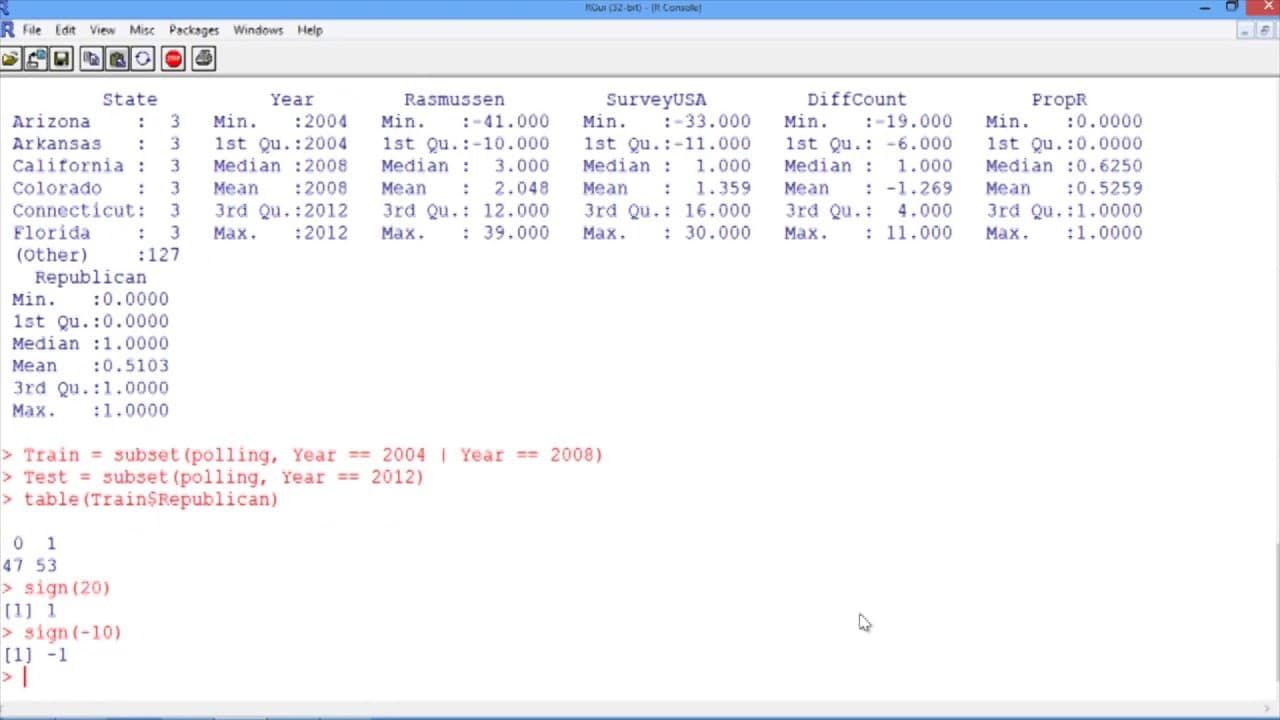
Now, we're ready to actually start building models. So as usual, the first thing we're going to do is split our data into a training and a testing set. And for this problem, we're actually going to train on data from the 2004 and 2008 elections, and we're going to test on data from the 2012 presidential election. So to do that, we'll create a data ... Read More
Key Insights
- 😫 Splitting data into training and testing sets is an essential step in building election prediction models.
- 🖤 A simple baseline model that always predicts the most common outcome lacks credibility and performance.
- ⚾ A smarter baseline model, based on polling data, can provide more reliable predictions.
- 🆘 Evaluating baseline models against actual election outcomes helps assess their accuracy and performance.
- 😥 The smarter baseline model outperforms the simple baseline model, making it a better starting point for comparison with logistic regression-based approaches in election predictions.
- 🖐️ Polling data plays a crucial role in creating more accurate baseline models for election predictions.
- 👻 The sign function allows the smarter baseline model to consider both positive and negative polling differences.
Install to Summarize YouTube Videos and Get Transcripts
Explore YouTube Video Summarizer or Get YouTube Transcript Extractor
Questions & Answers
Q: How is the data split for training and testing election prediction models?
The data is split into a training set and a testing set, with the training set containing data from the 2004 and 2008 elections, and the testing set containing data from the 2012 presidential election.
Q: What are the limitations of the simple baseline model?
The simple baseline model always predicts the Republican candidate as the winner, regardless of the actual polling data. This model fails to consider cases where the Democratic candidate is significantly ahead in the polls, making it an unreliable model.
Q: How does the smarter baseline model use polling data?
The smarter baseline model takes a specific poll (such as Rasmussen) into account, using the sign function to determine the predicted winner. If the Republican is polling ahead, it predicts the Republican as the winner, while if the Democrat is polling ahead, it predicts the Democrat as the winner.
Q: How does the smarter baseline model compare to the actual election outcomes?
The smarter baseline model performs better than the simple baseline model. It has fewer mistakes and inconclusive results when compared to the actual election outcomes, making it a more reasonable model to use for election predictions.
Summary & Key Takeaways
-
The content explains the process of splitting data into training and testing sets for election prediction models.
-
It introduces a simple baseline model that always predicts the Republican candidate as the winner, regardless of the actual polling data.
-
A smarter baseline model is proposed, which takes into account polling data by using a sign function to determine the predicted winner.
Read in Other Languages (beta)
Share This Summary 📚
Summarize YouTube Videos and Get Video Transcripts with 1-Click
Try YouTube Summary with ChatGPT & Claude or YouTube Transcript Generator
Explore More Summaries from MIT OpenCourseWare 📚


Summarize YouTube Videos and Get Video Transcripts with 1-Click
Try YouTube Summary with ChatGPT & Claude or YouTube Transcript Generator