Can AI Help Detect Medical Errors and Improve Diagnosis?
TL;DR
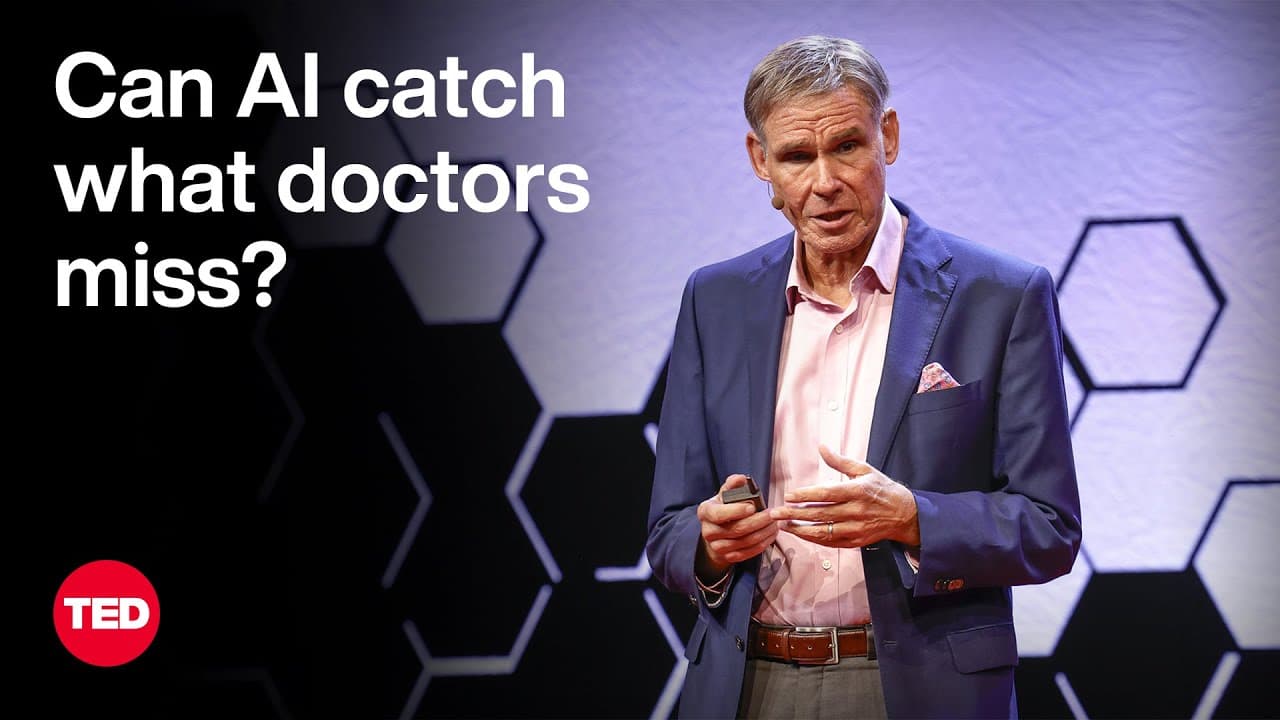
AI can significantly reduce diagnostic medical errors by enhancing accuracy in medical imaging and analysis, potentially preventing over 800,000 deaths or disabilities annually in the U.S. With advancements like AlphaFold and multimodal models such as GPT-4, AI demonstrates remarkable capabilities in identifying conditions that human experts may miss, thereby improving patient outcomes and transforming the healthcare landscape.
Transcript
I've had the real fortune of working at Scripps Research for the last 17 years. It's the largest nonprofit biomedical institution in the country. And I've watched some of my colleagues, who have spent two to three years to define the crystal 3-D structure of a protein. Well, now that can be done in two or three minutes. And that's because of the wo... Read More
Key Insights
- 🔬 The work of AlphaFold, a derivative of DeepMind, has revolutionized protein structure prediction, inspiring many other models and advancements in the field of life sciences, including RNA and antibody predictions.
- 🏥 Diagnostic medical errors are a significant problem in the medical community, leading to 800,000 deaths or disabilities each year in the US alone. AI has the potential to help address this issue through precision medicine and improved accuracy in diagnostics.
- 👁️ AI-powered machine vision has shown great promise in medical imaging, outperforming expert physicians in detecting conditions such as cancerous nodules in chest X-rays and polyps during colonoscopy.
- 🧠 Deep learning models, such as convolutional neural networks, have demonstrated the ability to detect and predict various medical conditions, including diabetes, heart disease, Alzheimer's disease, and Parkinson's disease, using electrocardiograms (ECGs) and other tests.
- 🔍 Transformer models, such as GPT-4, hold the potential for further advancements in healthcare by allowing for the analysis of larger volumes of data, integration of different modalities (language, images, speech), and self-supervised learning.
- ️ Keyboard liberation, made possible by AI, can help reduce the administrative burden on doctors and allow for more meaningful patient interactions, leading to improved healthcare outcomes.
- 🌐 The development of open-source models and collaboration among researchers is crucial for advancing medical AI and building on existing knowledge.
- 💡 AI-powered chatbots, such as ChatGPT, have proven to be effective tools in aiding diagnosis, even outperforming expert clinicians in some cases, and providing valuable insights into complex medical conditions.
Install to Summarize YouTube Videos and Get Transcripts
Explore YouTube Video Summarizer or Get YouTube Transcript Extractor
Questions & Answers
Q: How has the advancement of AlphaFold transformed protein structure prediction?
AlphaFold, a derivative of DeepMind, has revolutionized protein structure prediction by reducing the time required to define the crystal 3-D structure of a protein from two to three years to mere minutes. This breakthrough has inspired other models and expanded the application of predicting RNA, antibodies, missense mutations in the genome, and even inventing proteins that do not exist in nature.
Q: Should the AI model, specifically the transformer model used in AlphaFold, receive recognition as part of the Nobel Prize?
The speaker raises a thought-provoking question about whether the AI model should be acknowledged alongside its creators in the Nobel Prize award. Since the team of scientists behind AlphaFold does not fully understand the workings of the transformer model, it raises the ethical consideration of awarding an AI system that may be beyond human comprehension.
Q: Can AI help address the issue of diagnostic medical errors in the medical community?
Diagnostic medical errors are a significant problem, leading to the death or serious disability of 800,000 Americans annually. AI shows promising potential in mitigating these errors. Utilizing supervised learning with large, labeled datasets, AI-powered computer vision systems have consistently shown the ability to detect abnormalities and diagnose various medical conditions more accurately than expert physicians.
Q: What are some examples of AI's proficiency in medical imaging analysis?
AI has demonstrated remarkable capabilities in medical imaging analysis. By utilizing convolutional neural networks, AI-powered systems can detect and analyze various conditions such as diabetes control, heart calcium scores, Alzheimer's disease, kidney disease, liver and gallbladder disease, and even predict future medical events like heart attacks, strokes, and Parkinson's disease several years in advance.
Q: How can AI contribute to transforming patient-doctor relationships?
AI and its applications, such as natural language processing and machine learning, have the potential to liberate clinicians and patients from time-consuming administrative tasks. By automating the documentation process, AI can free up doctors' time to focus on face-to-face interactions, improving the quality and depth of patient care. AI also aids in making accurate diagnoses and provides comprehensive patient data, enhancing the patient-doctor relationship and improving healthcare outcomes.
Summary & Key Takeaways
-
The work of AlphaFold, a derivative of DeepMind, has greatly accelerated the process of defining the 3-D structure of proteins, leading to advancements in protein structure prediction and the ability to create proteins that don't exist in nature.
-
AI has the potential to greatly improve accuracy and precision in medicine, helping to reduce diagnostic errors and improve patient outcomes.
-
Deep learning models and transformer models, such as GPT-4, have shown remarkable capabilities in various medical applications, including retinal analysis, ECG interpretation, and cancer diagnosis, leading to keyboard liberation and transforming the patient-doctor relationship.
Read in Other Languages (beta)
Share This Summary 📚
Summarize YouTube Videos and Get Video Transcripts with 1-Click
Try YouTube Summary with ChatGPT & Claude or YouTube Transcript Generator
Explore More Summaries from TED 📚
Summarize YouTube Videos and Get Video Transcripts with 1-Click
Try YouTube Summary with ChatGPT & Claude or YouTube Transcript Generator