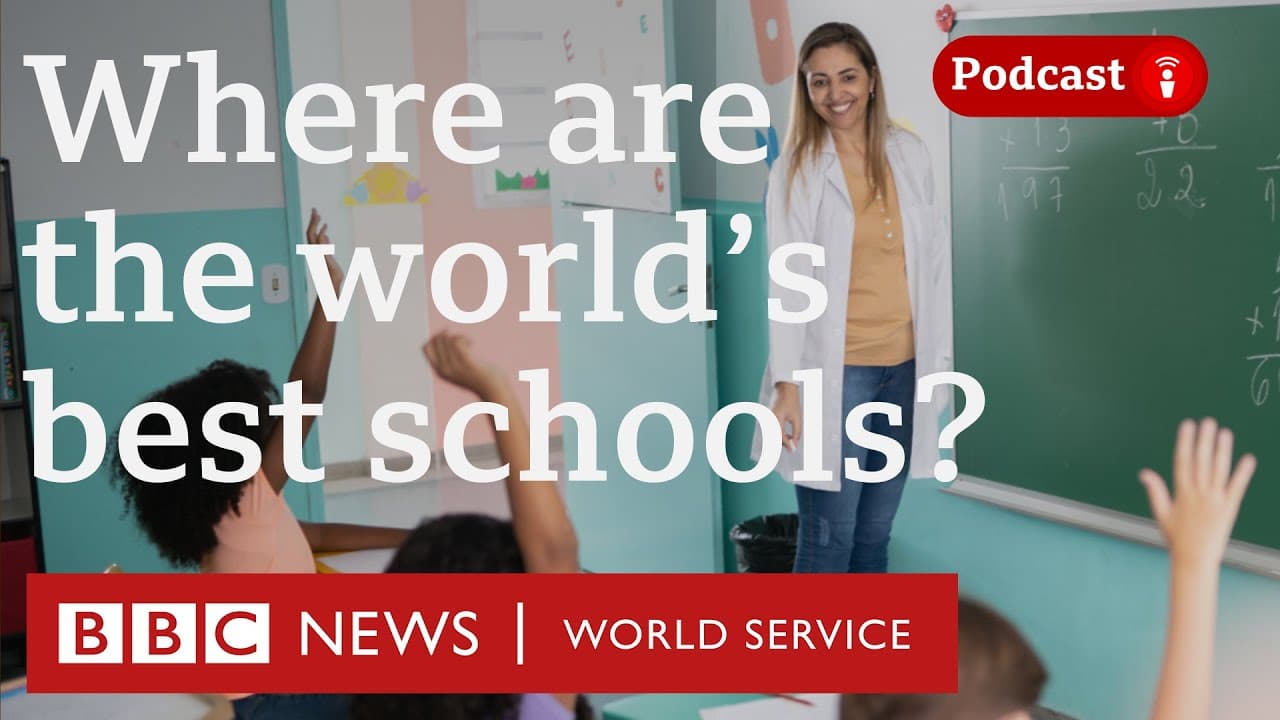
Which country has the best education in the world? - The Global Story podcast, BBC World Service
TL;DR
Global education rankings reveal disparities, with Asian and Nordic countries leading.
Transcript
Hello, I'm Lucy Hockings. From the BBC World Service, This is The Global Story. A good education can make us richer, healthier and help us to thrive. And governments around the world compete in global rankings to see which nation is deemed to have the best school system in the world. Asian schools often get the best results, with some Nordi... Read More
Key Insights
- The Pisa tests, conducted by the OECD, measure educational achievement in reading, maths, and science among 15-year-olds across 80 countries, offering a global comparison of education systems.
- East Asian countries like South Korea, Singapore, and Hong Kong consistently perform well in Pisa tests, while Nordic countries like Finland and Estonia also rank highly.
- Countries with successful education systems often ensure equal education access for all students, regardless of background, emphasizing the importance of equality in achieving high educational standards.
- Teacher quality significantly impacts student achievement, with good teachers contributing to substantial learning gains, though it's not the sole factor in international educational differences.
- Economic and social factors, such as poverty, war, and climate change, pose significant barriers to education, preventing millions of children, especially in conflict zones, from attending school.
- Girls outperform boys in reading across most countries, while performance in mathematics is more balanced, highlighting gender differences in educational achievement.
- Countries can change their education systems by learning from successful models, indicating that educational outcomes are not fixed and can be improved with the right policies and investments.
- Investing in education is crucial for economic development, as a skilled workforce is vital for a country's economic prosperity, demonstrated by countries like Singapore prioritizing education to boost their economies.
Install to Summarize YouTube Videos and Get Transcripts
Explore YouTube Video Summarizer or Get YouTube Transcript Extractor
Questions & Answers
Q: What are the Pisa tests and what do they measure?
The Pisa tests are assessments conducted by the OECD, measuring educational achievement in reading, mathematics, and science among 15-year-olds across approximately 80 countries. These tests provide a global comparison of education systems, highlighting countries' relative performance in key academic areas.
Q: Which countries perform well in the Pisa tests and why?
East Asian countries such as South Korea, Singapore, and Hong Kong consistently perform well in Pisa tests, along with Nordic countries like Finland and Estonia. These countries emphasize equal access to education and maintain high academic standards, which contribute to their success in these assessments.
Q: What barriers prevent children from accessing education globally?
Significant barriers to education include poverty, war, and climate change, which prevent millions of children from attending school. In conflict zones, schools are often closed, and in impoverished areas, lack of resources and infrastructure hinder educational access.
Q: How does teacher quality impact student achievement?
Teacher quality plays a crucial role in student achievement, with high-quality teachers contributing to significant learning gains. Students with good teachers can experience up to three or four months of additional learning over an academic year, highlighting the importance of investing in teacher development.
Q: Why do some countries prioritize education in their economic strategies?
Countries like Singapore prioritize education in their economic strategies because a skilled workforce is essential for economic prosperity. By investing in education, these countries aim to develop high-income, high-skills economies, ensuring long-term economic growth and competitiveness.
Q: What are the gender differences in educational achievement?
Globally, girls outperform boys in reading, a trend consistent across most countries and over time. In mathematics, performance is more balanced, with some countries showing an advantage for boys. These differences highlight the need to address gender disparities in education.
Q: Can countries change their education systems to improve outcomes?
Yes, countries can change their education systems by adopting successful models and implementing policies that promote equal access and quality education. Educational outcomes are not fixed, and with the right investments and strategies, countries can improve their education systems.
Q: What role does funding play in education quality?
Funding is vital for ensuring quality education, providing necessary resources, and supporting teachers and students. While money is essential, how it is allocated also matters, as effective spending can enhance educational outcomes. Investment in education infrastructure and support systems is crucial for improvement.
Summary & Key Takeaways
-
The Pisa tests provide a global comparison of education systems, highlighting the success of East Asian and Nordic countries. These tests have sparked debates about the definition of a good education, considering both academic and holistic aspects.
-
Teacher quality and equal access to education are crucial factors in successful education systems. However, barriers like poverty and conflict hinder millions of children worldwide from receiving education, impacting their future opportunities.
-
Countries can improve their education systems by learning from successful models, emphasizing that educational outcomes are not predetermined. Investment in education is essential for economic growth, as seen in countries like Singapore.
Read in Other Languages (beta)
Share This Summary 📚
Summarize YouTube Videos and Get Video Transcripts with 1-Click
Try YouTube Summary with ChatGPT & Claude or YouTube Transcript Generator
Explore More Summaries from BBC World Service 📚

Summarize YouTube Videos and Get Video Transcripts with 1-Click
Try YouTube Summary with ChatGPT & Claude or YouTube Transcript Generator