Problem 7: Based AC Analysis of CS CE Multistage Amplifier | Electronic Devices and Circuits 2
TL;DR
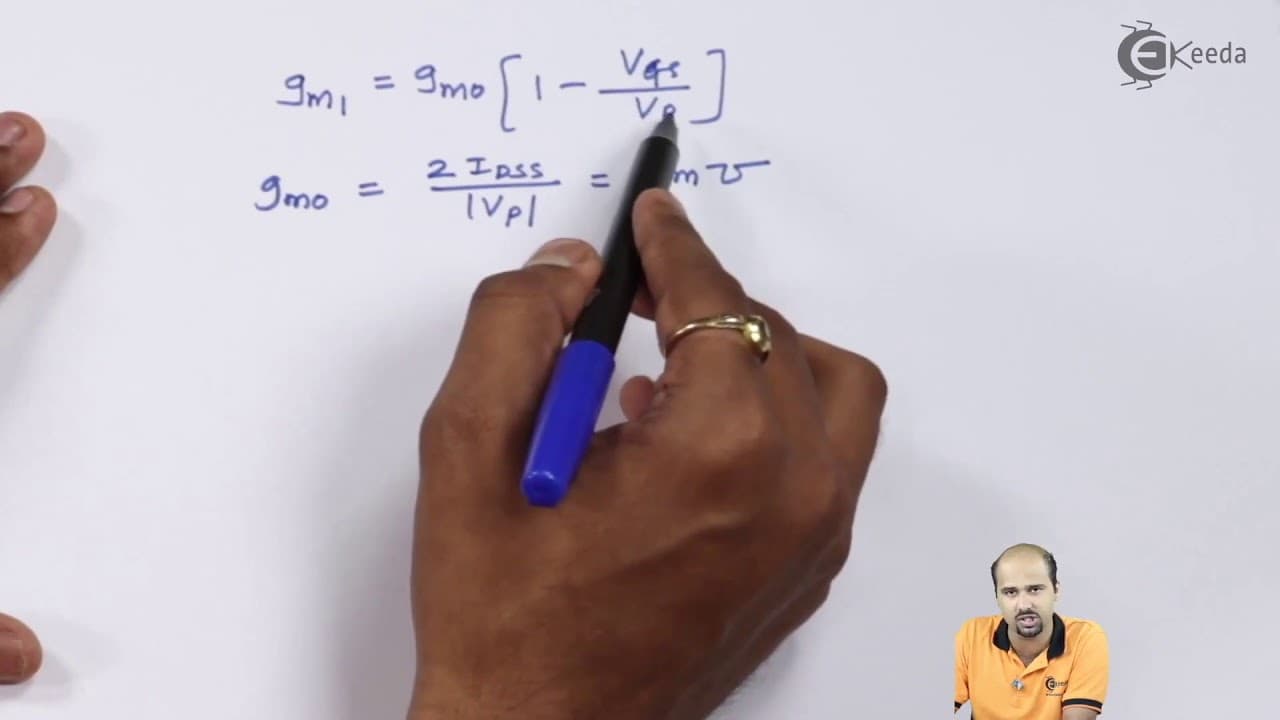
Solving a complex numerical based on CSCE input and CE output stages for a detailed analysis of AC and DC parameters.
Transcript
hi guys in this particular video we will learn some a complex numerical which is based on csce that is input stages jpeg and output stage is ce multi-stage amplifier uh here we have to directly deal with particular numerical which is asked in your one of the mumbai university question paper for may 2018 right so in this particular question uh somet... Read More
Key Insights
- 😂 DC analysis involves calculating Q points, GM values, and RS for proper biasing.
- 🔙 AC analysis includes drawing AC equivalent models, calculating GM1 and GM2, and determining voltage gain.
- 😆 Q point calculations help in setting optimum bias conditions for each stage.
- ❓ Understanding the significance of parameters like IDSS, VP, HIE, HFT, and DJ for CSCE analysis.
- ⚡ Voltage gain calculation is crucial for evaluating the performance and efficiency of multi-stage amplifier circuits.
- ❓ Relying on step-by-step analysis for comprehensive problem-solving in complex numericals.
- 🈸 Importance of accurate parameters and detailed calculations for successful analysis in engineering applications.
Install to Summarize YouTube Videos and Get Transcripts
Explore YouTube Video Summarizer or Get YouTube Transcript Extractor
Questions & Answers
Q: What specific parameters are required for solving the complex numerical involved in CSCE analysis?
Parameters such as GM, IDSS, VP, HIE, HFT, and DJ values are crucial for the analysis, along with finding the value of RS.
Q: How is the DC analysis carried out for the CSCE multi-stage amplifier circuit?
The DC analysis involves calculating Q points for each stage, determining the value of RS, finding GM1 and GM2, and establishing the Q points for DC biasing.
Q: What steps are involved in drawing the AC equivalent model for CSCE analysis?
The AC equivalent model entails forming independent stages for analysis, calculating GM1 and GM2, determining HIE, and finding the voltage gain for the entire circuit.
Q: What is the significance of finding the value of RS in the CSCE multi-stage amplifier circuit?
RS is essential for determining the proper biasing conditions, ensuring optimal performance, and calculating accurate voltage gain in the amplifier circuit.
Summary & Key Takeaways
-
Solving a complex numerical based on CSCE input and CE output stages from a Mumbai University question paper for May 2018.
-
Finding the value of RS, Q points for each stage, drawing AC equivalent models, and determining the voltage gain.
-
Detailed step-by-step analysis involving DC analysis, Q point calculations, and AC analysis for multi-stage amplifier circuits.
Read in Other Languages (beta)
Share This Summary 📚
Summarize YouTube Videos and Get Video Transcripts with 1-Click
Try YouTube Summary with ChatGPT & Claude or YouTube Transcript Generator
Explore More Summaries from Ekeeda 📚


Summarize YouTube Videos and Get Video Transcripts with 1-Click
Try YouTube Summary with ChatGPT & Claude or YouTube Transcript Generator