Phasor diagram | No-load at stand still | Induction Motor | Lec - 45
TL;DR
This content discusses modifications in the equivalent circuit for rotor resistance and its impact on performance.
Transcript
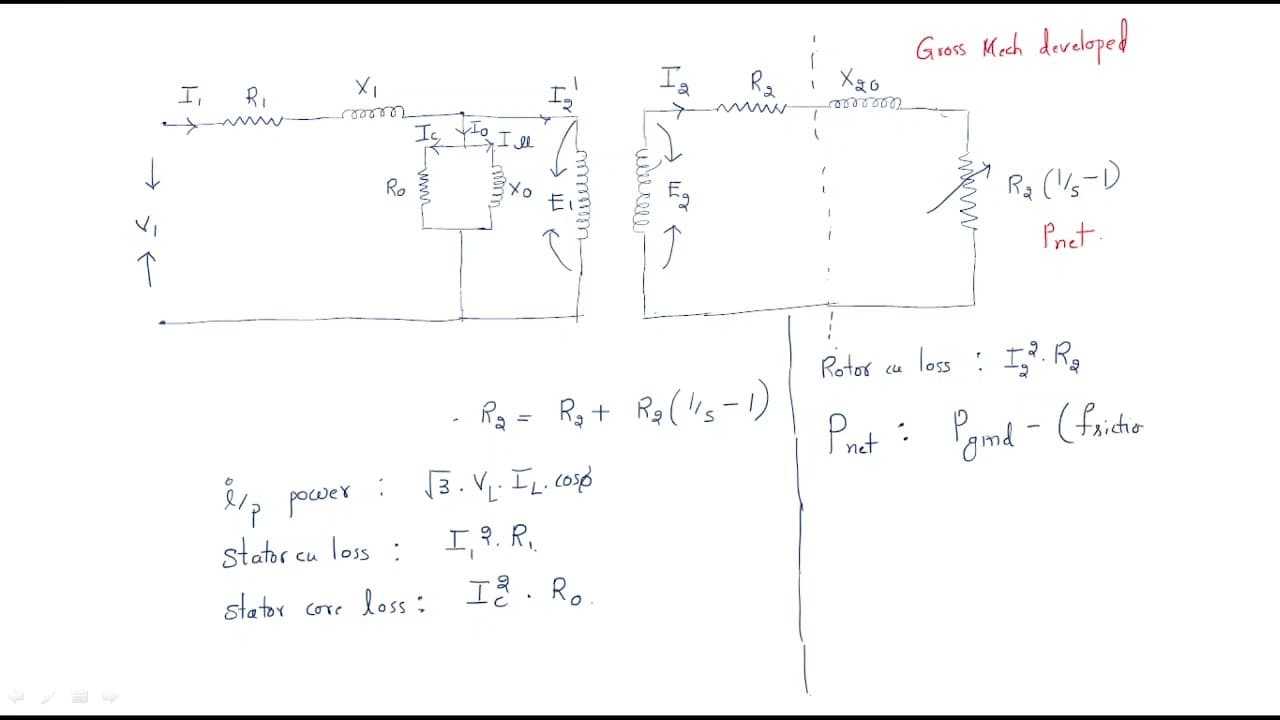
hello everyone in the last session we discussed about the complete equivalent circuit in that we modified that the rotor resistance will be divided into two terms that is r two plus r two one by s minus 1 so by using this concept we will modify the equivalent circuit that is here the r2 will be simply r2 will be again i will write r2 will be r2 plu... Read More
Key Insights
- 🥳 The equivalent circuit for motors can be significantly modified by dividing rotor resistance into two parts to enhance accuracy in performance analysis.
- ✊ Power calculations are critical in electric machines and involve determining input power alongside accounting for copper and core losses to evaluate efficiency.
- 🧑🦼 A phasor diagram at no load conditions provides a conceptual layout of electrical interactions, simplifying complex relationships in motor analysis.
- 💋 The calculated slip, determined by the difference in rotor and stator speeds, directly influences rotor resistance and, consequently, overall machine performance.
- 🧡 Magnetizing and core losses are essential components of the total model, affecting both input and output power across the motor's operational range.
- 👻 The analysis included variations in load and their implications on the rotor's performance, allowing for real-time adjustments in operational parameters.
- ☢️ Understanding the relationship between various currents (i1, i2, and active components) is crucial for effective fault diagnosis and performance monitoring in electrical circuits.
Install to Summarize YouTube Videos and Get Transcripts
Explore YouTube Video Summarizer or Get YouTube Transcript Extractor
Questions & Answers
Q: What is the significance of modifying rotor resistance in the equivalent circuit?
Modifying rotor resistance to include two components helps in accurately analyzing the performance of motors by considering slip-dependent changes. This allows for a better understanding of how resistance impacts efficiency, starting conditions, and operational stability of the motor under varying loads.
Q: How are input power and losses calculated in this equivalent circuit?
Input power is determined using the formula voltage times current multiplied by the power factor. Additionally, losses such as stator copper loss and core loss are calculated based on the respective currents and resistances, which are critical in assessing the overall efficiency and operational performance of the motor.
Q: What is the role of the phasor diagram in this analysis?
The phasor diagram serves as a vital tool for visualizing the relationships between various electrical components in the equivalent circuit. It illustrates the interactions between voltages, currents, and impedances at standstill conditions, aiding in the understanding of how these factors influence motor behavior and performance.
Q: Can you explain the relationship between stator and rotor currents in this circuit?
The relationship between stator and rotor currents is defined by their respective contributions in the circuit. The stator current is a combination of the no-load current and rotor current adjusted for slip. Analyzing this relationship helps in determining the efficiency and performance as well as in calculating the losses incurred within the motor.
Summary & Key Takeaways
-
The session elaborates on the division of rotor resistance into two components to improve the equivalent circuit for motors, affecting the performance calculations.
-
It explains the relationship between input power, losses, and power factor while analyzing stator and rotor components in electrical circuits.
-
Emphasis is placed on constructing the phasor diagram to visualize electrical parameters and interactions within the modified equivalent circuit, specifically at no load conditions.
Read in Other Languages (beta)
Share This Summary 📚
Summarize YouTube Videos and Get Video Transcripts with 1-Click
Try YouTube Summary with ChatGPT & Claude or YouTube Transcript Generator