VHDL data types I STD_LOGIC | Signed & Unsigned | Digital Systems Design | Lec-19
TL;DR
This video covers the STD logic data types in VHDL and how to use them.
Transcript
hi everyone in this video I'm going to explain about estd logic data types in vhdl so STD logic vhdl data types are nothing but which are used to initialize several types of low values High values and variables especially when a variable is going to be declared like a or BRC what type of data it is whether it is an integer or B or an sdore logic wh... Read More
Key Insights
- 🅰️ Understanding the nine STD logic values is crucial for initializing and managing data types in VHDL effectively.
- 📚 Proper library inclusions and package usages are foundational for any VHDL program, ensuring access to essential functionalities.
- 🖐️ The distinction between signed and unsigned data types plays a significant role in data manipulation and arithmetic in VHDL.
- 😤 The "Z" state is particularly important in designs requiring tri-state buffers and signal contention handling.
- 💬 Comments are an integral part of programming best practices, improving the clarity of VHDL code for better collaboration and maintenance.
- 🔰 Each VHDL program must begin appropriately with entity and architecture definitions to ensure a well-structured implementation.
- 🧡 The emphasis on initializing signed and unsigned data types illustrates the importance of defining the range for accurate computational results.
Install to Summarize YouTube Videos and Get Transcripts
Explore YouTube Video Summarizer or Get YouTube Transcript Extractor
Questions & Answers
Q: What are the nine STD logic data types mentioned in the video?
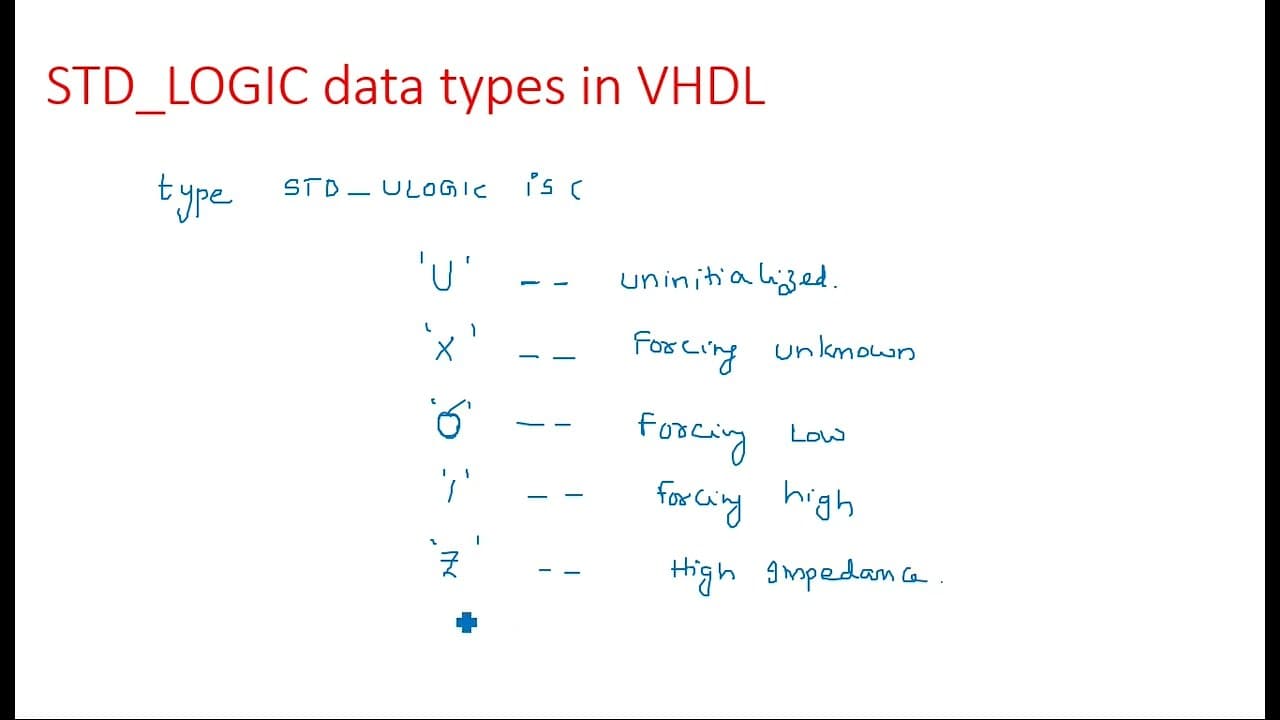
The nine STD logic data types in VHDL include U (uninitialized), X (forcing unknown), 0 (forcing low), 1 (forcing high), Z (high impedance), W (weak unknown), L (weak low), H (weak high), and - (don't care). These values help in initializing variables properly, providing a robust way to represent different states in digital circuits.
Q: Why is including the IEEE library important in VHDL?
Including the IEEE library in VHDL is crucial as it provides access to predefined functions and data type definitions necessary for proper coding. This library supports STD logic operations and is essential for initializing various data types, ensuring the VHDL code is syntactically and semantically correct.
Q: What is the difference between signed and unsigned data types in VHDL?
Signed data types in VHDL can represent both positive and negative values, making them suitable for operations involving negative integers. In contrast, unsigned data types only represent non-negative values. This distinction is important for arithmetic operations, as it affects how values are treated during calculations.
Q: How do you initialize signed and unsigned data types in VHDL?
For initializing signed data types, the numeric_std library must be included, allowing for the definition of signed arrays with specific ranges. Similarly, unsigned data types are initialized using the same library, creating arrays that can only hold non-negative integer values. Proper initialization is vital for accurate computation.
Q: What library and packages are needed for arithmetic operations in VHDL?
To perform arithmetic operations in VHDL, it is essential to include the IEEE library and the numeric_std package. This allows the use of various arithmetic functions and operations like addition and subtraction. Without these packages, the functionality would be limited, and the program would not compile correctly.
Q: Can you explain what the "Z" logic state represents?
In VHDL's STD logic data types, "Z" represents high impedance. This state indicates that the output is not driven to a definite value, effectively isolating the signal. It is a crucial state used in tri-state logic designs, where multiple outputs may contend for a single signal line.
Q: What is the role of comments in VHDL programming?
Comments in VHDL programming, indicated by two hyphens (--) followed by the comment text, are used to provide explanations or notes for the code without affecting its execution. They enhance code readability and help programmers document their reasoning or important details for future reference.
Q: How does one start a VHDL program structure after including the necessary libraries?
After including the necessary libraries and packages, a VHDL program structure begins with an entity declaration followed by architecture definition. The entity specifies the design's interface, while the architecture contains the actual implementation details, driving the overall behavior of the VHDL design.
Summary & Key Takeaways
-
The video provides an overview of the nine STD logic data types used in VHDL, such as U (uninitialized), X (forcing unknown), and Z (high impedance), explaining their meanings and uses.
-
It emphasizes the importance of including the IEEE library and utilizing specific packages for initializing and using various data types like signed and unsigned integers in VHDL programming.
-
The discussion includes necessary library statements for accessing logic and numeric operations, preparing viewers for practical programming in VHDL.
Read in Other Languages (beta)
Share This Summary 📚
Summarize YouTube Videos and Get Video Transcripts with 1-Click
Try YouTube Summary with ChatGPT & Claude or YouTube Transcript Generator