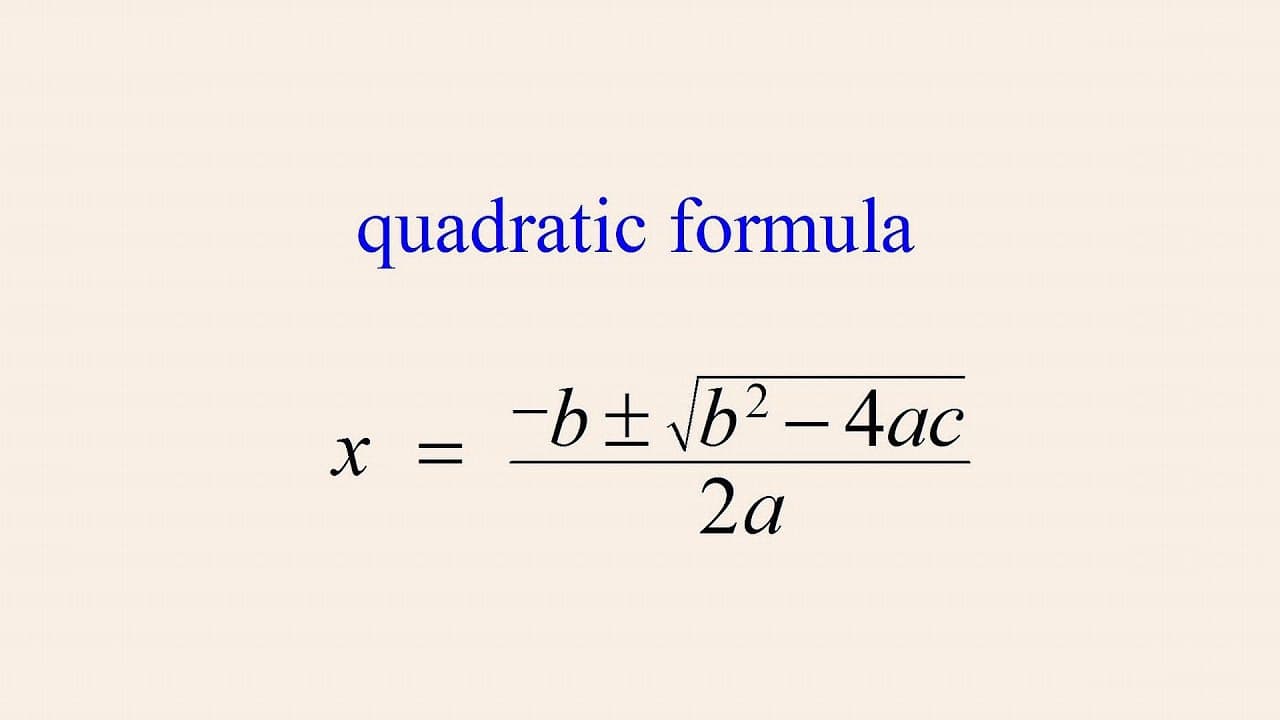
Algebra 77 - The Quadratic Formula
TL;DR
The quadratic formula simplifies solving any quadratic equation, providing solutions quickly.
Transcript
Hello. I'm Professor Von Schmohawk and welcome to Why U. In the previous lecture, we introduced a general method of solving quadratic equations called "completing the square". Before the method of completing the square was developed only very limited types of quadratic equations could be solved. This method eliminated those limitations allowing the... Read More
Key Insights
- 💨 Completing the square method paved the way for solving all quadratic equations.
- ❓ The quadratic formula simplifies finding solutions for quadratic equations significantly.
- ❓ The discriminant in the quadratic formula reveals the nature of real solutions for the quadratic equation.
- 🔂 Real solutions, single solutions, and no real solutions correspond to discriminant values in the quadratic formula.
- 😃 The quadratic formula elegantly ties together the values of a, b, and c for solving quadratic equations.
- ❓ Understanding the discriminant in the formula is crucial for determining the nature of solutions.
- ⚾ Quadratic equations can have two real solutions, one real solution or no real solutions based on the discriminant value.
Install to Summarize YouTube Videos and Get Transcripts
Explore YouTube Video Summarizer or Get YouTube Transcript Extractor
Questions & Answers
Q: What limitations did the method of completing the square eliminate?
The method of completing the square eliminated the limitations of only being able to solve limited types of quadratic equations, allowing solutions for any quadratic equation.
Q: How does the quadratic formula simplify solving quadratic equations?
The quadratic formula condenses the process of solving quadratic equations into a single formula based on the values of the constants a, b, and c in the general form "a x-squared plus bx plus c equals zero".
Q: What does the discriminant in the quadratic formula indicate?
The discriminant in the quadratic formula indicates the number of real solutions for the quadratic equation: positive discriminant equals two real solutions, zero discriminant equals one real solution, and negative discriminant equals no real solutions.
Q: What happens when the discriminant in the quadratic formula is zero?
When the discriminant is zero, the quadratic equation has one real solution, which corresponds to the quadratic function having a single zero.
Summary & Key Takeaways
-
Completing the square method unlocks solutions for all quadratic equations.
-
The quadratic formula condenses solving quadratic equations into a convenient formula.
-
The discriminant in the formula reveals the number of real solutions for the quadratic equation.
Read in Other Languages (beta)
Share This Summary 📚
Summarize YouTube Videos and Get Video Transcripts with 1-Click
Try YouTube Summary with ChatGPT & Claude or YouTube Transcript Generator
Explore More Summaries from MyWhyU 📚



Summarize YouTube Videos and Get Video Transcripts with 1-Click
Try YouTube Summary with ChatGPT & Claude or YouTube Transcript Generator