7.3 Redshift
TL;DR
Light waves undergo a transformation known as Lorentz Transformation, affecting their frequency and wavelength. This transformation results in either a blueshift or redshift, which indicates whether a light source is moving towards or away from an observer.
Transcript
MARKUS KLUTE: Welcome back to 8.20. In the previous section, we have seen the relativistic Doppler effect, and now we want to study how light-- in this case, a monochromatic plane wave-- transforms in the Lorentz transformation. In other words, we have, for example, a distant star emitting light at a specific frequency. The question now is, how do ... Read More
Key Insights
- ❓ Lorentz transformation is essential for understanding the relativistic Doppler effect.
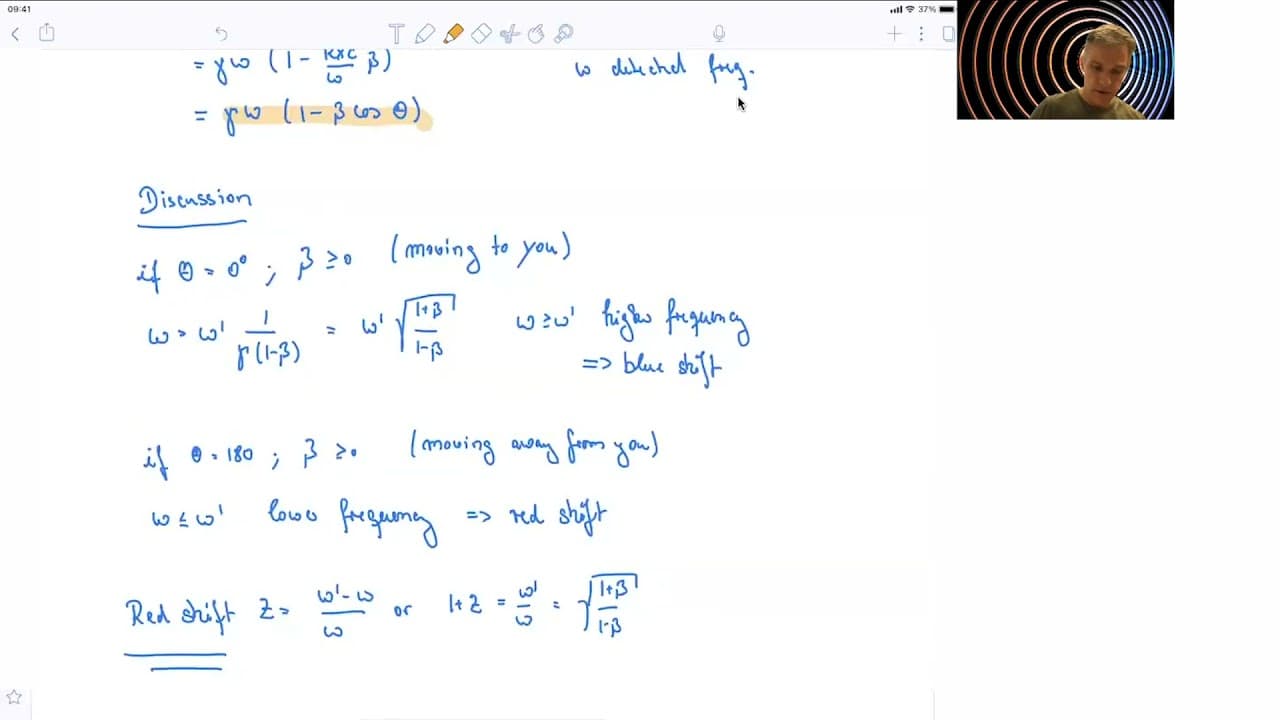
- ⚡ Blueshift occurs when the observer is moving towards the light source, resulting in a higher observed frequency.
- ⚡ Redshift indicates that a light source is moving away from the observer, with larger redshift values corresponding to higher velocities.
- 🤩 The expansion of the universe can be observed by determining the redshift of stars in our galaxy.
Install to Summarize YouTube Videos and Get Transcripts
Explore YouTube Video Summarizer or Get YouTube Transcript Extractor
Questions & Answers
Q: What is Lorentz transformation, and how does it relate to the Doppler effect?
Lorentz transformation is a mathematical framework used to describe how space and time coordinates change for an observer moving at relativistic speeds. This transformation is essential to understanding the relativistic Doppler effect, which describes the change in frequency and wavelength of light waves due to relative motion between the observer and the light source.
Q: How does Lorentz transformation affect the wave number and frequency of a light wave?
Lorentz transformation affects the wave number and frequency of a light wave by changing the coordinates of space and time. The wave number in the x direction remains the same, while the time axis undergoes a transformation. The transformed wave number and frequency can be expressed in terms of the original parameters and Lorentz transformation equations.
Q: What is blueshift, and under what conditions does it occur?
Blueshift refers to an increase in frequency and decrease in wavelength of a light wave. It occurs when the light source is moving towards the observer, resulting in a higher observed frequency. This shift towards the blue end of the electromagnetic spectrum can be observed in situations where a star is approaching our solar system.
Q: How is redshift measured, and what does it indicate?
Redshift is measured as the relative change in frequency between the observed frequency (omega prime) and the baseline frequency (omega) of a light wave. It indicates whether a light source is moving away from the observer. The larger the redshift, the higher the velocity of the source moving away from us. Redshift can be used as a measure of the expansion of the universe.
Summary & Key Takeaways
-
The relativistic Doppler effect is studied to understand how light waves transform under Lorentz transformation.
-
Monochromatic plane waves are used as an example, and the solution to the wave equation is discussed.
-
The transformation of wave numbers and frequencies is analyzed, leading to the identification of blueshift and redshift effects.
Read in Other Languages (beta)
Share This Summary 📚
Summarize YouTube Videos and Get Video Transcripts with 1-Click
Try YouTube Summary with ChatGPT & Claude or YouTube Transcript Generator
Explore More Summaries from MIT OpenCourseWare 📚



Summarize YouTube Videos and Get Video Transcripts with 1-Click
Try YouTube Summary with ChatGPT & Claude or YouTube Transcript Generator