The Moon is Rusting. It's the Earth's Fault.
TL;DR
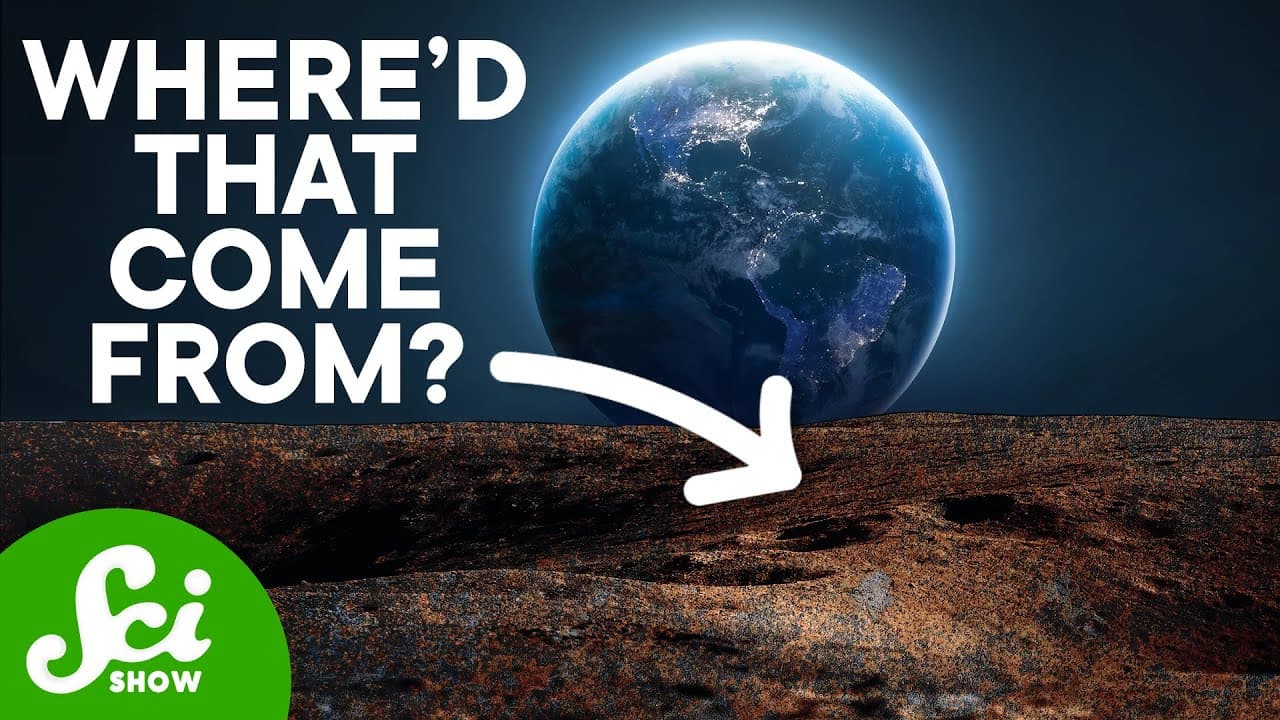
The Earth's magnetic field and solar wind contribute to hematite formation on the Moon's surface.
Transcript
Sometimes I look up at the Moon and wish I could just throw a lasso around it and pull it a little closer. But fortunately for everyone living on Earth, no one’s made a lasso that’s 384,000 kilometers long. That’s roughly how far away the Moon is from Earth. So other than gravity, or the occasional lunar eclipse, it’s hard to picture the Earth... Read More
Key Insights
- 💁 Hematite, a form of iron oxide, is being formed on the Moon's surface despite a lack of significant water and oxygen quantities.
- 💨 The solar wind acts as a reducer on the Moon's hematite, undoing oxidation reactions caused by the release of oxygen from Earth.
- ℹ️ Earth's magnetotail provides a source of oxygen ions that contribute to the formation of hematite on the lunar surface.
- 🤽 Research suggests that the Earth's atmosphere and magnetotail play a crucial role in the formation of water and hematite on the Moon.
- 💨 The Earth's magnetic field, solar wind, and magnetotail all play a part in creating the conditions necessary for rust formation on the Moon.
- 💁 Studies conducted on the formation of hematite on the Moon offer insights into the ancient atmosphere of Earth.
- 😑 The Earth-Moon relationship involves a transfer of oxygen ions and electrons that lead to chemical reactions on the lunar surface.
Install to Summarize YouTube Videos and Get Transcripts
Explore YouTube Video Summarizer or Get YouTube Transcript Extractor
Questions & Answers
Q: How is the Moon experiencing rust formation despite lacking water and oxygen?
The Earth's magnetic field and solar wind provide oxygen ions, contributing to hematite formation on the Moon's surface, even though the Moon itself lacks significant quantities of water and oxygen.
Q: What role does the solar wind play in reducing the hematite on the Moon?
The solar wind acts as a reducer on the Moon's hematite, undoing oxidation reactions by destroying the hematite crystals with reduction reactions.
Q: How does the Earth's magnetotail contribute to the Moon's rust formation?
The Earth's magnetotail flings charged particles from the upper atmosphere toward the lunar surface, providing oxygen ions that help in the formation of hematite on the Moon.
Q: How do Earth-originating oxygen ions and electrons contribute to lunar rust formation?
Earth-originating oxygen ions and electrons are implanted into the lunar surface, causing chemical reactions that generate water and contribute to the formation of hematite on the Moon.
Summary & Key Takeaways
-
The Moon is experiencing rust formation known as hematite, despite lacking water and oxygen quantities needed for its creation.
-
The solar wind from the Sun acts as a reducer on the Moon's hematite, undoing oxidation reactions.
-
Earth's magnetic field and magnetotail provide oxygen ions that contribute to the formation of hematite on the Moon.
Read in Other Languages (beta)
Share This Summary 📚
Summarize YouTube Videos and Get Video Transcripts with 1-Click
Try YouTube Summary with ChatGPT & Claude or YouTube Transcript Generator
Explore More Summaries from SciShow 📚

Summarize YouTube Videos and Get Video Transcripts with 1-Click
Try YouTube Summary with ChatGPT & Claude or YouTube Transcript Generator