T Flip flop | Truth table & Diagram | Digital Systems Design | Lec-80
TL;DR
T flip flops are modified JK flip flops that toggle output upon clock signal.
Transcript
hi everyone in this video I'm going to explain about t flip flop T flip flop so previous we have previously we have studied Sr flip flop JK flip flop the next uh flip flop for those two is T flip flop okay t means t means toggle t means toggle where we have had this we have had is toggle condition in the JK flip flop When J and K are ones when both... Read More
Key Insights
- 🐬 The T flip flop is fundamentally a toggle flip flop that changes output states based on input at the clock signal.
- 🐬 Its internal structure is simpler than that of other flip flops, making it easier to implement for specific tasks.
- 🤢 T flip flops are versatile and integral to creating counter circuits, enhancing their use in various electronic applications.
- 🦖 Understanding the toggling mechanism of a T flip flop is crucial for grasping its function in digital circuits.
- 🦖 The relationship between T, JK, and SR flip flops highlights the evolution of digital storage elements in electronics.
- 🎨 The design of T flip flops can lead to more efficient circuit designs, especially in timing applications due to their straightforward toggle operation.
- 🦖 The application of T flip flops extends beyond counters, influencing areas such as frequency dividers and sequence generators in digital logic designs.
Install to Summarize YouTube Videos and Get Transcripts
Explore YouTube Video Summarizer or Get YouTube Transcript Extractor
Questions & Answers
Q: What differentiates a T flip flop from other types of flip flops?
A T flip flop is unique in that it is specifically designed to toggle its output state with each clock pulse when the T input is high. This makes it simpler than JK flip flops, which can have multiple states, and it streamlines certain applications like counters.
Q: How does the truth table for a T flip flop function?
The T flip flop truth table outlines its behavior: when T is 0, the output remains the same (no change), while when T is 1, the output toggles from its previous state. This toggling action occurs solely on the rising edge of the clock signal.
Q: In what applications are T flip flops commonly used?
T flip flops are primarily utilized in the creation of counters in digital circuits. They serve as essential components in both synchronous and asynchronous counters, facilitating operations where a toggling output is necessary for counting events or states.
Q: Can you explain how a T flip flop is constructed?
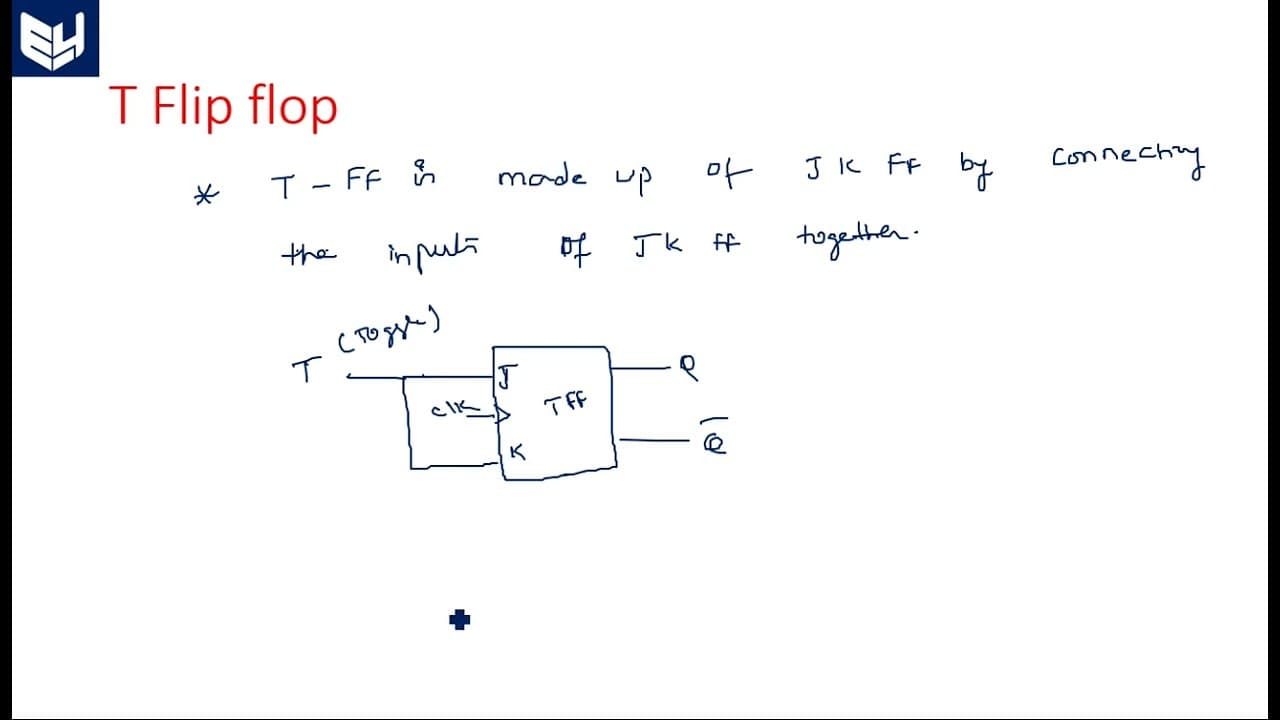
A T flip flop is constructed from a JK flip flop by shorting the J and K inputs together, effectively making it operate with a single input T. When T is high, it allows for the toggling behavior, while the structure supports standard flip flop functionality.
Q: What are the advantages of using T flip flops in circuits?
The primary advantage of T flip flops lies in their simplicity and efficiency in toggling outputs, which is crucial for reducing complexity in circuit design. This makes them preferable for applications requiring straightforward counting mechanisms.
Q: What are the relationships among the different types of flip flops?
Flip flops are hierarchical; the T flip flop is an evolution from the JK flip flop, which in turn is a modification of the SR flip flop. Each type serves distinct purposes based on their state handling and input configurations within digital systems.
Summary & Key Takeaways
-
The T flip flop is a type of flip flop derived from the JK flip flop, where both inputs J and K are connected together to a single T input for toggling.
-
The truth table of the T flip flop shows its output behavior based on clock signals, indicating no change when T is 0 and toggling the output when T is 1.
-
T flip flops are widely used in applications like synchronous and asynchronous counters, highlighting their significance in digital electronics.
Read in Other Languages (beta)
Share This Summary 📚
Summarize YouTube Videos and Get Video Transcripts with 1-Click
Try YouTube Summary with ChatGPT & Claude or YouTube Transcript Generator