What Are Ramanujan's Infinite Expressions and Their Values?
TL;DR
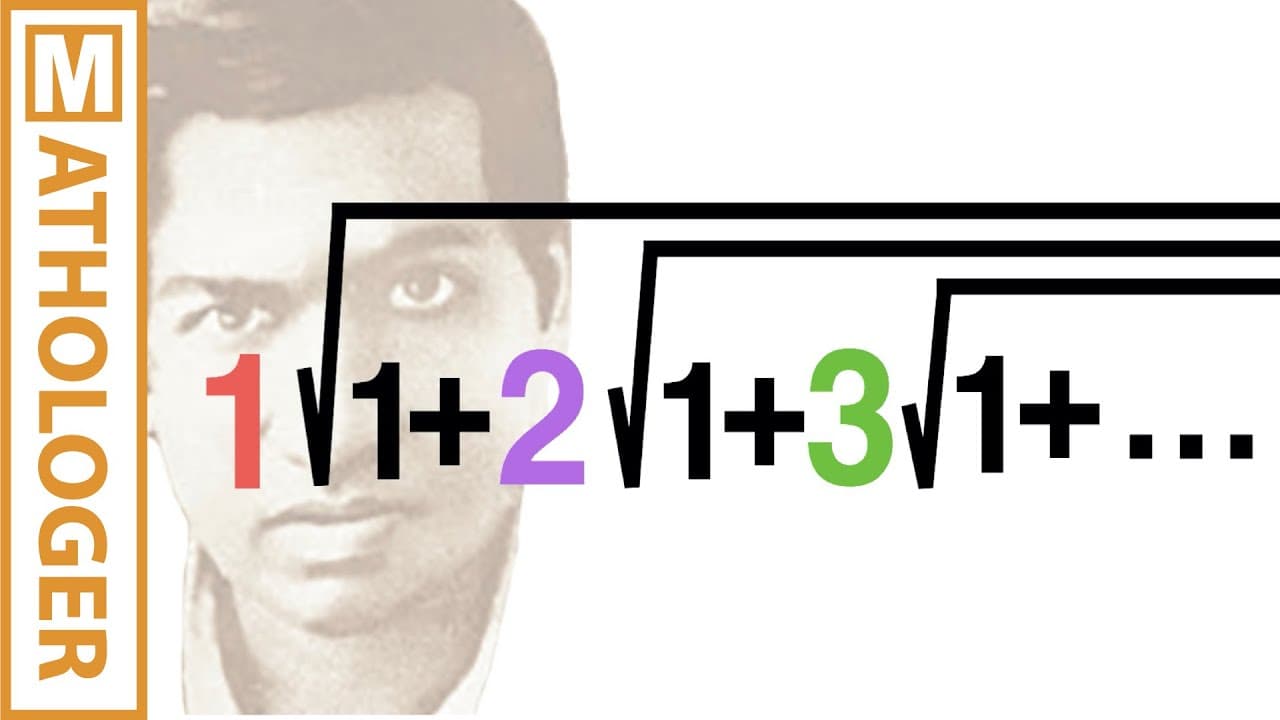
Ramanujan's infinite nested radical converges to 3, but his reasoning is flawed since similar arguments can yield contradictory results, such as asserting it equals 4. Assigning values to infinite expressions depends on calculating partial sums or products; if the sequence converges, it's given a specific value. Different methods can exist for these assignments, but certain approaches are favored in mathematical theory.
Transcript
You're watching a Mathologer video, so that probably means that you're familiar with Srinivasa Ramanujan, one of the most ingenious mathematicians who ever lived. You are probably also familiar with his strange counterintuitive identity 1 + 2 + 3 and so on is equal to -1/12. If you don't know about any of these things check out my video about this.... Read More
Key Insights
- 😑 Ramanujan's infinite nested radical expression is flawed because the same argument can be applied to other numbers as well.
- 😑 Assigning values to infinite expressions involves calculating partial sums or products and determining if the sequence converges.
- 😑 Different approaches to assigning values to infinite expressions may exist, but there can be a preferred or standard way based on mathematical theory.
- 😑 Infinite expressions and their behavior are connected to the Mandelbrot set and the iteration of functions.
Install to Summarize YouTube Videos and Get Transcripts
Explore YouTube Video Summarizer or Get YouTube Transcript Extractor
Questions & Answers
Q: How does Ramanujan's infinite nested radical expression work?
Ramanujan's argument involves repeatedly rewriting the expression and showing that all the rewritten expressions are equal to 3. However, this argument is flawed, as the same process can be applied to another number like 4, leading to a contradiction.
Q: Can there be multiple ways of assigning a value to an infinite expression?
Yes, there can be different ways of associating a number to an infinite expression that are valid and reasonable. However, in some cases, such as with Ramanujan's expression, there may be a preferred or standard way of assigning a value based on mathematical theory.
Q: How are infinite expressions related to the Mandelbrot set?
Certain types of infinite expressions, such as the complex number iteration in the Mandelbrot set, can be represented using these expressions. The iteration process and the behavior of the infinite sequence of numbers play a role in determining points inside or outside the set.
Q: What is the significance of fixed values of functions in analyzing infinite expressions?
Fixed values of functions, when considered as initial values for infinite iteration, can help find patterns and determine the behavior of the infinite expression. Exploring fixed-point theorems can further enhance the understanding of infinite expressions.
Summary & Key Takeaways
-
The video begins by discussing the strange and counterintuitive identity that 1 + 2 + 3 + ... is equal to -1/12, as well as Ramanujan's infinite nested radical expression that he claimed is equal to 3.
-
It then explores the concept of assigning values to infinite expressions by calculating partial sums or products, and establishes rules for determining their values.
-
The video also discusses the context in which these infinite expressions arise and poses additional challenges for viewers to explore.
Read in Other Languages (beta)
Share This Summary 📚
Summarize YouTube Videos and Get Video Transcripts with 1-Click
Try YouTube Summary with ChatGPT & Claude or YouTube Transcript Generator
Explore More Summaries from Mathologer 📚

Summarize YouTube Videos and Get Video Transcripts with 1-Click
Try YouTube Summary with ChatGPT & Claude or YouTube Transcript Generator